
Series: How to Play Poker (Beginner) • Part 5 of 6
What Does “Option” Mean in Poker? Big Blind Explained
Your First Few Hands
Well, now let's play some poker.
You look down at A♠7♦.
You're first to act.
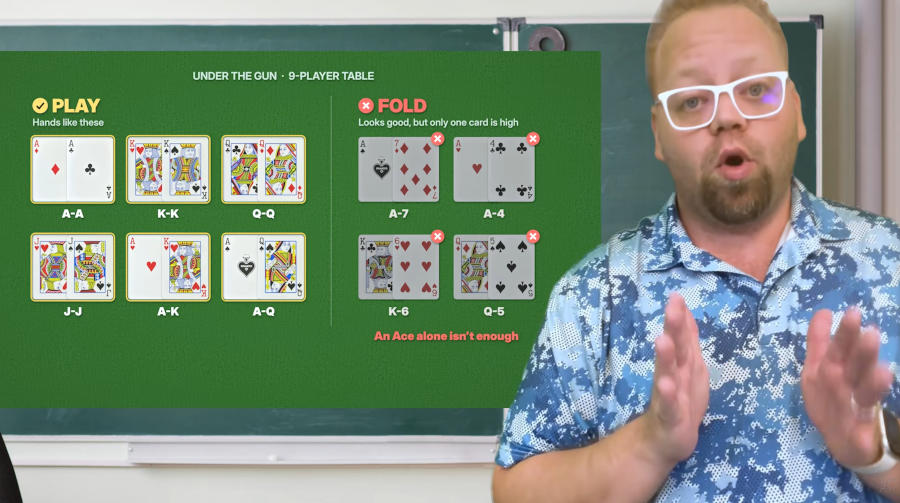
You know there's a chance you could win the hand, and you know an ace is a strong card. But your buddy told you to play tight when you're starting out. He explained that pocket pairs and high cards tend to be the strongest starting hands, and that one high card and one low card doesn't really count as "high cards."
So you fold.
You slide your cards forward face down. The dealer takes them and places them near his left elbow, where he's holding the remaining deck of cards, known as the stub.
The player to your left folds. Then the next player folds. The dealer gathers those cards and mixes them with yours.
A few seats later, it's your buddy's turn. He places two red chips into the betting area.
"Raise to ten," the dealer announces.
Everyone folds. Even the player in the big blind.
As he's folding, he flashes 7♣2♠ to the table.
Your buddy laughs.
"You folded that?"
The player smiles and nods.
With no one willing to continue, your buddy wins the hand immediately. The dealer pushes him the blinds, and the hand is over.
The dealer button moves one seat to the left.
Your buddy tosses the dealer one of the white chips he just won. The dealer thanks him sincerely, taps the chip against the metal tray, and drops it into the toke box.
Then the dealer gathers the cards, shuffles with a speed and rhythm that takes years to develop, and begins pitching another hand. You try to follow the shuffle. You can't. It looks much different than the home game you played with your buddy.
The dealer begins pitching out the next hand. As he pitches around the table, he looks at you and says:
"Big blind."
Then he deals the final card and points to the player on your left.
"Action."
You notice the player to your right has one white chip in front of them. That's the small blind. You remember learning that the small blind posts $1 and the big blind posts $2 before the cards are dealt.
You don't have any $1 chips, but that's not a problem. You place a red $5 chip in front of you. The dealer will make change later. Exact change is not required.
The action begins moving around the table. You want to pay attention, but first you need to look at your cards.
You peek at them: 8♥4♦.
You hope no one noticed your disappointment.
When you look back up, you realize the action has already moved around the table. Your buddy called the $2. The player on the dealer button called the $2. Everyone else folded.
Now the small blind adds one more dollar to complete the bet.
The dealer looks directly at you.
"Option."
What Does "Option" Mean?
In poker, every player still in the hand gets a chance to act on the current bet amount during every betting round. Once all players have acted, the betting round is complete and the hand moves forward.
Before the flop, most players must put more money into the pot if they want to continue. Players who haven't acted yet and aren't in the blinds start with $0 invested. They must put in $2 to call the big blind.
The small blind already has $1 invested, so they only need to add $1 more.
But you're different. You're the big blind. You already have $2 in the pot.
That means you have an option. You can raise. You can fold. Or you can continue without putting in any additional money.
Even though 8♥4♦ isn't considered a strong starting hand, it doesn't make much sense to fold when you can see the flop for free.
So you decide to continue.
"I'm good," you tell the dealer.
The dealer smiles.
"Check?"
Another piece of poker terminology enters your vocabulary. The dealer is clearly looking for a response.
The Proper Way to Check
Checking means you would like to continue in the hand without increasing the current bet amount.
The simplest way to check is to clearly say:
"Check."
Some players say:
"Pass."
Both are universally understood.
The most common physical way to check is to tap the table twice with an open hand. Poker players often describe this as:
"Tap the table twice to check."
There are plenty of other ways people try to check.
Ask a poker dealer and they'll probably tell you there are approximately 417,633 different ways players try to do it. At least that's what it feels like after you've spent enough time around poker tables.
Players tap a single finger. Players tap a chip. Players wiggle a chip. Players point. Players nod. Players invent entirely new methods every week.
The problem is that some of these actions can be difficult for the dealer to see or understand. If there's any doubt, the dealer may have to stop the action and ask for clarification.
By clearly saying "check" or tapping the table twice with an open hand, you'll almost never run into that problem.
Back to Your Turn
If you had been dealt pocket aces, perhaps you would have raised.
But you don’t, so you confirm.
"Check."
The dealer gathers the chips from the betting round and moves them into the center of the table. Then he taps the table twice, almost as if he's checking himself.
He takes the top card from the deck and places it face down beneath the pot. This is called the burn card.
Without exposing it to anyone, he immediately takes the next three cards from the top of the deck and smoothly spreads them face up in the center of the table.
The flop is out.
Enjoyed this lesson?
Join our newsletter to get the latest casino industry courses delivered straight to your inbox.
Series
How to Play Poker (Beginner)
Part 5 of 6
Related Free Learning Hubs: Poker, All Hubs
Related Terms & Definitions: Center of the Table, Complete The Bet, Betting Round, Dealer Button, Small Blind, Big Blind, Burn Card, Face Down, Checking, Toke Box, Back Up, Face Up, Full Dictionary
Related Courses

How to Play Poker (Beginner)
Nov 28, 2026 Marc Shumsker and Mike Laake
Step inside a real casino poker room and discover what to expect before sitting down for your first hand.
How to Become a World Series of Poker Dealer
Feb 21, 2019 Heather Ferris
Learn the steps you need to take, the minimum requirements and qualifications needed and what games you need to know in order to be hired as a WSOP dealer.

Partnerships that keep the cards on the felt
Jan 6, 2026 Heather Ferris
Here is an overview of the sponsored products and advertising options available through Vegas-Aces.
Buy Bets vs Place Bets
Jul 17, 2026 Massimo Morana
Learn the difference between buy bets and place bets in craps. Compare payouts, house edge, commission fees, and discover when buy bets are better than place bets.

How to Get a Job as a Casino Dealer in Italy
Sep 14, 2026 Alessandro Cinà
Discover what it takes to become a casino dealer in Italy, from essential skills and requirements to career opportunities.
How to be a Floor Supervisor
Sep 7, 2026 Andrew Uyal
Master the skills casino floor supervisors need to protect the games, lead their teams, and keep the action running smoothly.
Table of Contents
Series Navigation
Part 5 of 6
- Part 2: How to Look at Your Cards
- Part 3: Fold, Call, or Raise
- Part 4: Poker Hand Rankings Explained
Part 5: What Does “Option” Mean in Poker? Big Blind Explained
Current article
- Part 6: Flop, Turn & River Explained