
Series: How to Play Poker (Beginner) • Part 6 of 6
Flop, Turn & River Explained
The Flop
The flop comes out:
Q♠ 8♠ 2♥
The small blind taps the table twice, and the dealer looks at you.
You have 8♥4♦, and your eyes immediately lock onto the 8♠ on the board. You have a pair. For a moment, that feels exciting. Then you notice the queen and wonder if someone else might have connected with it.
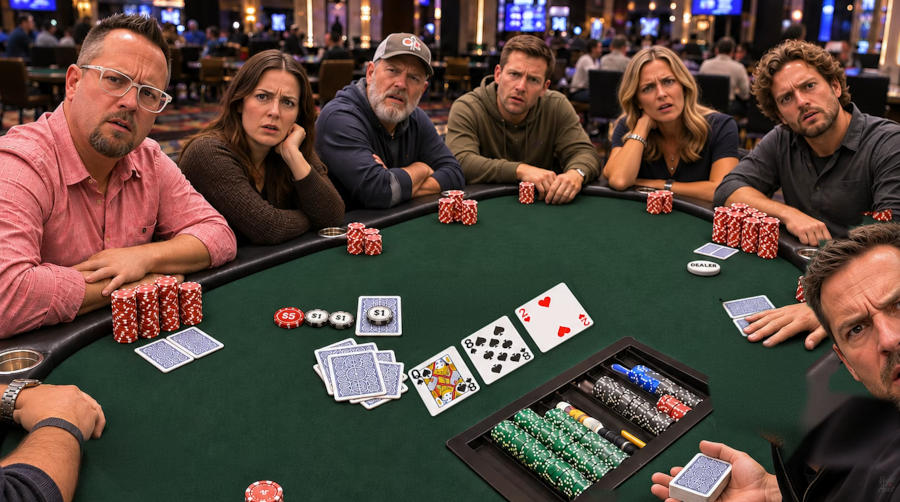
All the attention is on you now. The dealer is looking at you. The other players are waiting. Ten seconds have gone by, but it feels much longer. You didn’t picture it feeling this way when you imagined playing your first live hand.
You announce, “Check,” partly because you’re not sure what to do and partly because you just want the attention off you.
Your buddy checks behind you. Then the player on the button tosses out one red chip worth $5, and the small blind calls.
Now it’s back to you. Fortunately, you knew one very important thing before you sat down to play:
“Only play with money you can comfortably afford to lose. If you can’t afford to lose it, you have no business being at the poker table.”
You have a pair. Everyone else seems to be continuing. You decide to put in the $5 and say, “Call.”
Your buddy calls too. The dealer gathers the chips from each player and pulls them into the pot. Then he taps the table, burns one card, and places another card face up next to the flop.
This card is called the turn.
The Turn
The turn is:
4♣
You now have two pair.
All of a sudden, you feel a lot better about your hand. You sit up straighter in your chair, and your heart starts beating a little faster. The small blind checks, and the action comes to you again. You look at the board:
Q♠ 8♠ 2♥ 4♣
Earlier, your buddy told you something simple:
“Today, don’t worry about being fancy. If you have a strong hand, it’s okay to bet and try to get called by worse hands.”
You’re pretty sure two pair is a strong hand. Someone with a queen might call you. Someone chasing a flush might call you. Someone with a pair might call you. You don’t know exactly what everyone has, but you know one thing for certain: you like your hand a lot more than you did a minute ago.
Now the question becomes how much to bet. You don’t remember the perfect answer, but then you remember something else your buddy said:
“When you’re new and unsure, betting somewhere around the size of the pot from the previous betting round is a simple place to start.”
You don’t know if that’s always the best advice, but right now it gives you something to do.
You say, “Twenty,” and place four red chips into your betting area.
It’s done. Your chips are out there. Your buddy looks at you for a moment, then calls. The button calls too. The small blind folds. Now there are three players left in the hand. The dealer gathers the bets, pulls them into the pot, taps the table, and burns one card. Then he places the final community card face up.
This card is called the river.
The River
The river is:
6♥
The full board now reads:
Q♠ 8♠ 2♥ 4♣ 6♥
The dealer motions to you with an open palm and says:
“Check or bet.”
You’re not completely sure what to do now. You still have two pair, and that feels strong. But this is poker, and strong does not always mean unbeatable. Someone could have a better two pair. Someone could have three of a kind. Someone could have made a straight. Still, you ask yourself a simple beginner question:
“Are there worse hands that might call me?”
You imagine someone with a queen might call. Maybe someone with a smaller two pair would call. Maybe someone just doesn’t believe you. You also know that if someone bets, you’re probably going to call. So instead of checking and waiting, you decide to bet.
You look down at your chips. You have $73 left. You choose an amount that feels like someone with a worse hand might call.
“Thirty,” you say.
Your hands shake a little as you put six red chips into the betting area. Your buddy folds. The player on the button calls. The hand is going to showdown.
The Showdown
The dealer announces:
“Showdown.”
You hold your cards up in the air and show your opponent. The opponent doesn’t move. You’re not sure what’s going on.
The dealer says again:
“Showdown. Someone must show their hand face up on the table.”
Now you understand. You take your cards and place them face up on the felt in front of you. The dealer looks at your hand, then the board.
He frames the cards that matter and announces:
“Eights and fours. Two pair.”
Your opponent tosses their cards face down toward the dealer. You never see what they had. The dealer places their cards into the muck, then pushes the pot toward you.
You won.
You look at your buddy, and he smiles.
“Big blind special.”
You ask what he folded. “I had spades,” he says. “If I got there, I was taking all your money.” Before you sat down, your buddy explained one of his personal rules at the poker table:
No friends at the table.
If he’s in a hand against you, he’s trying to win your chips. He told you a story in the car about a time he played too softly against a friend, changed how the hand played out, and ended up losing a huge pot to someone else because of it.
You shrug and say, “The dealer likes me, so no spade was coming.”
You pull the chips toward yourself and begin stacking them.
A few hands ago, the poker room felt overwhelming. Now you’re still nervous, but you’re starting to feel like you belong at the table. Your buddy catches your eye and gives a small nod toward the dealer.
You remember what he told you in the car. Dealers make much of their income from tips, and it’s customary to tip when you win a pot. He said that as a beginner, you don’t need to overthink it. One dollar per hand is a simple place to start, and you can always give more if you’re especially happy with the dealer or the pot.
You are happy. You toss the dealer $3.
He smiles and says, “Thank you.” His eyes also thank your buddy.
What Just Happened?
You don't realize it yet, but a lot happened between the moment you walked through that casino door and this one.
When you first entered the poker room, you had no idea what to expect. Now you've played a hand all the way through and won. You went from assuming your first $100 was probably gone forever to sitting behind a stack of chips that's roughly twice as large as when you started. You also went from being a complete rookie sitting next to your experienced buddy to... well... still being a rookie sitting next to your experienced buddy.
You may have a long way to go before you catch him, but the gap has closed a little.
Think about everything you've already done. You signed up for a game, bought chips, learned how to look at your cards, folded hands, posted a blind, checked, called, bet, made it all the way to a showdown, and learned how to properly show your hand. You even won a pot.
Not bad for your first session.
The Structure of a Poker Hand
More importantly, you understand the structure of a poker hand now.
Every hand of Texas Hold'em follows the same general sequence:
1. The two players to the left of the dealer post the small blind and big blind.
2. Players receive two private cards called hole cards.
3. A round of betting takes place before any community cards are dealt.
4. Three community cards are dealt face up. This is called the flop.
5. Another betting round takes place.
6. A fourth community card is dealt. This is called the turn.
7. Another betting round takes place.
8. A fifth and final community card is dealt. This is called the river.
9. A final betting round takes place.
10. If more than one player remains, the hand goes to showdown and the best five-card poker hand wins.
Folding
The next hand begins, and this time nobody has to remind you to post your blind. You look down at your cards, decide they're terrible, and fold to a raise. That's okay. Folding is your friend. When it's time to fold, life is easy. You sit back, relax, and watch the other players navigate the hand.
As the session continues, you're spending less time thinking about the mechanics and more time thinking about your decisions. For the first time, you're starting to see the game underneath the rules.
You also realize you have a lot of questions for your buddy on the drive home.
Enjoyed this lesson?
Join our newsletter to get the latest casino industry courses delivered straight to your inbox.
Series
How to Play Poker (Beginner)
Part 6 of 6
Related Free Learning Hubs: Poker, All Hubs
Related Terms & Definitions: Community Cards, Betting Round, Small Blind, Big Blind, Face Down, Checking, Red Chip, Showdown, Straight, Face Up, Seconds, Session, Full Dictionary
Related Courses

How to Play Poker (Beginner)
Nov 28, 2026 Marc Shumsker and Mike Laake
Step inside a real casino poker room and discover what to expect before sitting down for your first hand.
How to Become a World Series of Poker Dealer
Feb 21, 2019 Heather Ferris
Learn the steps you need to take, the minimum requirements and qualifications needed and what games you need to know in order to be hired as a WSOP dealer.

Partnerships that keep the cards on the felt
Jan 6, 2026 Heather Ferris
Here is an overview of the sponsored products and advertising options available through Vegas-Aces.
Buy Bets vs Place Bets
Jul 17, 2026 Massimo Morana
Learn the difference between buy bets and place bets in craps. Compare payouts, house edge, commission fees, and discover when buy bets are better than place bets.

How to Get a Job as a Casino Dealer in Italy
Sep 14, 2026 Alessandro Cinà
Discover what it takes to become a casino dealer in Italy, from essential skills and requirements to career opportunities.
How to be a Floor Supervisor
Sep 7, 2026 Andrew Uyal
Master the skills casino floor supervisors need to protect the games, lead their teams, and keep the action running smoothly.
Table of Contents
- # Back to Top
- The Flop
- The Turn
- The River
- The Showdown
- What Just Happened?
- The Structure of a Poker Hand
- Folding
Series Navigation
Part 6 of 6
- Part 2: How to Look at Your Cards
- Part 3: Fold, Call, or Raise
- Part 4: Poker Hand Rankings Explained
- Part 5: What Does “Option” Mean in Poker? Big Blind Explained
Part 6: Flop, Turn & River Explained
Current article