
Blackjack Strategy Chart: Basic Strategy for Every Hand
Use these blackjack basic strategy charts to decide when to hit, stand, double down, split or surrender. Choose the chart for your game’s rules, then view it on your phone or download a printable PDF. Basic strategy helps reduce the house edge, but it does not guarantee a winning hand or session.
Choose Your Blackjack Strategy Chart
Start with your deck count and the dealer’s soft-17 rule:
- 4, 6 or 8 deck shoe charts
- 4, 6 or 8 deck charts with surrender
- Double-deck charts
- Single-deck charts
S17 means the dealer stands on soft 17. H17 means the dealer hits soft 17. Also match the chart to your table’s surrender rules, doubling restrictions and double-after-split rules. These factors can change the correct play.
The multi-deck examples in the explanations below assume a standard American game in which the dealer checks for blackjack before players act when showing a 10 or Ace. Games with different dealer-blackjack rules may require different decisions.
4, 6, or 8 Deck Shoe Blackjack
Use a multi-deck chart for a standard 4-, 6-, or 8-deck shoe game. Check the dealer’s soft-17 rule, doubling restrictions and whether doubling after splitting is allowed. For surrender decisions, use the surrender section below.
A soft 17 is any hand totaling 17 that includes an Ace counted as 11, such as Ace-6. The table rules require the dealer either to hit or to stand on soft 17; this is not the dealer’s choice. This rule directly affects your odds and your optimal playing strategy.
Dealer Stands on Soft 17
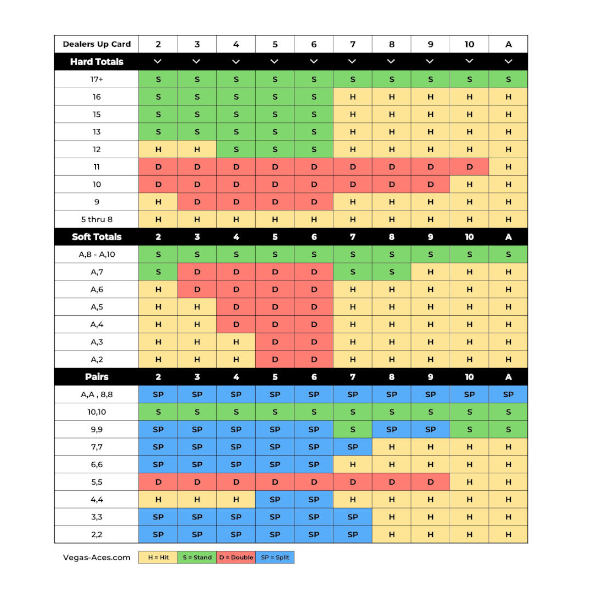

Dealer Hits Soft 17
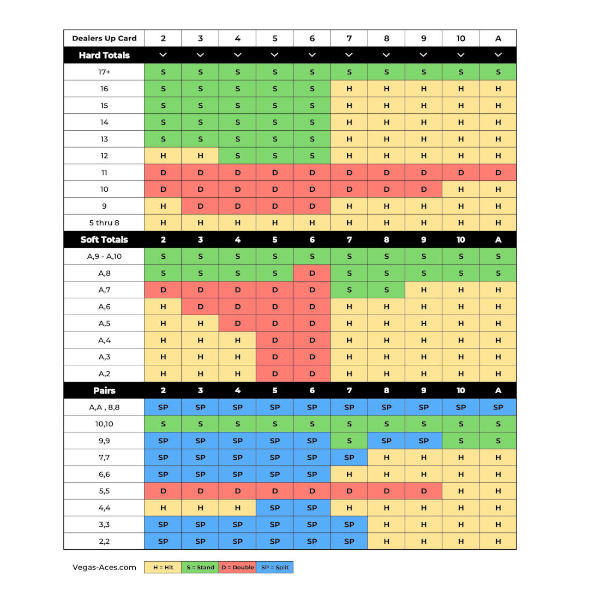

Surrender Available on a 4, 6, or 8 Deck Shoe
Surrender lets you end an eligible hand and lose half your original bet. Late surrender applies only when the dealer does not have blackjack; in a standard American peek game, any required blackjack check happens first. Early surrender lets you give up the hand before a possible dealer blackjack is resolved and uses a different strategy.
The examples here use late surrender in standard American 4–8 deck games. Do not apply them to early-surrender games.
| Your initial two-card hand | Dealer stands on soft 17 (S17) | Dealer hits soft 17 (H17) |
|---|---|---|
| Hard 15 | Surrender against 10 | Surrender against 10 or Ace |
| Hard 16, excluding 8-8 | Surrender against 9, 10 or Ace | Surrender against 9, 10 or Ace |
| 8-8 | Split | Surrender against Ace; split against other upcards |
| Hard 17 | Stand | Surrender against Ace; stand against other upcards |
These are total-dependent basic-strategy recommendations. Surrender normally applies only to your first two cards, before hitting, doubling or splitting. If surrender is unavailable, use the corresponding no-surrender chart. Hard 18 or higher should not be surrendered under these rules.
Dealer Stands on Soft 17
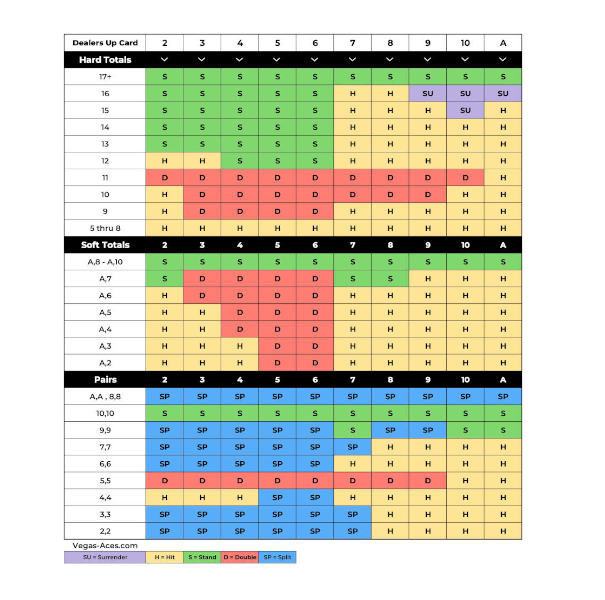

Dealer Hits Soft 17
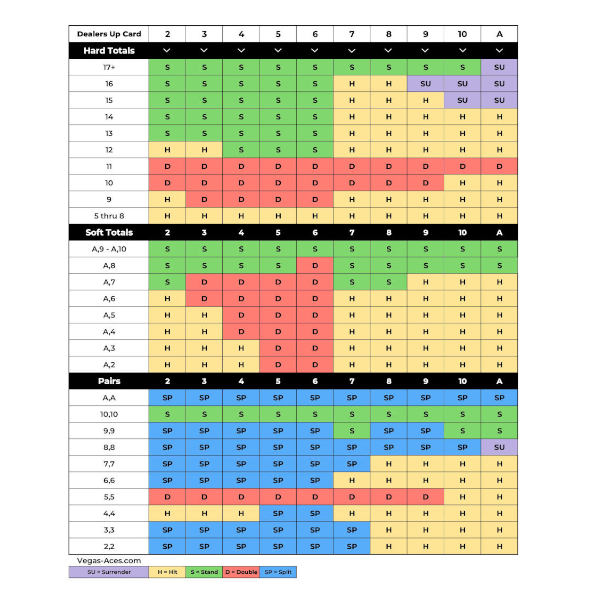

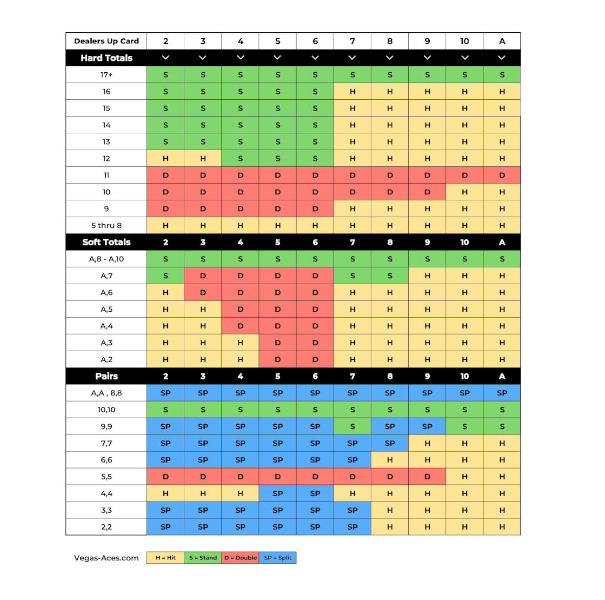
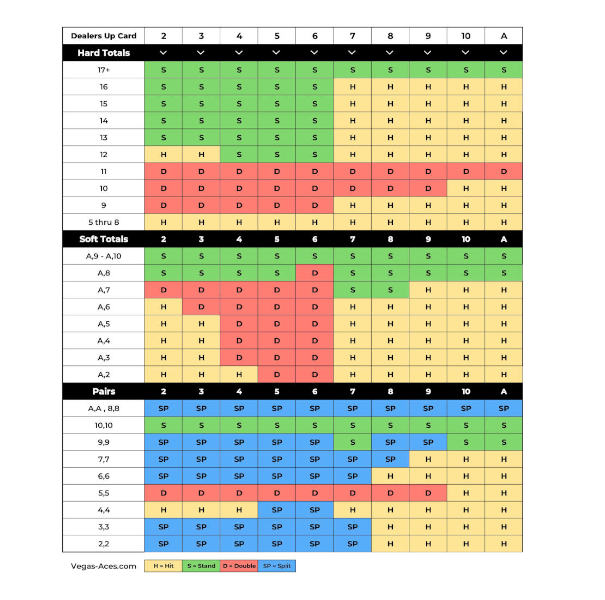
Double Deck Blackjack
Double-deck blackjack uses two standard 52-card decks. Use a double-deck chart: some decisions differ from multi-deck strategy. Compare the full rules, not just the number of decks.
Confirm whether the dealer hits or stands on soft 17, whether doubling after splitting is allowed, and which totals may be doubled before choosing a chart.
Dealer Stands on Soft 17

Dealer Hits Soft 17

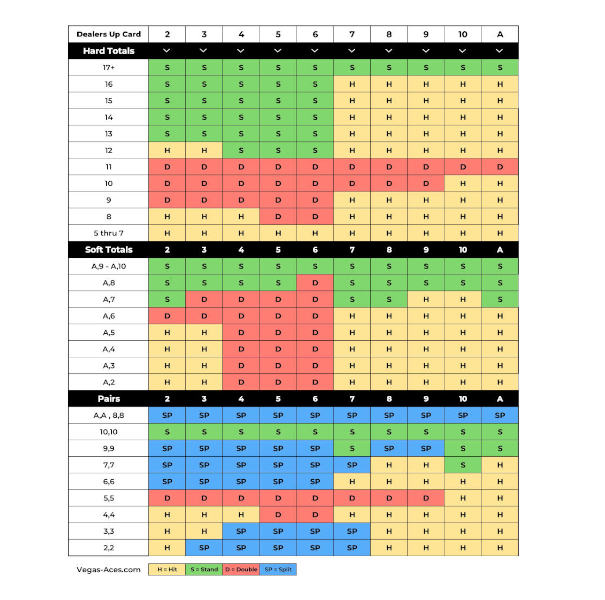
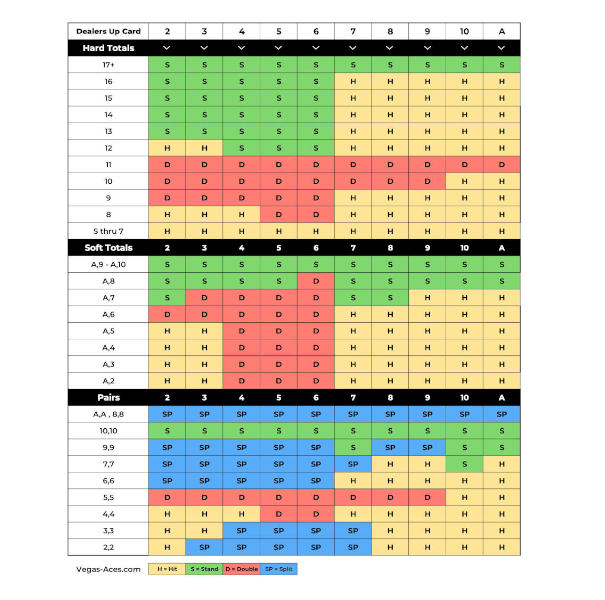
Single Deck Blackjack
Single-deck blackjack uses one 52-card deck. Its strategy differs from double-deck and shoe games, so do not apply the multi-deck quick rules below to a single-deck table.
However, a single-deck game paying 6:5 on blackjack may offer worse odds than a multi-deck game paying 3:2. Always confirm the payout and rules of the game before assuming a game is good.
Dealer Stands on Soft 17

Dealer Hits Soft 17

What Is Blackjack Basic Strategy?
Basic strategy recommends the play with the best expected return for your hand against the dealer’s upcard under a particular set of rules. Sometimes that means choosing the action that loses less on average, rather than an action expected to win money.
A basic strategy chart does not track the changing count of the shoe. Card-counting deviations are a separate subject, covered in our Card Counting 101 guide.
How to Read a Blackjack Strategy Chart
- Choose the correct game. Match the deck count, soft-17 rule and other table rules.
- Identify your hand. Use the pairs section for two matching cards, the soft-hand section when an Ace counts as 11, and the hard-hand section when no Ace counts as 11.
- Find the dealer’s upcard. A 10 includes a 10, Jack, Queen or King.
- Read the recommended action. Follow the chart’s legend and any rule-specific notes.
- Check whether the action is available. Doubling, splitting and surrender have restrictions. Use the appropriate fallback when an action is unavailable.
Hard Hands, Soft Hands and Pairs
- Hard hand: No Ace is counted as 11. For example, 10-6 is hard 16; A-5-10 is also hard 16.
- Soft hand: An Ace counts as 11. For example, A-7 is soft 18.
- Pair: Two cards of the same rank, such as 8-8. Check the pair decision instead of automatically treating the hand as hard 16.
Chart Symbols and Unavailable Actions
Use the legend printed on the chart. These Vegas Aces charts use:
| Symbol | Action | Meaning |
|---|---|---|
| H | Hit | Take another card. |
| S | Stand | Keep your current hand. |
| D | Double | Add the required wager and take exactly one more card. |
| SP | Split | Separate a pair into two hands with an additional wager. |
| SU | Surrender | End an eligible hand and lose half the original wager. |
If a chart recommends doubling but you cannot double, the fallback is usually to hit. For soft 18 or soft 19, stand when the recommended double is unavailable. For example, a three-card soft 18 may require standing where an eligible two-card A-7 would be doubled.
If surrender is unavailable, consult the no-surrender chart. If splitting is unavailable, use the appropriate hit, stand or double decision for the unsplit hand, subject to the table’s restrictions. Split Aces can have special restrictions on drawing cards and resplitting.
Quick Blackjack Strategy Rules
These reminders are for standard American 4–8 deck games. Check surrender and pair decisions before applying rules for hard totals.
- Hard 8 or less: Hit when the hand is not being split.
- Hard 17 or more: Stand after checking surrender. An eligible hard 17 against an Ace is a late-surrender exception in H17 games.
- Aces and 8s: Usually split. In H17 shoe games with late surrender, surrender 8-8 against an Ace.
- 10s: Do not split under basic strategy.
- Hard 11: Double against 2–10. Against an Ace, hit in S17 games and double in H17 games. Hit if doubling is unavailable.
- Insurance: Decline it when following basic strategy.
These reminders do not replace a complete chart and should not be applied unchanged to single-deck, double-deck or specialty blackjack games.
Strategy Cheat Sheet
For standard American 4–8 deck blackjack with a dealer blackjack check before player actions when required.
| Feature | Dealer Stands on Soft 17 (S17) | Dealer Hits Soft 17 (H17) |
|---|---|---|
| House edge | Lower, all other rules being equal | Higher, all other rules being equal |
| Soft 18 (A-7) against a dealer’s 2 | Stand | Double; stand if doubling is not allowed |
| Hard 11 against a dealer’s Ace | Hit | Double |
| Blackjack payout to look for | Choose 3:2 over 6:5 | Choose 3:2 over 6:5 |
Use the chart that matches your table’s rules. The doubling examples refer to eligible two-card hands. If doubling on hard 11 is prohibited, hit. Surrender availability does not change the soft-18 decision shown here.
Choose the Right Blackjack Table
The rules affect both the house edge and the strategy you should use. Before sitting down, check:
- Blackjack payout: Prefer 3:2 over 6:5. A reduced blackjack payout increases the house edge.
- Soft 17: S17 is better for the player than H17 when other rules are equal.
- Number of decks: Fewer decks generally favor the player when other rules are equal, but a single-deck label does not make an unfavorable table a good choice.
- Doubling restrictions: Check whether you can double on any initial two cards or only certain totals, and whether you may double after splitting.
- Surrender: Find out whether it is available and whether it is early or late surrender.
- Dealer blackjack rules: A no-hole-card game in which dealer blackjack takes doubled and split wagers can require different strategy from a standard American peek game.
- Side bets: Many have a higher house edge than the main game played with basic strategy. Check the specific wager and pay table.
Learn more about 3:2 blackjack payouts and 6:5 blackjack payouts.
Blackjack Strategy Tips for Players and Dealers
Learn one rule set at a time. Practice identifying hard hands, soft hands and pairs, then work through the decisions on the matching chart. Pay particular attention to when a recommended double or surrender is unavailable.
Follow the mathematical decision rather than changing your play because of a recent win, loss or another player’s reaction. Basic strategy improves expected results compared with making playing errors; it cannot control which card comes next.
For dealers and floor staff, familiarity with basic strategy also helps explain common player questions. A player choosing a different action is not, by itself, evidence of advantage play or cheating.
For a beginner-friendly introduction, see our Top 5 Quick Blackjack Tips for Beginners.
Practice & Memorize Blackjack Basic Strategy
Choose the rules you plan to practice, then use the same matching chart throughout your session. Work on one group of decisions at a time: hard hands, soft hands, pairs and surrender.
Download a Free Blackjack Strategy Worksheet
Use the homework resources in our card-counting guide alongside the appropriate basic strategy chart.
View the blackjack homework resources
Practice With Blackjack Learning Tools
Visit our blackjack hub for learning resources and practice tools. Match any practice game’s rules to the chart you are studying.
Explore blackjack practice resources
If you use a free online blackjack game, check its rules first. The same applies when exploring blackjack resources or online casino listings: confirm whether a practice mode exists and which rules it uses.
History
Playing “by the book” generally means following basic strategy. Edward O. Thorp’s Beat the Dealer helped popularize the mathematical study of blackjack and card counting. Julian Braun’s How to Play Winning Blackjack is another work on blackjack strategy.
For today’s player, the essential point is that there is no single chart for every version of blackjack. Use strategy calculated for the rules of the game you are playing.
Learn More About Blackjack
- Blackjack Payout Chart
- Blackjack 6:5 Payout Chart
- Card Counting 101
- Top 5 Quick Blackjack Tips for Beginners
- How to Deal Blackjack
- Blackjack Hub
FAQ
What is the best blackjack strategy?
For a player who is not counting cards or using other additional information, start with basic strategy matched to the table’s rules. It identifies the action with the best expected return for each hand under those assumptions.
Is blackjack strategy always correct?
A chart’s recommendations depend on its assumptions. Check the deck count, soft-17 rule, doubling restrictions, surrender and dealer-blackjack rules. Even a correctly played hand can lose; basic strategy concerns expected results over repeated play.
Can blackjack strategy beat the casino?
Basic strategy reduces losses caused by playing mistakes, but typical casino blackjack games still have a house edge. Card counting is a separate technique that uses information about the remaining cards; a basic strategy chart alone does not do that.
What is the easiest blackjack strategy to remember?
Start by distinguishing hard hands, soft hands and pairs. Learn the decisions for one rule set, then add the exceptions for doubling, splitting and surrender. Short memory aids are useful, but a simplified rule is not always the same as full basic strategy.
When should you hit or stand in blackjack?
Check whether surrender, splitting or doubling is the recommended action first. For standard multi-deck games, once those decisions are accounted for, stand on hard 12 against 4–6 and on hard 13–16 against 2–6; hit those totals against other upcards. Soft hands and pairs have their own decisions. Use a separate chart for single-deck or double-deck games.
When should you split pairs in blackjack?
Aces and 8s are generally split, while 10s are kept together under basic strategy. Other pairs depend on the rules and dealer’s upcard. There are surrender exceptions: for example, surrender 8-8 against an Ace in standard H17 shoe games when late surrender is available.
Does blackjack strategy change based on the number of decks?
Yes. Use a chart for the correct deck count. Some doubling and splitting decisions change between single-deck, double-deck and multi-deck games.
Does blackjack strategy change when the dealer hits soft 17?
Yes. For example, in a standard American multi-deck game, A-7 against a dealer’s 2 is a stand with S17 and a double with H17; stand if that double is unavailable. Surrender decisions can also change.
Does surrender change what you do with soft 18 against a dealer’s 2?
No. In standard American 4–8 deck games, stand with S17; double with H17 if allowed, and stand if doubling is unavailable. Do not surrender this hand.
Can you use a blackjack strategy chart at a casino?
Many casinos permit small printed strategy cards, but ask the dealer or floor staff about the house rules. Permission to use a printed card does not necessarily mean phones or electronic aids are permitted at the table.
How do you memorize blackjack basic strategy?
Practice one rule set at a time. Quiz yourself on hard hands, soft hands, pairs and surrender, and review the decisions you miss. Check that your practice tool and chart use the same rules.
Enjoyed this article?
Join our newsletter to get the latest casino industry articles delivered straight to your inbox.
Related Free Learning Hubs: Blackjack, All Hubs
Related Terms & Definitions: Basic Strategy, Multiple Decks, Double Down, Single Deck, House Edge, Blackjack, Insurance, Up Card, Action, Button, Casino, Dealer, Full Dictionary
Related Posts
The New Player at Third Base Didn’t Ruin Your Blackjack Hand
Sep 22, 2026 Monika Dragojlovikj
Third-base players can change who receives the next card, but they cannot predict it. This is why the blackjack myth survives at live tables.
Blackjack Payout Calculator & 3:2 Payout Chart
Download the official 3:2 Guide instantly. Use this printable PDF and our FREE strategy course to master basic strategy and guarantee you maximize your odds.

12 Things You Should Never Do at a Blackjack Table
Aug 30, 2026 Heather Ferris
Discover the 12 blackjack mistakes that can expose a rookie, annoy the table, and even get you kicked out.
How to Use a Blackjack Payout Calculator
Learn how to use a blackjack payout calculator with simple step-by-step examples. Calculate 3:2, 6:5, insurance, and blackjack payouts accurately every time.
6:5 Blackjack Explained: Is It Worth Playing?
Aug 2, 2026 Daniel Odeyemi
Learn what 6:5 blackjack means, how it compares to 3:2 payouts, and why many experienced players avoid 6:5 blackjack tables.
Blackjack Hand Signals Every Player Should Know in 2026
Jul 29, 2026 Amelia Winters
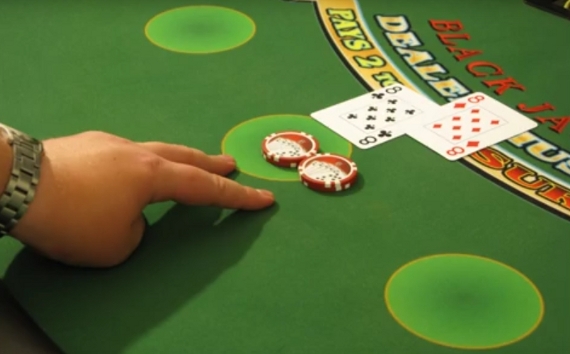
Learn blackjack hand signals for hitting, standing, doubling, splitting and surrender, with clear guidance for face-up, handheld and live dealer games.
Table of Contents
- # Back to Top
- Download Free Blackjack Strategy Charts
- Choose Your Blackjack Strategy Chart
- 4, 6, or 8 Deck Shoe Blackjack
- Surrender Available on a 4, 6, or 8 Deck Shoe
- Double Deck Blackjack
- Single Deck Blackjack
- What Is Blackjack Basic Strategy?
- How to Read a Blackjack Strategy Chart
- Quick Blackjack Strategy Rules
- Choose the Right Blackjack Table
- Blackjack Strategy Tips for Players and Dealers
- Practice & Memorize Blackjack Basic Strategy
- History
- Learn More About Blackjack
- FAQ