
The Strange World of Hand Strategy Decisions in Blackjack
What happens when a blackjack strategy that looks completely wrong is actually the smartest play at the table?
Casino expert Bill Zender explores 10 fascinating blackjack decisions, revealing which common mistakes increase the house edge and which unusual moves are mathematically correct. Discover the surprising differences between basic strategy, poor playing habits, and advanced card counting techniques. Through real-life casino stories and mathematical insights, you'll learn how to recognize costly blackjack mistakes and identify strategic decisions that could signal an advantage player.
Bad Plays that Some People Think are Smart Decisions
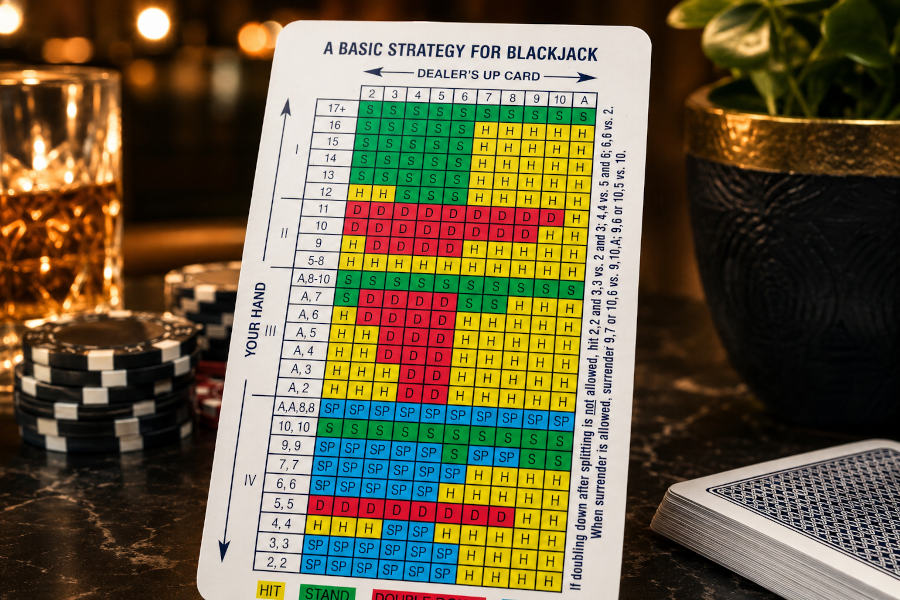
During my lengthy time in the casino industry, I have witnessed quite a few noteworthy Blackjack hand strategies. A large number of players will use a strategy that is very close to the perfect computer play known as “Basic Strategy”. These Blackjack customers give up an additional but small mathematical edge to the house because they are not familiar with the finer points of Basic Strategy. This widely used strategy is referred to as “Common Strategy”, and about 90% of the gambling public utilize it. Only a very small percentage of the public plays Basic Strategy. I would guess 1% or less of Blackjack players take the time to learn these finite decisions solid. The remaining Blackjack players fall into an uninformed and naïve category, that rely more on gut instinct and bad thought process. This strategy has been referred to as the “Whiskey, Tango, Foxtrot” strategy because many of the hand decisions have no basis in mathematical (or logical) reality.
Following are some of the more interesting strategy decisions I have seen during my time in the pit. I have also included the mathematical cost for making these erroneous plays as well as a narrative of interactions I had with several of these uneducated players.
1. Never Hitting a Busting Hand
Question, what is the primary reason the game of Blackjack wins for the casino? The player acts on his or her hand prior to the dealer, and if they bust their hand, the dealer’s hand outcome does not matter. Based on that principle, never hitting any hand that could lead to a busting hand should be avoided at all costs. Or should it?
A Blackjack player who never hits a stiff hand (12–16) gives up roughly 1.5%–2.5% in additional house edge, depending on the exact mix of rules. That is catastrophically expensive in a game where normal basic strategy house edge is only 0.5%–0.6% (3:2 blackjack payoffs).
While working as a floor supervisor at a Las Vegas downtown casino in the late 70’s I had the experience of witnessing a Blackjack customer who swore by the strategy of “never hitting a busting hand”. Any hand that would bust, 12 through 16, was immediately tucked under his wager. His belief was why would anyone bust and just give money to the dealer, and he followed this “losing” strategy religiously. One day he enters our casino in a very foul mood. His son was in town staying in a hotel on the Las Vegas Strip and the previous night they spent gambling at his son’s hotel/casino. After playing Blackjack for a short time he had been winning. All of a sudden, he was approached by the shift manager and security and told his Blackjack play was no longer welcomed. This was standard practice when barring someone from play because the casino believed he or she was counting cards. Here is a guy who never hit a busting hand? The only thing I could think of was he must have been playing into some seriously “plus” decks while staying on some “stiff” combinations, hands that would be typical for someone utilizing a card counting hand strategy.
2. Mimicking the Dealer; Hit 16 and Under, Stand on 17 and Over
A blackjack player who “mimics” the dealer (hits 12–16, stands on 17+) in a standard 6 deck game plays a strategy that gives the house an additional edge of roughly +3.5% to +4.0%. That is about 3% worse than basic strategy and about 1% worse than a player who simply refuses to hit stiff hands (see previous bad play example). The “mimic” player’s total disadvantage becomes 2%–3%, which is worse than a number of “carnival” table games that are usually offered on the casino floor.
I was once told by an older gentleman that most people that played Blackjack were “stupid”. When I ask “why?”, he explained that the best strategy for playing Blackjack was to “mimic” what the dealer does. He hadn’t seen many players who knew this. He told me that if you always hit to a hard total of 16 and stood on any hard total of 17 or higher, a player could gain the advantage over the house. His theory was that if you mimicked or played exactly like the dealer, you would be even with the dealer. The break for the player was the 3 to 2 blackjack payout versus a dealer only winning even money. He told me he had been using the mimic strategy for a couple of years. I asked how he was doing with it, and he stated that he was having “some bad luck”, but that should turn around any day now.
3. Doubling 12 Against 5 or 6 Up-Card
Doubling 12 vs a dealer 5 or 6 is one of the worst possible blackjack decisions. It costs about 25% to 35% on that single decision as compared to the correct play (standing). In a game where the house edge is 0.5% making a single decision that costs 25–35% of a unit is catastrophic, but since this situation happens so infrequently, the overall increase effect on the mathematical house advantage isn’t that severe.
Here is another downtown Las Vegas strategy “gem”. I watched a Blackjack player double on a hard 12 against a dealer’s 6 up-card. The player caught a 9 and won the hand. A little time later the same player doubled 12 against a 5 up-card and again won. Our casino manager was also watching this action. After the second hard 12 double down he demanded that I take the cards off the game because they were probably “marked”. Once off the game he examined the cards and couldn’t find any markings. The player doubled a third hard 12 against another 5 up-card. This time he had me take the dealer off the game. The casino manager proceeded to accuse the dealer of working with the player by flashing the top card of the dealer’s handheld deck. A little while later the player again doubled on a hard 12 but this time, he caught a ten-value card and busted. After the casino manager left the pit, I asked the player why he doubled down on hard 12. His explanation is interesting. It was his belief that a hard 12 was only one spot greater than a hard 11, and since there wasn’t that much of a difference in the two totals, why not double on a hard 12 as well. As stated previously, doubling on hard 12 is “one of the worst possible blackjack decisions”, but his actions did have our casino manager on edge.
4. Failing to Hit (or Double) on Ace-6
Standing on A,6 (soft 17) against any dealer up-card costs roughly 15%–20% per occurrence, compared to correct play (hit or double). In aggregate, that’s about +0.03%–0.05% extra house edge added to the game. Misplaying a soft 17 in this manner is one of those “looks safe, quietly expensive” decisions. In the long run: Because A,6 isn’t super frequent, this error alone doesn’t destroy the player, but it pushes the mathematical house advantage of the game closer to 0.6%–0.7% (from 0.5%).
Many common strategy players make this mistake. They play very conservative by nature and have a hard time understanding why they should hit a “17” even though they cannot bust the hand. It was explained by one player that she once hit a soft 17 and caught a 6, then hit again a caught a ten to bust out. Her theory was why hit the 17 and put yourself in a worse position. This is also true for a soft hand of ace-7 (soft 18). I go into more detail on hitting a soft 18 in the second half of this article, “Good plays that seem bad but are not”
5. Always Taking “Even Money” (Insure) When Holding a Blackjack Against a Dealer’s Ace Up-Card
The simple answer is that always insuring a blackjack (taking even money) vs a dealer ace in a 3:2 game costs about 3.8% of the bet’s value every time it happens. Of course, your best course of action is to follow basic strategy that advises the player to never take insurance. This situation (blackjack versus dealer’s ace) happens infrequently, creating a minor increase of the mathematical house advantage.
Question: What is the worst two-card hand to insure? It’s not 16 or 15? As a blackjack hand, holding a 20 is great, 16 is awful. However, insurance is actually a side-bet where you win when the dealer has a blackjack, i.e., when the hole-card is a ten-value card. As a card‑removal effect on insurance: T–T is actually worse than T–6, because it reduces more of the very cards you’re betting on (tens) from the shoe or deck. So, holding two tens makes insurance worse, not better. The deeper point of “protecting” a good hand with insurance is backwards. The better your hand (and the more tens you hold), the worse wagering on insurance becomes.
Good Plays that Seem Bad But are Not
Where the previously discussed five Blackjack hand decisions and strategies were mathematically bad for the customer, the following five hands are smart plays that most casino executive view as being “stupid” but are actual correct. I have broken the hand decisions into two categories, correct Basic Strategy decisions that appear as bad but actually identify the player as knowing more about the game of Blackjack than a majority of the Blackjack players, and correct strategy plays based on the changing deck composition identified by someone that counts cards on an advanced level.
1. Hitting Ace-7 (Soft 18) Against a Dealer’s 9, T, or Ace Up-Card
Almost all common strategy players will stand on a soft 18 (A-7). They may double the hand against a dealer 5 & 6 up-cards, but they will never hit. The player that knows Basic Strategy understands that standing against a dealer’s up-card of 9, Ten, and Ace is costly on average of about 6% (8%, 4%, 7% respectively) every time the player does not hit.
During my casino table game protection classes, I strongly emphasize the important of knowing Basic Strategy “solid” by all employees who are involved in protecting Blackjack’s bankroll. I point out that a Blackjack customer who wagers a significant amount of money is observed hitting A-7 versus a dealer’s 9, Ten or Ace knows more about the game than the average player, and even though it is no indication that they are doing something wrong, the casino employee needs to consider focusing more attention on that customer.
2. Splitting 8-8 Against a Dealer’s Ten Up-Card
Many Blackjack customers and casino employees are reluctant to split two 8’s against a strong ten-value dealer up-card. Why turn a terrible hand of 8-8 (16) into two not-so-much-better hands? However, the Basic Strategist knows splitting against a Ten is the best play.
Note: Anytime the player holds a hand of 12 through 17 it is known by mathematician as the “player’s dilemma”. Why? There is only one hand combination where the player has at least a 50/50 chance of breaking even. It is the hand of 17 v a dealer’s 6 up-card. The rest of the decisions in that matrix result in losers; the player hits and stands correctly to lose less money.
Any hand that could result in the player correctly doubling down, either with a hard or a soft hand total, is known as the “player’s revenge”. This is due to the fact that anytime the player correctly doubles down they do so to win more money.
Pair splitting has an element of both worlds. In some pair splits, the player splits to win more money (example: 8-8 v 6) and to lose less money as mentioned with splitting 8-8 v Ten. And failing to split 8’s against a dealer’s up-card of Ten will cost the non-splitting player about 4-5% of their wager.
3. Surrendering
Before a hand can be surrendered the casino has to offer this option as part of their Blackjack rules. If Surrender is offered, the Basic Strategist understands that it is wise to surrender a hand that has greater than a 75% chance of losing. Why? Because by surrendering your two cards, you do not have to act further on your hand, but you will receive 50% of the wager back from the dealer. There are seven hands that fall under the “greater than 75%” category. Those hands are:
- Player 16 v 9, T or Ace
- Player 15 v T or Ace
- Player 17 v Ace
- Player 8-8 v Ace
However, I know of several well-educated players who will not surrender under any condition. They look at surrendering a hand as the same as giving up and giving up is against their nature.
Surrendering hands are key plays to look for especially when the player is wagering a significant amount of money. If someone is making perfect surrender decisions, it is an indication that the player knows more about Blackjack than the average player. For a casino employee tasked to protect Blackjack, this could be someone they may want to watch.
Another downtown Las Vegas story. Acting in my capacity as a floor supervisor, I was watching a player wagering a significant amount of money on a single deck game that also offered surrender. The player started to attract attention from the pit and shift managers because the player was starting to win an uncomfortable amount of money. On one specific hand, with the dealer receiving an ace as her up-card, the player elected to take insurance. When the dealer peeked and did not turn up a blackjack, the player tossed over his two cards and surrendered his hand. I heard the pit and shift managers snicker and softly comment that the guy must be an idiot. He gave up half his bet through losing the insurance wager and then the other half of his bet through surrendering. They exclaimed he would have been better off either standing or hitting his hand, the worst he could do was lose the entire bet and he also had a chance of winning. Unfortunately for my two superiors, they did not understand the player’s strategy. The correct Basic Strategy play was to surrender, but why insure a 16? The player turned out to be a card counter and insured the 16 because the deck was subject to a high plus count at the time. The pit and shift managers wrote the player off as just another idiot Blackjack player when all along he was just the customer they were supposed to watch out for.
This leads me into the next section on decisions that are correct as the deck or dealing shoe card composition favors the players. Following are two situations where the casino employee supervising Blackjack should take note instead of referring to them as “dumb” plays. Both are strong indicators that the player in question is counting cards or spotting the dealer’s hole-card and the play needs to be questioned.
4. Taking Insurance on “Weak” Hands
When asking casino employees about which hand they witness players insure, they always tell me when the player holds a solid two-card 20. When asked if they insure any other hands, I am told that players that insure, insure only good hand. Note: What I find interesting is that players are reluctant to insure a two-card 11 (i.e., 6-5, 7-4, 8-3, and 9,2). A two-card 11 is the third strongest starting two-card total right behind blackjack and 20. Of course (explained earlier) anyone taking insurance is giving up money. Why? Based on a full deck of cards (or decks of cards), insurance is not profitable. If the player takes insurance and wins the bet, they are paid at a rate of 2 to 1. For the wager to be break even, the casino would have to pay 2.25 to 1.
I don’t see casinos paying out any more money but based on the ever-changing composition of cards as the game is dealt, any time there are a number more “ten value” cards in the deck, the bet could become profitable. In card counting nomenclature, when the “true count” of the deck is equal to or greater than +3 (Hi/Lo count system), wagering on insurance is profitable for the player. This means that regardless what cards the card counter holds in their hands, at a +3 true count when the dealer’s up-card is an Ace, they wager on insurance.
Since the profitable wagering of insurance provided the card count with 6-7% of their edge over the game when insurance is profitable, they have to take insurance regardless what cards they hold; even if the hand is a total of sixteen. I tell participants in my table game protection classes that the “million dollar” indicator of a player counting cards is seeing a player, wagering a significant amount of money, insure a “junk” hand of 12 through 16. If you see this happen, there is a very good chance that the customer is playing Blackjack in your casino with an advantage.
5. Splitting Ten Value Cards Against a 5 or 6 Up-Card
The professional level card counter must master all the techniques of card counting in order to play profitably. One technique is to know when to deviate from Basic Strategy based on the true count. These top deviations are known as the “Illustrious 18” and represent 90% of all deviation from Basic Strategy. Two of these deviations have to do with splitting two ten value cards against a dealer’s up-card of 5 (true count of +5=>) and against an up-card of 6 (true count of +4=>).
Split tens???? Most casino floor and surveillance employees believe that a customer who splits two tens is an idiot. This is true for the player wagering near table minimum while powering down draft beers all night. But not so for the customer wagering a significant amount of money. Splitting tens is an indication that the player knows more about the game of Blackjack than 99% of your customers. For the card counter, splitting tens against a dealer’s 5 or 6 represents the 4th and 5th most important deviations. In addition, if the player is smart enough to try and peek the dealer’s hole-card ad see the dealer is holding a “stiff hand” of 12 through 16, splitting tens is the best play. A dealer holding a stiff two card hand is in a high bust situation, and it is the hole-card advantage player’s job to get as much money onto the layout as possible. Splitting tens (and doubling down on hit-able hands) are the correct and profitable strategy decisions.
Enjoyed this article?
Join our newsletter to get the latest casino industry articles delivered straight to your inbox.
Related Free Learning Hubs: Blackjack, All Hubs
Related Terms & Definitions: Basic Strategy, Pair Splitting, Double Down, Single Deck, Even Money, House Edge, Percentage, True Count, Blackjack, Insurance, Soft Hand, Bankroll, Full Dictionary
Related Posts
Blackjack Strategy Chart: Basic Strategy for Every Hand
Use our free blackjack strategy chart to learn when to hit, stand, split, or double down. Printable charts for single, double, and shoe games.
The New Player at Third Base Didn’t Ruin Your Blackjack Hand
Sep 22, 2026 Monika Dragojlovikj
Third-base players can change who receives the next card, but they cannot predict it. This is why the blackjack myth survives at live tables.
Blackjack Payout Calculator & 3:2 Payout Chart
Download the official 3:2 Guide instantly. Use this printable PDF and our FREE strategy course to master basic strategy and guarantee you maximize your odds.

12 Things You Should Never Do at a Blackjack Table
Aug 30, 2026 Heather Ferris
Discover the 12 blackjack mistakes that can expose a rookie, annoy the table, and even get you kicked out.
How to Use a Blackjack Payout Calculator
Learn how to use a blackjack payout calculator with simple step-by-step examples. Calculate 3:2, 6:5, insurance, and blackjack payouts accurately every time.
6:5 Blackjack Explained: Is It Worth Playing?
Aug 2, 2026 Daniel Odeyemi
Learn what 6:5 blackjack means, how it compares to 3:2 payouts, and why many experienced players avoid 6:5 blackjack tables.
Table of Contents
- # Back to Top
- Bad Plays that Some People Think are Smart Decisions
- 1. Never Hitting a Busting Hand
- 2. Mimicking the Dealer; Hit 16 and Under, Stand on 17 and Over
- 3. Doubling 12 Against 5 or 6 Up-Card
- 4. Failing to Hit (or Double) on Ace-6
- 5. Always Taking “Even Money” (Insure) When Holding a Blackjack Against a Dealer’s Ace Up-Card
- Good Plays that Seem Bad But are Not
- 1. Hitting Ace-7 (Soft 18) Against a Dealer’s 9, T, or Ace Up-Card
- 2. Splitting 8-8 Against a Dealer’s Ten Up-Card
- 3. Surrendering
- 4. Taking Insurance on “Weak” Hands
- 5. Splitting Ten Value Cards Against a 5 or 6 Up-Card