
3rd Card Rule in Baccarat: Conditions for Player and Banker
The 3rd card rule in Baccarat permits the Banker or Player to draw an extra card under specific conditions, with a focus on the player’s total.
We will break down Baccarat's Third Card Rule in this article for further understanding of the classic game.
Natural Hands
The goal in Baccarat is to have a total of 9 or as close to 9 as possible to win. The Player and Banker each receive only two cards. If the first two cards equal an 8 or a 9, this is known as a Natural Hand and is an automatic winner. The best outcome of the first two initial cards is a Natural 8 or a Natural 9.
If the Player’s hand total is a Natural 8 or 9 and the Banker’s is 0 through 7, the Player's bet wins. Conversely, if the Banker’s hand total is a Natural 8 or 9 and the Player’s is 0 through 7. The Banker bet wins. No third cards are dealt to anyone in either case.
3rd Card Rule Conditions
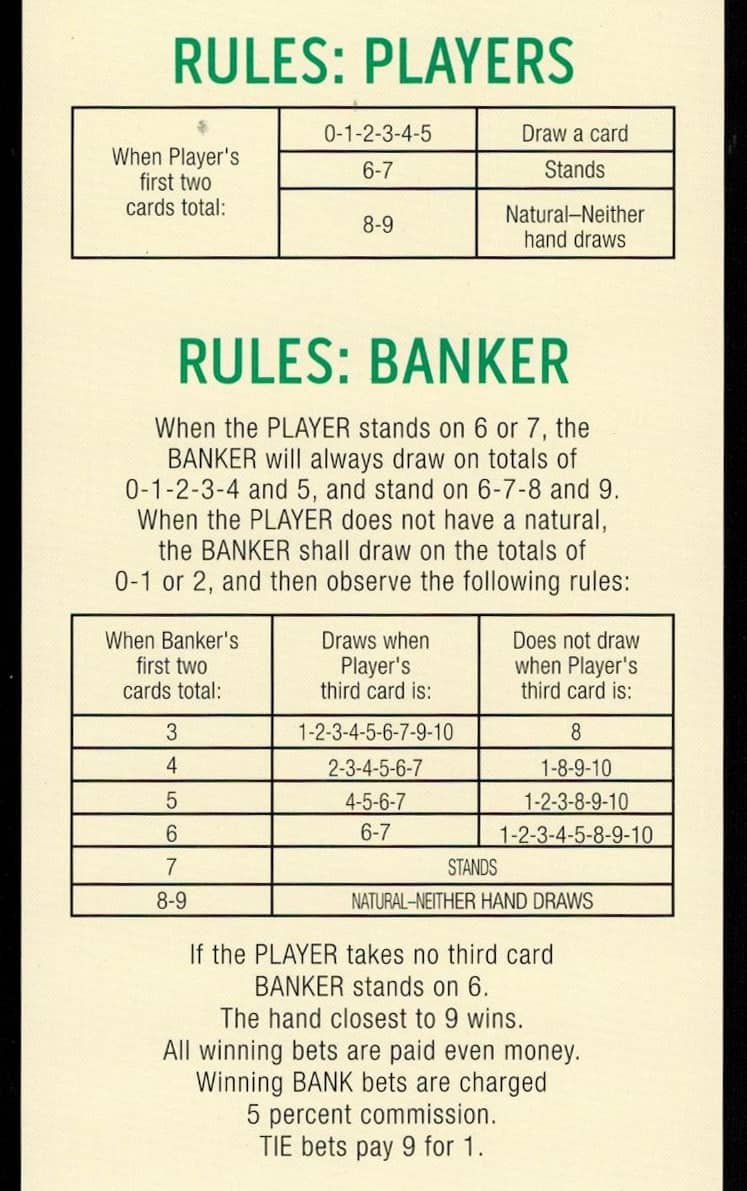
Player Rules
The player must always act first, before the banker.
- 1. The Player will receive a third card, if their initial hand totals 0 to 5.
- 2. The Player must stand (keep the current hand and reject any extra card) on a total of 6 or 7
Banker Rules
If the Player stands on a 6 or a 7, the Banker must likewise draw a 3rd card on a total of 0-5 and Stand on 6-7. But if the Player draws a third card, the Banker’s action is determined by their own total and the value of the card the Player drew.
Here is a quick rundown of the rules to remember
- 1. If the Banker’s initial hand total equals 0 through 2, the Banker can draw a 3rd card regardless of what the player's third card is.
- 2. If the Banker’s initial hand total equals 3, the Banker can draw a 3rd card if the Player’s third card is any total but 8.
- 3. If the Banker’s initial hand total equals 4, the Banker can draw a 3rd card if the Player’s third card is 2 through 7. But if it is 1, 8, 9, or 10, the banker cannot draw a third card.
- 4. If the Banker’s initial hand total equals 5, the Banker can draw a 3rd card if the Player’s third card is 4 through 7. But if it is 1, 2, 3, 8, 9, or 10, the Banker cannot draw a third card.
- 5. If the banker’s initial hand total equals 6, the banker can draw a 3rd card if the Player’s third card is 6-7. But if it is 1, 2, 3, 4, 5, 8, 9, and 10, the banker cannot draw a third card.
- 6. If the banker’s initial hand total equals 7, the banker can do nothing but Stand.
Remember, in Baccarat:
- Face cards and 10s have 0 point value
- Aces are worth 1.
- If the hand total exceeds 9, the first digit is dropped. For example, if you have 8 and 9. You have 17 total. But it will be valued as 7.
Final Thoughts
The 3rd-card rule in Baccarat is good for players to know, so they understand why the dealer hits or stays on certain cards. It takes effect when gameplay extends beyond the first two cards dealt based on the total of the Player or the Banker. It doesn't disrupt gameplay but maintains the flow.
Enjoyed this article?
Join our newsletter to get the latest casino industry articles delivered straight to your inbox.
Related Posts

Where the Banker Edge Comes From: The Math of Baccarat in Plain Numbers
Oct 13, 2026 Logan Weaver
Why does Banker have the edge in baccarat? Discover the surprising math behind the odds, payouts, and winning strategies!

Baccarat Dealing Rules: How Casinos Deal Mini-Baccarat
Oct 4, 2026 Daniel Odeyemi
Learn official baccarat dealing rules used in casinos. Follow the dealer's step-by-step procedures for mini-baccarat, card handling, payouts, commissions, and game protection.

The Math Behind Baccarat: Why It’s a Player Favourite
Jul 6, 2026 Thor Furman
Discover the math behind baccarat and why it remains a favourite among players worldwide.
Casino Gaming Charges: Commission, Vigorish, and Rake
Mar 6, 2015 Daniel Odeyemi
Learn how casinos calculate and deduct commissions, rake, or vigorish when you play table games such as Baccarat, Craps, Pai Gow Poker, and Poker.

How to Protect your game from this Mini-Baccarat Scam
Nov 10, 2022 Heather Ferris
In this video you'll learn how to protect your mini-baccarat game from marked cards.
How to Play Mini-Baccarat
Sep 19, 2019 Heather Ferris
How do you play Mini-Baccarat? Learn how to play online free for beginners.