
Who Invented the Blackjack Strategy Guide?
The blackjack strategy guide remains one of the most iconic casino gaming tools ever invented. To many players, it's simply “a book” recommending what action to take, based on your cards and the dealer's card. But it is much more than that. It is a historic contribution to the game of 21, built on mathematics and, later, early computer simulations. The first basic strategy came from four U.S. Army mathematicians in 1956; it was Edward Thorp, author of Beat the Dealer, who put it on a computer and proved the game could actually be beaten.
This article traces that history; from the “Four Horsemen” to Thorp and Julian Braun and explains how “The Book” became the standard.
Blackjack Before Strategy Charts
The blackjack strategy guide didn’t exist until the mid-20th century. Before then, players simply followed the rules of the game and played based on instinct alone. If anyone won, it was put down to luck. Casinos had the edge, and they loved it. But their big grin soon wound down as some mathematically inclined players, nicknamed the Four Horsemen, took an interest in the game.
In 1956, Roger R. Baldwin, Wilbert E. Cantey, Herbert Maisel, and James P. McDermott published “The Optimum Strategy in Blackjack” in the Journal of the American Statistical Association. Baldwin, a U.S. Army private with a master’s degree in mathematics, had become fascinated by blackjack as played in Las Vegas. He enlisted friends who also had strong mathematical backgrounds, and together they set out to find the best strategy.
Their paper derived a mathematical solution to when a player should stand versus draw. They did most of the work on mechanical desk calculators rather than a computer, and while their calculations didn’t yet cover every situation, their work is widely recognised: they established that the right strategy could cut the house edge to well under 1%, the foundation Thorp later used to beat the game outright.
Then came Ed Thorp in the 1960s with the goal to develop a blackjack strategy guide that could reduce the house edge to nearly 0. He used Baldwin's calculations but corrected a few inaccuracies to develop the optimal strategy for playing blackjack today.
How Edward Thorp Changed Blackjack Forever
Edward Thorp is a mathematics professor often credited with bringing the basic blackjack strategy guide to the masses. He was born in Chicago, Illinois, in 1932 and earned his first degree in physics at UCLA. He then earned a PhD in Mathematics from UCLA in 1958, and from 1959 to 1961 he taught at MIT.
Thorp’s interest in blackjack stemmed from the notion that casino games based on chance cannot be beaten, including blackjack. He didn’t agree to this on the basis that when a card is dealt in blackjack, the probability of the outcome changes.
In 1958, Thorp decided to visit Las Vegas to learn more about blackjack. He read Baldwin's article before he left to better understand the game. Upon arriving in Vegas and playing the game, Thorp became even more fascinated by it. He wrote, “The atmosphere of ignorance and superstition surrounding the blackjack table that day had convinced me that even good players didn’t understand the mathematics underlying the game. I returned home intending to find a way to win.”
Prof. Edward Thorp began to dig into the theory of probability, which could help him beat blackjack. But he didn't want a shortcut solution. He wanted to be able to prove his calculations and establish it as a strategy guide for all players. So, unlike Baldwin, he utilized a computer.
The First Computer-Generated Blackjack Strategy

Thorp used an IBM 704 computer at MIT to find the best strategy for players. He used the Fortran programming language to simulate multiple blackjack hand plays. He then based his wager calculations on the Kelly criterion, a renowned mathematical formula for determining the optimal size of bets to place.
From his simulations, Thorp found that the odds shift with the cards left in the deck. Ten-value cards, 10s, jacks, queens, and kings, are better for the player when more of them remain, so he developed a counting method he called the “Ten-Count” to track them.
A fresh card deck has 16 tens and 36 other cards. So, Thorp calculated the ratio (36/16 = 2.25). This ratio changes as the cards are dealt. When low cards (2 through 6) are dealt, the ratio drops. When it goes below 2.0, the deck becomes rich in tens, giving the player a mathematical edge. So, when the ratio was low, Thorp raised his bet high, but when it was high, he bet low.
Confident in his work, Thorp secured a $10,000 bankroll from a backer and headed to the Las Vegas tables. His theory held up he won a significant amount, about $11,000 in his first weekend alone.
With sufficient evidence that his calculations and strategy worked, Edward Thorp published a book titled “Beat the Dealer” in 1962 to share his knowledge with players of all kinds. The book became a bestseller. About 700,000 copies were sold. Thorp became widely popular. Many news outlets and magazines wrote about him. A popular one was “The Professor Who Breaks the Bank” by Paul O'Neil. But the modern guide wasn’t Thorp’s work alone: his book caught the attention of Julian Braun, who would refine the strategy further.
How Julian Braun Improved Blackjack Strategy
The late Julian Braun was a crucial figure in blackjack history. He was a computer programmer at IBM who was also intrigued by blackjack. He read Edward Thorp’s book and was impressed by how he used a computer to run simulations and develop a strategy.
Having access to high-speed computers at work, Braun reached out to Thorp about his book and asked if he could send him the Fortran program he used. Thorp obliged. Braun ran the program on an IBM 7044 mainframe and refined Thorp’s basic strategy, making it (in his words) more precise, with “a lesser degree of approximation.”
In 1966, Thorp released a revised edition of his book, incorporating Julian Braun's blackjack calculations. It became the standard blackjack strategy guide and has since been called “The Book.”
In the acknowledgments, Thorp wrote: “The results of the first edition have been sharpened and improved by the extensive research of Julian Braun of the IBM corporation. He has made most of the calculations for the point-count method and has made numerous detailed and valuable suggestions. I am grateful to him for allowing his work to be incorporated into the second edition.”
Braun kept studying the game, and in 1980 published his own book, “How to Play Winning Blackjack,” covering strategy, card counting, the Hi-Lo system, and the underlying math.
What Is Basic Blackjack Strategy?
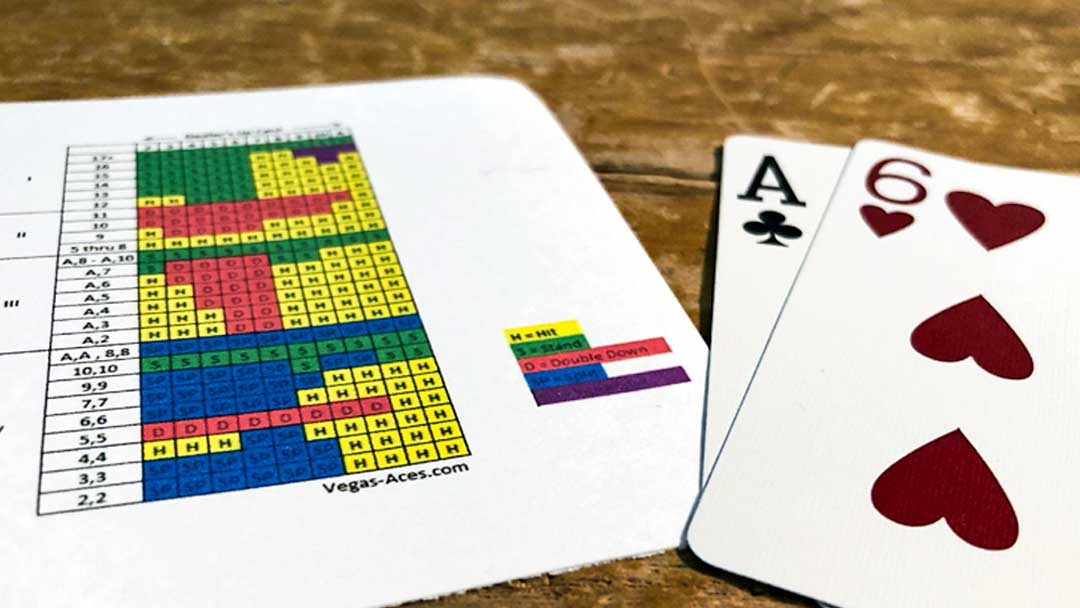
Basic blackjack strategy is a mathematical tool that tells you the best action (hit, stand, split, or double) for every possible two-card total against the dealer’s up card. Each decision is based on probability, designed using computer simulations that account for every card in the deck.
Playing with basic strategy reduces the house edge from about 2% for an untrained player down to roughly 0.5%.
The Core Decisions
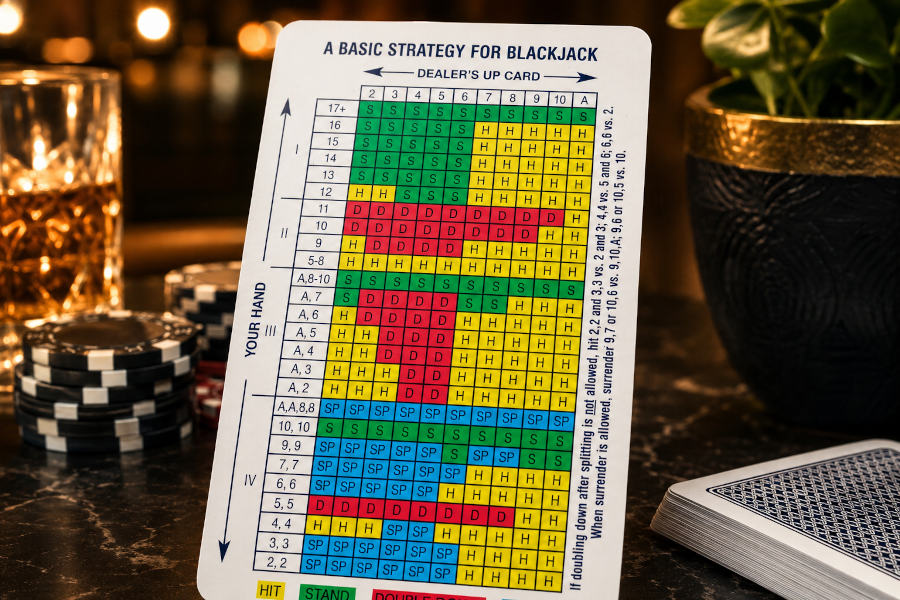
Edward Thorp's blackjack basic strategy, available as a chart, compares your two-card total to the dealer’s upcard (the card you can see). It tells you when to Hit (Take another card), Stand (Keep your current total and end your turn), Double Down (Double your wager, take an extra card, and stand), or Split (Separate a pair of equal value cards into two hands, and double your bet).
When to Hit
Hit on totals of 12 to 16 if the dealer shows a 7 through Ace. In these cases, the dealer’s hand is strong. You have to take the risk of hitting to beat the dealer, who is likely hoping to have a high total.
When to Stand
Stand on hard totals of 12 to 16 when the dealer shows a 2 through 6 (with a few exceptions, hit a hard 12 against a dealer 2 or 3). These up cards are weak, so you avoid the risk of busting.
When to Split
Do not split 10s. The total is 20. It is a potential winning hand. Split Aces and 8s instead. Having two Aces gives you two chances at 21 since an Ace is a dual value card (1, 11). Two 8s equal 16, which is not a great hand to have in blackjack. You can easily bust. Splitting gives you flexibility to build your total.
When to Double Down
- Double on 11 if the dealer's upcard value is 2 through 10. You have an opportunity to complete the blackjack total (21) with a 10-value card.
- Double on 10 if the dealer shows a 2 through 9.
- Double on 9 if the dealer shows a 3 through 6.
- Double Soft 13 through 18 if the dealer shows a weak up card 3 through 6. A soft hand has an ace, which is a safety net against busting in this situation. Note the exceptions: soft 13–14 double only vs 5–6, soft 15–16 double only vs 4–6, and soft 18 stands vs 2 and 7–8.
Why Insurance Is Usually a Bad Bet
Some players take insurance when the dealer's up card is an Ace. They judge the probability that the dealer has a 10 to be high, but mathematically, it is low. Hence, taking insurance in blackjack is often a non-profitable move. It is a bad side bet that offers a 2:1 payout but has a high house edge of 7.4%.
Why Different Blackjack Tables Require Different Strategies
The basic blackjack strategy must be adapted to a table for it to work. Different tables have different rules as the casino wills. So, here are the rules to watch out for.
Number of card decks Single-deck games are more strategy-friendly than shoe games (4–8 decks), and you adjust mainly on splitting and doubling. For example, in a single-deck game you double a hard 11 against a dealer Ace; in a shoe game you hit it.
Dealer hits soft 17 vs stands on soft 17 Most casinos use “dealer stands on soft 17.” When the rule is “dealer hits on soft 17,” the house edge rises by 0.22%. To offset it, you double more often on soft hands.
Double After Split rule Not all blackjack tables allow players to double down after a split. But in casinos where the rule is in place, splitting low pairs like 2s, 3s, 4s, and 6s can be highly beneficial for your total. It reduces the house edge by about 0.14%
Surrender Surrender is optional. Where it’s allowed, you can give up half your bet instead of playing out a tricky hand like a hard 15 or 16. Late surrender reduces the house edge by about 0.07%
Why Casinos Change Blackjack Rules
Casinos often adjust blackjack rules to increase the house edge. Common examples include:
- Offering a 6:5 blackjack payout, which increases the house edge by 1.39%. So instead of paying $15 for a $10 bet, it pays $12.
- Mandating dealers to hit on Soft 17, increasing the house edge by 0.22%.
- Restricting doubling, limiting it to 9–11 only raises the house edge by about 0.09%, and to 10–11 only by about 0.18%.
Tip: Always play at a 3:2 blackjack table for the best payout.
Blackjack Strategy vs Card Counting
Basic strategy and card counting are two legal ways to win at blackjack, and although Thorp’s and Braun’s work covers both, they’re different. Card counting is built on basic strategy, you have to master basic strategy to count well.
Basic strategy gives the optimal play for every hand, reducing the house edge to about 0.5%. Card counting tracks the cards dealt to estimate the quality of the remaining deck and is used to size bets: raise your bet when the deck is rich in high cards (tens and aces), lower it when it’s rich in low cards. Basic strategy minimises losses; counting lets you press your edge. A counter who ignores basic strategy will still fail (the exception to this is predetermined strategy deviations).
| Feature | Basic Strategy | Card Counting |
|---|---|---|
| House Edge | 0.5% to 1% (in favor of the house) | Less than 0.5% (in favor of the player) |
| Primary Goal | Minimize losses | Maximize winnings |
| Legality | Legal | Legal except when electronic devices are used. |
| Ease of Learning | Easy to learn through charts | It can take time to master. Practice is required. |
| Prerequisites | Know the rules of blackjack | You have to learn basic strategy first. |
Strategy Deviations
Casinos watch for deviations from expected play to spot advantage players, and using an electronic device to count can get you banned. Some deviations are legal, though — for example the Illustrious 18, a set of 18 key basic-strategy departures popularised by Don Schlesinger. They tell a Hi-Lo counter when to ignore standard basic strategy in favour of the play best suited to the current deck composition.
Are Blackjack Strategy Cards Legal?
Yes, using printed blackjack strategy cards is legal in casinos. Casinos are not threatened by basic strategy. Yes, it reduces the house edge, but it doesn't guarantee a win. Also, having the cards encourages players to play longer, which benefits casinos. They want you to be entertained as the small house edge slowly eats into your wager. The only thing casinos frown upon is using electronic devices at the tables to cheat. In Nevada, players who are caught are often charged with a felony and banned.
The Lasting Legacy of Blackjack Strategy Guides
Blackjack strategy guides did more than give players an edge, they influenced gambling broadly. The success of “Beat the Dealer” encouraged other math-minded gamblers to publish their own books, and players became motivated to take on the house. The most famous example is the MIT Blackjack Team, which won at casinos using card counting alongside basic strategy and inspired the bestseller “Bringing Down the House” and the movie “21.” As online casinos went mainstream, basic strategy became a core training tool, available through apps and printable charts.
How Blackjack Strategy Continues to Evolve
Even with advances in modern casinos, basic blackjack strategy remains relevant because the classic table game has not changed. Blackjack strategy evolution has continued through:
Online simulators You don't need an IBM computer like Edward to run hand simulations. There is consumer-grade software that can run millions of hand-play simulations in a few seconds to determine the best action.
AI With AI, blackjack analysis has been made easier. You can type a detailed gameplay scenario into an AI chatbot, and it will inform you on what to do.
Mobile strategy trainers There are now mobile online platforms where players can learn basic blackjack strategy from professional players.
However, casinos are fully aware of all these technologies. Therefore, they have also evolved, improving their surveillance to catch advantage plays that may deviate from the basic strategy.
Conclusion
The history of blackjack strategy guide reveals how the classic 21 card game has been shaped by the tool. The contributions of Roger R. Baldwin, Julian Braun, and Edward Thorp towards the creation of the basic strategy have changed the game forever. Now every player has a chance to beat the house, whether at a land-based establishment or an online casino.
With printable charts available at Vegas-Aces, you can learn basic blackjack strategy and play at any table with confidence.
FAQs
Who invented the blackjack strategy guide?
The first basic strategy was created in 1956 by the “Four Horsemen” (Baldwin, Cantey, Maisel, and McDermott). Edward Thorp then produced the first computer-tested version and was the first to prove the game could be beaten, in his 1960s book “Beat the Dealer”.
What was Beat the Dealer?
“Beat the Dealer” was Edward Thorp’s famous blackjack book that introduced mathematically proven blackjack strategy and card counting concepts.
What is “The Book” in blackjack?
“The Book” is a nickname players gave to the blackjack strategy guide and related blackjack strategy systems developed by Edward Thorp and Julian Braun.
Does blackjack strategy actually work?
Basic strategy helps reduce the house edge by using mathematically optimal decisions for each hand.
Is using a blackjack strategy card legal in casinos?
Yes. Most casinos allow players to use printed blackjack strategy cards at the table.
What computer did Edward Thorp use?
Edward Thorp used an IBM 704 computer to run blackjack simulations and develop his strategy.
Enjoyed this article?
Join our newsletter to get the latest casino industry articles delivered straight to your inbox.
Related Free Learning Hubs: Blackjack, All Hubs
Related Terms & Definitions: Basic Strategy, Double Down, House Edge, Blackjack, Insurance, Soft Hand, Bankroll, Counter, Seconds, Up Card, Action, Backer, Full Dictionary
Related Posts
Blackjack Strategy Chart: Basic Strategy for Every Hand
Use our free blackjack strategy chart to learn when to hit, stand, split, or double down. Printable charts for single, double, and shoe games.
The New Player at Third Base Didn’t Ruin Your Blackjack Hand
Sep 22, 2026 Monika Dragojlovikj
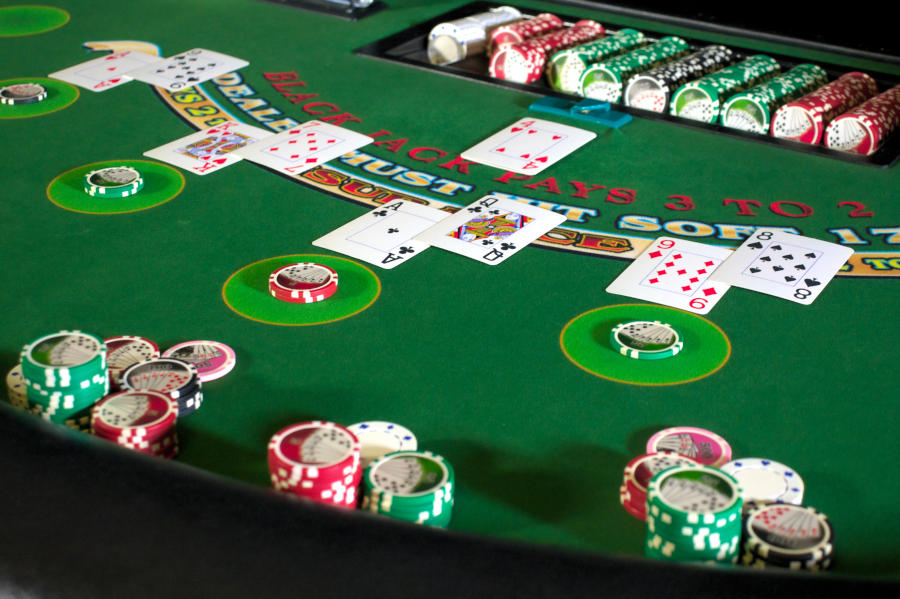
Third-base players can change who receives the next card, but they cannot predict it. This is why the blackjack myth survives at live tables.
Blackjack Payout Calculator & 3:2 Payout Chart
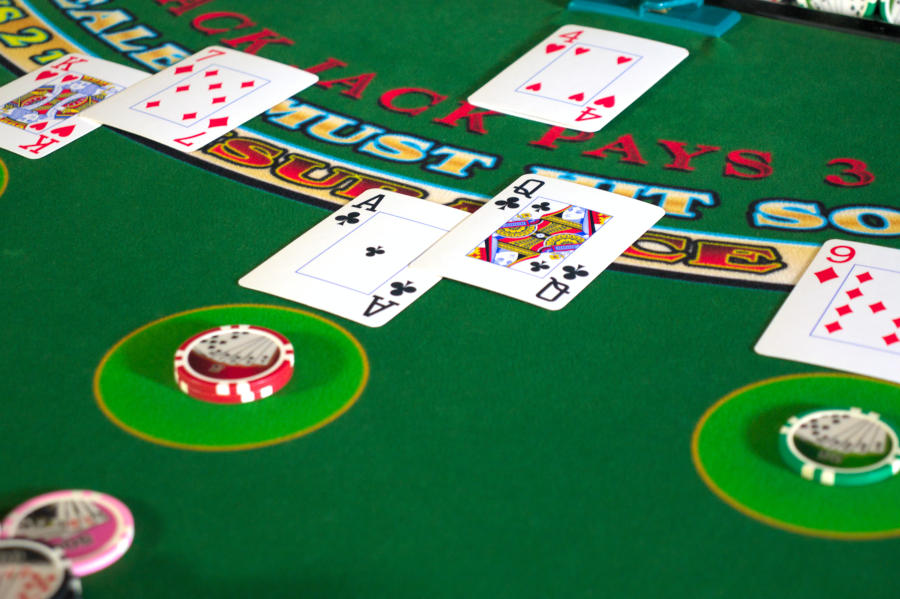
Download the official 3:2 Guide instantly. Use this printable PDF and our FREE strategy course to master basic strategy and guarantee you maximize your odds.

12 Things You Should Never Do at a Blackjack Table
Aug 30, 2026 Heather Ferris
Discover the 12 blackjack mistakes that can expose a rookie, annoy the table, and even get you kicked out.
How to Use a Blackjack Payout Calculator
Learn how to use a blackjack payout calculator with simple step-by-step examples. Calculate 3:2, 6:5, insurance, and blackjack payouts accurately every time.
6:5 Blackjack Explained: Is It Worth Playing?
Aug 2, 2026 Daniel Odeyemi
Learn what 6:5 blackjack means, how it compares to 3:2 payouts, and why many experienced players avoid 6:5 blackjack tables.
Table of Contents
- # Back to Top
- Blackjack Before Strategy Charts
- How Edward Thorp Changed Blackjack Forever
- The First Computer-Generated Blackjack Strategy
- How Julian Braun Improved Blackjack Strategy
- What Is Basic Blackjack Strategy?
- Why Different Blackjack Tables Require Different Strategies
- Why Casinos Change Blackjack Rules
- Blackjack Strategy vs Card Counting
- Strategy Deviations
- Are Blackjack Strategy Cards Legal?
- The Lasting Legacy of Blackjack Strategy Guides
- How Blackjack Strategy Continues to Evolve
- Conclusion
- FAQs