
Poker Cheat Sheet for New Players: Essential Hands, Rules, Odds, and Strategies
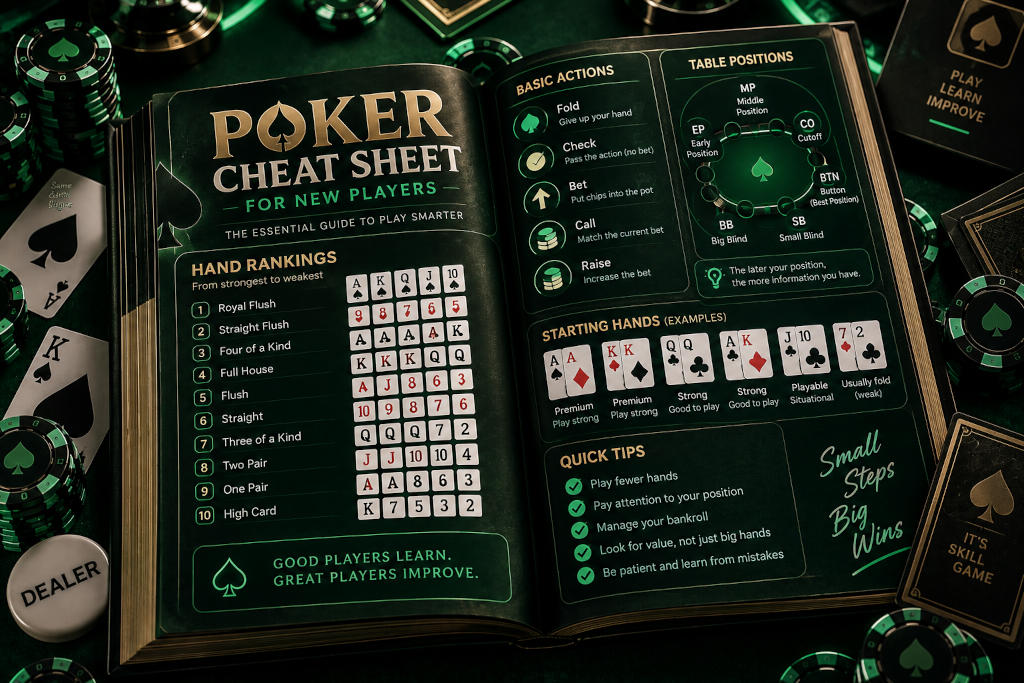
A beginner does not need dozens of charts to play the first Texas Hold'em hands correctly. The essential reference is smaller: know the hand order, understand what each betting action means, recognize position, count clean outs and compare the price of a call with the pot. This cheat sheet keeps those rules in one place.
Use this poker cheat sheet for new players as a quick table reference. Before entering a pot, check your starting hand and position. After the flop, identify your current five-card potential, stronger combinations the board allows, useful outs and the price of continuing. These checks cover the decisions beginners face most often.
Poker Rules Every New Player Should Know
Texas Hold'em gives each player two private hole cards and places up to five community cards on the board. The hand moves through pre-flop, flop, turn and river. If two or more players remain after the final betting round, showdown determines the winner from each player's best available five-card combination.
The same sequence applies to standard online crypto poker tables. Check means passing without betting when permitted, bet puts chips into an unopened betting round, call matches an existing wager, raise increases it, and fold gives up the hand. Small and big blinds create the initial pot, while the dealer button determines positional order.
Poker Hand Rankings from Strongest to Weakest
This is the first part of the poker cheat sheet worth memorizing:
- Royal Flush
- Straight Flush
- Four of a Kind
- Full House
- Flush
- Straight
- Three of a Kind
- Two Pair
- One Pair
- High Card
Three shortcuts prevent common ranking errors. A Flush beats a Straight. A Full House beats a Flush. If two players have the same category, compare the relevant card ranks according to that category. For One Pair, for example, compare the pair first and then kickers. Suit does not break an otherwise exact tie in standard Texas Hold'em.
Starting Hands and Table Position
For a beginner cheat sheet, divide starting hands by practical strength rather than memorizing a large pre-flop matrix. AA, KK and QQ are premium pairs. AK is a premium unpaired holding. Medium pairs and strong broadway combinations can be playable but become more dependent on position, previous action and effective stack.
A compact poker glossary makes the rest of the sheet easier to use: button means the dealer position, pot is the chips currently contested, kicker is an unpaired card used for some tie-breaks, draw is an incomplete combination, outs are cards that can improve it, and showdown is the final hand comparison.
A Simple Pre-Flop Approach for Beginners
Position changes the value of starting hands. From early position, several players still have an opportunity to wake up with stronger cards, so use a tighter range. From the cutoff or button, fewer opponents remain and acting later post-flop gives you more information.
Keep one pre-flop rule visible: strong hand + favorable situation = raise more often; marginal hand + early position or strong action = fold more often. Do not automatically limp or call because two cards look playable. If someone raises before you, reassess the hand against that action rather than using your original plan.
Poker Odds and Outs Explained Simply
The beginner calculation starts with outs. If you hold A♥ 7♥ and the flop is K♥ 4♥ 2♣, you have four visible hearts. Thirteen hearts exist in the deck, leaving nine unseen hearts that can complete your Flush.
For fast estimates, keep only two calculations on the cheat sheet:
- Flop to River: clean outs × 4 gives an approximate probability of improving by the river. Nine outs ≈ 36%.
- Turn to River: clean outs × 2 gives an approximate probability of improving on the river. Nine outs ≈ 18%.
The exact probabilities for nine flush outs are about 35% across the final two cards and about 19% with one card remaining. The shortcut is deliberately approximate. Count clean outs, not every card that changes your hand. An apparent out loses value if it frequently completes an opponent's stronger combination.
Pot Odds and Basic Decision-Making
Pot odds answer a more useful question than “Do I have a draw?” They tell you whether the current call is cheap enough relative to the potential return.
Suppose the pot contains $80 and an opponent bets $20. Calling costs $20, and the resulting pot becomes $120. Your call therefore needs about 16.7% equity to break even on immediate pot odds. If your realistic winning probability is comfortably above the required threshold, the call can be mathematically justified. If it is below it, folding avoids paying too much for the draw.
Essential Poker Strategy for New Players
The practical cheat sheet can be reduced to six checks before committing chips: hand, position, effective stack, board, pot size and opponent action. Missing one of them often explains beginner mistakes.
Start with fewer hands rather than trying to play every ace, suited holding or connected combination. Position deserves extra weight because acting later reveals more information. A marginal hand on the button and the same hand under the gun are not equivalent situations.
On the flop, stop judging strength from hole cards alone. A♠ K♦ on A♣ 8♥ 3♠ gives top pair with top kicker. If later community cards heavily connect the board, that same One Pair can lose relative strength even though your original cards have not changed.
Effective stack sets the amount actually at risk against a particular opponent. If you hold 90 BB and your opponent has 25 BB, the relevant stack between you is 25 BB. This affects how much money can enter the pot and how much room remains for decisions on later streets.
Common Beginner Mistakes to Avoid
Use a short mental warning before difficult calls: do not pay simply because you already paid. Chips invested on earlier streets do not make a bad river call profitable. Judge the current decision using the current pot, bet size, hand strength and opponent action.
Do not chase every draw either. Nine outs can be useful against a small bet and too expensive against another sizing. Avoid overvaluing One Pair against heavy action, playing weak hands from early position, ignoring kickers and counting cards as outs without checking whether they actually create the likely winning hand.
One final shortcut helps at showdown: build the strongest five-card hand first, then compare categories. Texas Hold'em gives access to seven cards by the river, two hole cards plus five community cards, but only five form the final hand. You can use both, one or none of your hole cards if the board produces the better combination.
Final Thoughts
Keep the beginner poker cheat sheet simple enough to remember during play: hand ranking, position, effective stack, board strength, outs and pot odds. Once those checks become automatic, more detailed starting ranges and post-flop strategy have a solid foundation instead of becoming another set of rules to memorize.
Disclosure: This article contains sponsored content.
Enjoyed this article?
Join our newsletter to get the latest casino industry articles delivered straight to your inbox.
Related Free Learning Hubs: Poker, All Hubs
Related Terms & Definitions: Community Cards, Straight Flush, Betting Round, Dealer Button, Under the Gun, Royal Flush, Full House, Position, Showdown, Straight, Action, Button, Full Dictionary
Related Posts
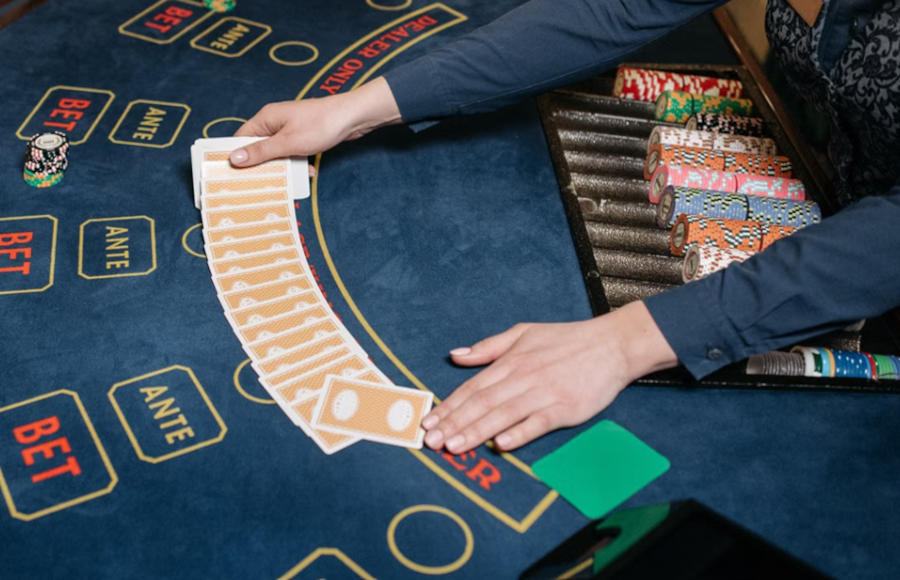
Could You Pass a Poker Dealer Audition If You’ve Only Ever Played Online?
Sep 14, 2026 Jamie Gilchrist
Online poker teaches you the game, but discover what it really takes to command the dealer’s chair.

Why The Speed Of A Poker Game Transforms The Dynamic
Sep 8, 2026 Alice Oziran
Discover how poker’s pace can reshape strategy, pressure, player psychology, and the entire dynamic of the game.
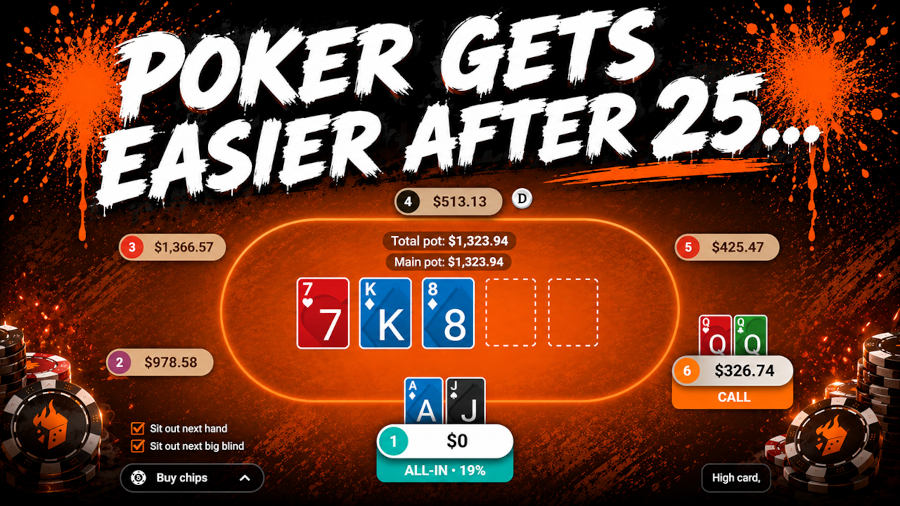
Poker Advice I Wish I Knew at 25
May 27, 2026 Edward Paoletti
This article shares practical poker lessons on discipline, patience, table selection, and avoiding emotional decisions to improve long-term profits.

New Strategies Changing How Poker Is Played
Feb 27, 2026 Gabriela Pelayes
Online growth and analytics tools are reshaping poker strategies, speeding play and transforming decision-making worldwide.

What Makes Poker a Skill Game
Feb 17, 2026 Daniel Odeyemi
Discover what makes poker a skill game. Learn how probability, psychology, strategy, and bankroll management outweigh luck over the long run.
Top Poker Mistakes Beginners Make and How to Improve
Jan 30, 2026 Andy Brams
Learn the most common beginner poker mistakes and how strong early habits improve structure, clarity, and confidence for beginner players.
Table of Contents
- # Back to Top
- Poker Rules Every New Player Should Know
- Poker Hand Rankings from Strongest to Weakest
- Starting Hands and Table Position
- A Simple Pre-Flop Approach for Beginners
- Poker Odds and Outs Explained Simply
- Pot Odds and Basic Decision-Making
- Essential Poker Strategy for New Players
- Common Beginner Mistakes to Avoid
- Final Thoughts