
Baccarat Dealing Rules: How Casinos Deal Mini-Baccarat
Your training as a casino dealer isn’t complete until you know how to deal baccarat. The classic table game is popular with whales and high rollers, so if you want to work the tables where the big tips come from, you have to learn how baccarat is actually dealt. Procedures vary slightly between casinos, but the core rules stay consistent. This guide is for aspiring dealers, dealers in training, and curious players, the steps of dealing baccarat, based on real casino experience.
What Are Baccarat Dealing Rules?
Baccarat dealing rules are a set of predetermined instructions that dictate the flow of the game. The goal in baccarat is to get a hand total closest to nine, either as a banker or a player. So your responsibilities as a dealer include maintaining game security, following casino procedures, and being consistent.
The following are the rules for baccarat dealer training:
Card Distribution Rule
Deal four cards face up from the shoe in alternating order: Player, Banker, Player, Banker: Player’s 1st card, then Banker’s 1st card, then Player’s 2nd card, then Banker’s 2nd card. Place the Banker cards under the lip of the shoe.
Wagering Rules
Before any cards are dealt, all bets must be placed; announce “No more bets.” The Banker bet has a low 1.06% house edge, the Player bet 1.24%, and the Tie bet a high 14.36%.
Hand Values Calculations
As a dealer, you must learn to be swift with calculating hand totals. In baccarat, any total above 9 is valued as a single digit. If a hand total equals 10 or more, drop the tens digit to establish the final value. Therefore, your total calculation must always fall between 0 and 9. E.g 8 + 7 = 15. Drop the 1. The hand total is 5.
- Aces: Worth 1 point.
- 2 through 9: Worth their face value.
- 10s and Face Cards (J, Q, K): Worth 0 points
The Natural Hand Rule
If either the Player or the Banker has a hand total of 8 or 9, it is called a Natural. Whoever gets this point wins, and the round ends immediately. If both have the same total, you declare it a tie.
If neither the banker nor the player has an 8 or 9, you proceed with gameplay according to the baccarat third-card rule.
The Third Card Rule
Baccarat has no player or dealer decisions, whether a third card is drawn is dictated entirely by fixed rules, and you simply apply them. The Player hand always acts first, then the Banker.
The third-card rule for the banker differs from that of the player. You can learn them using the third card rule chart, which is often the same across casinos. But if there are any slight changes, you should always follow the house rules.
Commission Rule
At a traditional (commission) table, winning Player and Banker bets pay even money (1:1), but a 5% commission is collected when Banker wins. For example, if a player bets $100 on the Banker and wins, pay the player $100 and place $5 in the commission box to be collected later. Or the dealer can take the $5 out of the winnings and pay the player $95.
There are also Commission-Free / No-Commission variants where you don’t deduct a commission (see the payout note below).
Equipment Used at a Baccarat Table
The following equipment is used for casino dealing procedures at a baccarat table:
Shoe: a plastic box used to hold the 6 or 8 standard decks of cards.
Discard rack: Used to collect used cards until the entire shoe is finished.
Chip Tray: a built-in metal tray for holding chips of different denominations. The chips are used for wagering and paying out winnings.
Commission box: Used to collect a 5% commission on banker’s bet winnings. You place the appropriate chips here to mark exactly how much commission a specific player owes the house. The player will pay the commission at the end of the shoe, before they leave the table, or at any point they wish to.
Layout: The table layout is where all bets and gameplay action take place. It has clearly marked betting sectors for each player seat.
Player/Banker/Tie betting areas: Players can only bet on the anker's hand, the player's hand, or a tie.
Cut card: A plastic card that is inserted into the shuffled 6 or 8-decks before it is placed into the shoe. When the cut card appears during play, it means the current round is the final hand before a reshuffle.
Step-by-Step Baccarat Dealer Procedure
Follow these steps to master the baccarat dealer procedures:
Open the Table
Opening a baccarat table for gameplay to commence involves a few steps. To begin, you must first perform a "clean hands" gesture. Show your palms up to the surveillance camera above the table. Proceed to verify the bankroll by breaking down and counting the chips that are in the table rack, so that they are visible to surveillance. You have to count the colored chips on the felt, stacking them in groups of 20. When you are done, you can announce in this manner: "We have $10,000 in purples, $8,000 in blacks, $4,000 in greens, and $1,000 in reds.” The floor supervisor will verify the total amounts and approve the table for gameplay to begin.
Continue by inspecting the cards to ensure they are complete and not damaged or marked in any way. Then complete the house shuffle. The floor supervisor will place the cut card into the shuffled cards before the dealer puts them in the shoe.
Accept Player Bets
With all the needed tools in place, you can collect bets from players. They can bet on the player's hand, the banker's hand, or a tie. To do this, they have to exchange their cash for chips. You are to give them the chips that match the amounts they are wagering. The chips will be placed on their selected betting area. Once everyone has made their bets, announce "No more bets.” Verify the wagers are not above or below the table minimum or maximum.
Deal the Cards
Baccarat is often played using 8 decks of cards. Following the mini-baccarat rules, the cards are dealt face up. The dealer will deal one card, face up, to the Player and then deal one card, face up, to the Banker. You do it in this order:
- Player's 1st card
- Banker's 1st card
- Player's 2nd card
- Banker's 2nd card
The same order applies on big baccarat, though there the cards are usually dealt face down and the players turn over the hand they bet on. After the deal, the dealer will read the totals. If it’s a Natural, the round is over; otherwise the third-card rule applies.
Third Card Rules
The baccarat third card rule dictates how an extra card must be dealt to either the Player or the Banker. Casinos often have a chart that highlights how the 3rd card must be dealt. But here are the basic rules to remember:
Player Rules
The Player draws a third card if:
- A two-card total of 0 through 5
- Stands on 6 or 7
- A Natural 8 or 9 are automatic winners*
*Depending on whether the Banker has a higher Natural than the Player.
Banker Rules
- The Banker will always draw a third card if their original two cards are a 0 through 2.
- The Banker will always stand on a 7.
- Natural 8 or Natural 9 are automatic winners*
*Depending on whether the Banker has a higher Natural than the Player.
If the Player stands:
- The Banker draws on 0 through 5 and stands on a 6 or 7
If the Player draws a third card:
- If the Player’s third card is an 8, the Banker will stand on a 3, otherwise they will hit.
- If the Player’s third card is a 2 through 7, the Banker will hit if they have a 4, otherwise they will stay.
- If the Player’s third card is a 4 through 7, the Banker will hit if they have a 5, otherwise they will stay.
- If the Player’s third card is a 6 or 7, the Banker will hit if they have a 6, otherwise they will stay.
The chat below shows the standard baccarat third card rules you must know as a dealer:
Announce the Winning Hand
If, during the initial deal, either the banker or the player gets a natural hand of 8 or 9, you, as the dealer, should announce the final point values. Example: "Player shows a four, Banker has Natural nine". Then proceed to say in this case, "Banker Natural 9 over 4."
Never show favoritism for one hand or the other by stating they “won” or have a “winning hand”. Keep the announcement as neutral as possible.
If the gaming round result is "Player shows a seven. Banker has seven," announce, “Tie. Seven, seven."
Pay Winning Bets
Before you pay the winner of a baccarat round, you must first clear all losing wagers from the layout. Depending on your casino’s procedures, you will place the losing bets in a stack, in front of the dealer but outside of the rack, or you will have an empty tube in the rack where you will place the losing bets. The reason why is because if there is a dispute, the floor person can determine the amount of the player’s wager by looking at the stack of lost bets.
Pay the winning wagers by sizing into the bet, color-for-color. Do not convert unless you receive approval to do so by your floor supervisor. For quick mastery, the table below shows how you should pay winning bets as a baccarat dealer:
| Bet Result | Payout |
|---|---|
| Player Win | 1:1 (even money) |
| Banker Win (Commission) | 1:1, minus the 5% commission |
| Tie Bet | 8:1 or 9:1 depending on house rules |
When finished, repeat the “clean hands” gesture for surveillance to confirm that no chips have been palmed.
Mini-Baccarat vs Full-Size Baccarat Procedure
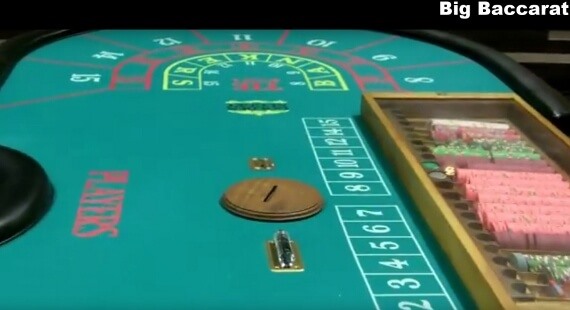
Dealing mini-baccarat and big baccarat follow similar procedures, however, please note a few differences, as shown in the comparison table below.
| Mini-Baccarat | Big Baccarat |
|---|---|
| The dealer handles the cards | Players may handle cards |
| Faster pace | Slower pace |
| Lower limits | Higher limits |
| Simpler procedures | Additional rituals |
Casino Etiquette During Baccarat
There are unwritten rules, i.e., etiquette, you must uphold as a dealer during baccarat gameplay. They are:
Dos
Give the players enough time to make a bet before announcing “No more bets” so that the floor supervisor hears and surveillance is able to see your hand sweep the layout indicating that no more bets shall be made.
Do remain stoic and professional when dealing the game. Baccarat is not like blackjack where the dealer talks to or interacts with the players freely. It is considered to be a more serious game.
At the end of the shoe, collect the commission that is owed by players.
Don’ts
Never touch or adjust a player's bet once you have begun dealing cards from the shoe.
Do not show favoritism by announcing one side won over the other side. Avoid using the words “winning”, “win”, or “won” on the table.
Do not go so fast or so slow that it ruins the pace of the game. The dealer should give players enough time to make a decision but should also keep the game moving.
Conclusion
The more you know about casino table games, the better of a casino dealer you will be and the more valuable you’ll be to casinos. In this article, we have outlined the baccarat dealing procedures, from opening the table to handling payouts and the third card rule. Focus on accuracy and maintaining the integrity of the game, as this will make you a good dealer.
Learn more with Vegas Aces mini-baccarat course. Our website offers a range of free courses, and you can also reach out to us for guidance on securing a dealer role.
Frequently Asked Questions
How many cards are dealt in baccarat?
After the initial wager, four cards are dealt in total (two cards each to the Player and Banker hands). The maximum number of cards dealt is six (three cards each to the Player and the Banker).
Do baccarat dealers decide whether to draw?
No. In mini-baccarat the third-card draws are mandatory under the fixed rules; the dealer just applies them, making no decisions.
Why is there commission on Banker bets?
A 5% commission is charged on a Banker's bet because it has been proven that Banker wins more hands than Player. The casino balances this out by charging a commission on the Banker. It is considered to be the best bet in baccarat, having a low house edge of 1.06%.
Can players touch the cards?
In mini-baccarat, no. But at big baccarat, yes.
How does mini-baccarat differ from big baccarat?
Mini-baccarat is a scaled-down version of the traditional game big baccarat. Mini-baccarat is faster, with fewer procedures and lower limits.
Enjoyed this article?
Join our newsletter to get the latest casino industry articles delivered straight to your inbox.
Related Free Learning Hubs: Mini Baccarat, All Hubs
Related Terms & Definitions: Discard Rack, Floor Person, Initial Deal, Commission, Even Money, House Edge, Blackjack, Chip Tray, Face Down, Baccarat, Bankroll, Cut Card, Full Dictionary
Related Posts

Where the Banker Edge Comes From: The Math of Baccarat in Plain Numbers
Oct 13, 2026 Logan Weaver
Why does Banker have the edge in baccarat? Discover the surprising math behind the odds, payouts, and winning strategies!

The Math Behind Baccarat: Why It’s a Player Favourite
Jul 6, 2026 Thor Furman
Discover the math behind baccarat and why it remains a favourite among players worldwide.
Casino Gaming Charges: Commission, Vigorish, and Rake
Mar 6, 2015 Daniel Odeyemi
Learn how casinos calculate and deduct commissions, rake, or vigorish when you play table games such as Baccarat, Craps, Pai Gow Poker, and Poker.

How to Protect your game from this Mini-Baccarat Scam
Nov 10, 2022 Heather Ferris
In this video you'll learn how to protect your mini-baccarat game from marked cards.
How to Play Mini-Baccarat
Sep 19, 2019 Heather Ferris
How do you play Mini-Baccarat? Learn how to play online free for beginners.
Why Casinos Love And Fear Baccarat, The World's Biggest Gambling Game
Jul 21, 2018 Heather Ferris
The number one casino game in the world is a bit of a mystery to many American casino-goers. Baccarat traces its history to the gambling salons of Italy and France, but within the past thirty years its rise in casinos—mostly in Asia but increasingly in the United States—has made it a game that casino managers and gamblers alike are flocking to.
Table of Contents
- # Back to Top
- What Are Baccarat Dealing Rules?
- Hand Values Calculations
- The Third Card Rule
- Commission Rule
- Equipment Used at a Baccarat Table
- Step-by-Step Baccarat Dealer Procedure
- Third Card Rules
- Announce the Winning Hand
- Pay Winning Bets
- Mini-Baccarat vs Full-Size Baccarat Procedure
- Casino Etiquette During Baccarat
- Conclusion
- Frequently Asked Questions