
Strategy for Applying Superior Customer Service Strategy to Your Table Games
When management makes the important decision to invest time and money into a customer service policy, their next step is to develop a strategic plan for training their employees as to the skills needed to achieve the degree of superior service that will improve the casino’s performance and reputation in a service-oriented industry.
But how does management implement these philosophies in the table game department? What is required of the dealers? What information needs to be passed along to the pit supervisory staff? How much time in a training class is required before the employees reach a level of satisfaction as desired by management?
It’s All in the Customer Perception
I just finished having breakfast at a local restaurant. I’ve been traveling recently due to demands of my job, and I haven’t eaten breakfast in this particular restaurant for several weeks. At one time my wife and I ate there at least once a week. As I was paying for my bill, the cashier looked up, smiled, and said, “Hello stranger, I haven’t seen you for some time. It’s good to see you back. How was everything?” I answered that the food was good as always (which it is), and that business had kept me away the last several weeks. “I hope we see you again real soon”, she commented with a nice smile. As I walked away from the restaurant I thought to myself, wow, they actual recognized me as a regular customer. The fact that I was a regular customer was true, but the restaurant’s cashier recognized and acknowledged the fact made me feel good…it made me feel a little important.
This is exactly the feeling you the casino executive needs his or her employees to project when dealing with their customers. Make them feel recognized and acknowledge that they are important enough at “this” casino to be remembered. How does your employees pass this important element of human relationship and acceptance along to your customers? Unfortunately, there isn’t a “magic” phase or salutation that instantly constructs a superior customer-employee relationship. Developing custom loyalty is actually a steady process that is repeated over and over again while the customer is inside one’s business. This steady process will either consciously or subconsciously motivate the customer to realize that his or her experience inside your establishment is pleasant and accommodating. That he or she is important. That he or she will be acknowledged every time they enter and gamble at your casino.
Bringing your Pit Employees on Board
Even though there is not a special phrase to accomplish this customer-oriented goal, there are different processes your frontline employees can use to achieve the desired results. Remember, the goal is to make the customer feel recognized and appreciated, and this can be accomplished with non-verbal communication such as a head nod, a smile, and eye contact, as well as a pleasant “hello”, “good luck”, or “see you next time”.
The demeanor and actions of table games dealers are very important because they are usually the first frontline employee the customer comes in contact with. Some of the customer service techniques they need to apply are suggested as follows:
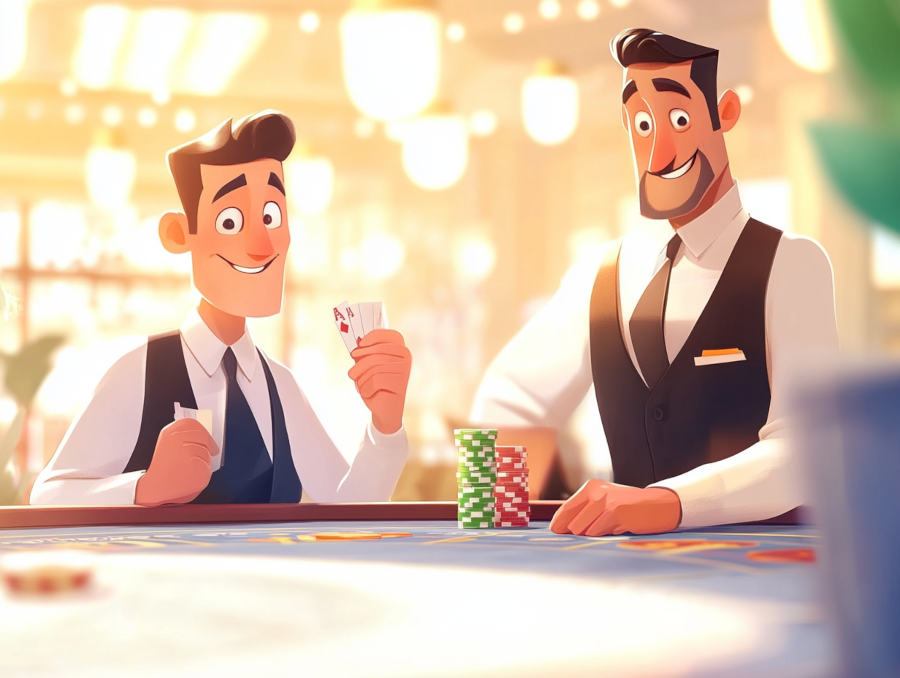
- Dealers must greet all players who approach the table to play. Make eye contact, smile, and use a verbal greeting such as a simple “hello”.
- If a customer appears to look interested in playing on your table, invite him/her to sit down.
- If he/she hesitates, ask if he/she needs any information or directions.
- Do not halt play to do so. Wait until there is a lull in the dealing activity.
- When a customer leaves the table, the dealer must say good bye in a proper manner. Be aware of a player’s mental state at the time. If they are aggravated because of a recent loss, be respectfully sincere when saying “good-bye”.
- While on a “dead game”, the dealer needs to remain “inviting”. Make eye contact and greet any guest that walks near the table. The dealer needs to actively attempt to bring players onto his/her table. Always stand at the dead game with an inviting appearance; never stand with your arms folded across your chest (defensive posture).
- When a dealer enters into a new game, he/she needs to greet everyone at the table with a smile and a “hello”.
- When a dealer leaves a game, he/she needs to thanks all the players and introduce the oncoming dealer, by name, to all the players at the table.
- While walking through the casino, all employees must smile and greet the customers. If a customer is within ten feet of the employee, the employee will make eye contact and nod. If a customer is within five feet of the employee, the employee must make eye contact and say “hello”.
This last bullet point is commonly known in the customer service field as the “5-10” rule. When a customer is within 10 feet of any employee, the employee is to acknowledge the customers presents with a nod and a smile. When the customer is within 5 feet of any employee, the employee acknowledges the customers presents with a smile and a pleasant “hello”. In many previous hospitality situations, the “5-10” rule has propelled hotel/resorts from grade ranking of a three-star to four-star status.
♠️ The View from the Box
“Want to improve customer service in your table games department while helping your dealers increase their earnings? Our Casino Dealer: How to Give Yourself a Raise course dives deeper into the customer service techniques discussed in this article, teaching dealers how to make players feel welcomed, appreciated, and valued. By providing superior customer service, dealers can help improve player satisfaction and loyalty while potentially increasing their tokes (tips), giving them a financial incentive to deliver an exceptional casino experience.”
— Heather Ferris, Vegas Aces
The other important frontline employee in the table game section is the floor supervisor. The floor supervisor has a number of benefits that contribute to his or her important role in superior customer service. First, the floor supervisor is perceived by the customer as holding a much more lofty position of importance in the casino then they actually have. Usually known by the customers as the “pit boss”, the floor supervisor is looked at as someone who is directly responsible for the operation of the casino; almost like a “mini” casino manager. Any time a “pit boss” communicates with a customer, other customers at the table figure that player is someone “special”, or noteworthy to casino management. Maybe even a “high roller”. To be noticed and acknowledge by a floor supervisor can be quite an ego boost to most players.
Second, the floor supervisor has the ability to move around to a number of gaming tables, and in being able to do so, has access to many more players than the table bound dealer. Even though the dealer may be establishing customer relationships though his or her continual game interactions, the floor supervisor’s perceived importance allows him or her to make more the same quality customer relationships during brief interactions. A smile and comment about a positive play stratagem will make most players feel important, and in a position to be revived by other customers at the table.
Get your Floor Supervisors to Develop Relationships with Regular Customers
It’s important that management stresses the same points with the floor supervisor as they did with the dealer. Greet customers that present their player’s card, answer question, always be receptive to questions, and most important, follow the “5-10” rule when on the casino floor or in the public eye while on the property. It is also important that the “supervisor” make certain that all dealers follow the required customer service standards. They are there to help identify any non-compliance, and suggest corrective measures to help assist the errant employee to get back on course. However, the floor supervisor and other pit management personnel have a more important task; build relationships with the players.
Find a good casino table games customer and learn the player’s first name and be sure to purposely greet him every time he comes in to play. “Hi Bob, good to see you…can I help you with anything…fine, if you need anything just ask”. The personalization of every encounter will do wonders with building customer loyalty. Not only will it reduce player desertion, but the fact that personal recognition is very important to most individuals, it will move them away from indifference when a group needs to decide where they want to go to have fun. “Let’s go to the XYZ casino. When I’m there, I always have a great time.”
Have the floor supervisors build one relationship per day. Instruct them to identify with one of the regular and better wagering players. Have them learn the player’s name, and recognize him or her on sight. Whenever the player is in the casino, the floor supervisor needs to acknowledge their presence as soon as possible. At the end of the month each floor supervisor will have established associations with twenty or more of your better players. Multiple that number by the number of people in your floor staff, and it calculates out to a huge informal player base.
♠️ The View from the Box
“Inform your employees to be careful when running into your casino customers outside the casino. In some instances, casino customers would rather their friends and family members not know they are a regular player at a gaming establishment. Preserving their privacy outside the casino can also increase a player’s loyalty towards your establishment.”
— Bill Zender, BZ & Associates
Some casino executives are reluctant to use this system of developing customer loyalty. It is their opinion that the customers build a loyalty base with the individual floor supervisors and not with the casino in general. Their argument, “What if the floor supervisor leaves and goes to the competition”. It assumed that the floor supervisor can build a customer list of the casino better players, and use that bargaining chip to find better employment. Basically, this is not a valid argument. First, one friendly employee “does not a good customer service atmosphere make.” If the other casino is not up to the customer service quality of your casino, there is a good chance the customer will return to your casino regardless the relationship he or she has established with the ex-employee. Second, why would the floor supervisor wish to leave your casino in the first place? If the management is progressive enough to emphasis customer service, employees will understand that management’s focus is on the workplace. Even if the rate of pay is not as good as the next casino, employees see that management is taken an interest in the floor operation of the pit games, and realize they are working in a secure and progressive work environment. Why leave when where you present workplace is providing job education and job security?
Conclusion
A commitment to superior customer service is a commitment to provide the best training for your employees regarding the skills and techniques necessary for them to accomplish their tasks. Without the proper training strategy for your frontline employees, even the ability to achieve adequate levels of customer service is questionable. Be sure that you employees understand the target of their training, the customer, and that each employee is an important cog in the superior customer service wheel. Their need to properly interact with all customers is as essential as pitching cards, handling chips, and calculating payoffs. The frontline employees will be the primary interaction point between your casino and the customer. Inspire your people to place the need for not just “good”, but “great” customer service high on their list of daily achievements. Motivate them to develop relationships. Turn “your” customers into “our” customers. Stress the importance of a nod, a smile, and a friendly “hello”. Express the importance for your floor supervisors to establish relationships with key casino players, and trust in the supervisor’s use of the relationship to help build a more loyal customer base.
Most importantly, management must strongly support their superior customer service doctrine, especially starting at the top and working down to the lower levels of management. Upper management need to set constant example of superior customer service. They need to “walk the talk”. And, remember one last important point, superior customer service will always be a “work in progress”. Superior customer service will not happen overnight, and it will never reach it apex. Superior customer service will take time, money, and a never ending commitment from management. Remember, when your casino achieves that level of superior service, the rewards will be well worth the time, effort and monetary investment.
Enjoyed this article?
Join our newsletter to get the latest casino industry articles delivered straight to your inbox.
Related Free Learning Hubs: Casino Management, All Hubs
Related Terms & Definitions: High Roller, Dead Game, Position, Deliver, Bullet, Casino, Dealer, Player, System, Board, Field, Games, Full Dictionary
Related Posts

The Present Threat to Table Games: Social Engineering
Nov 15, 2026 Bill Zender
Discover how social engineering can manipulate casino management into approving costly promotions, changing table game procedures, and exposing casinos to substantial financial losses.

Table Game Minimums and Profitability
Nov 15, 2026 Bill Zender
Learn how table game minimums, average wagers, house advantage, and operating expenses affect casino profitability.

Superior Customer Service: Is it Really Necessary?
Nov 8, 2026 Bill Zender
Could superior customer service be a casino’s secret to higher profits? Discover why good service isn't enough.

Critical Functions All Casino Executives Need to Consider to be Successful
Nov 8, 2026 Bill Zender
What separates successful casinos from struggling ones? Discover five critical management mistakes that could be costing casinos millions.

Reducing the Cost of Table Game Match Play Coupons
Nov 1, 2026 Bill Zender
Are match play coupons secretly costing casinos a fortune? Discover Bill Zender’s strategies to stop the losses!
Motivating Your Dealers: Letting Them Keep Their Own Tips
Oct 31, 2026 Bill Zender
Could letting casino dealers keep their own tips transform customer service, boost profits, and revolutionize casino operations?