
How to Choose a Payment Method for Online Card Games: A Player's Practical Guide
Most players only think about their payment method when something goes wrong. A withdrawal takes a week. A deposit gets declined. A fee shows up on the bank statement that nobody warned you about. By then, you're stuck with the choice you already made.
A little upfront thinking saves you those problems. Card game players especially. If you play blackjack, poker, or baccarat online, your sessions run longer than a slot player's, your bankroll swings bigger, and your deposits and withdrawals get bigger too. The payment method you pick matters more than you think.
Below is a practical guide to picking one. Read through the criteria, look at how the common methods stack up, and choose the one that fits how you actually play.
Speed: How Fast Can You Get Your Money?
Deposit speed is easy. Cards, e-wallets, pay by phone bill, and crypto all fund your account in seconds. Bank transfer and ACH take a few hours. That's about it.
Withdrawal speed is where you need to pay attention. This is where the real waiting happens.
E-wallets like PayPal and Skrill get you your money in under 24 hours. Crypto is even faster, often minutes. Cards take 1 to 3 business days. Bank transfer and ACH take 3 to 5. If you like to bank a win right after a good session, pick a method with a fast withdrawal.
Limits: Does the Method Match Your Stakes?
Every method comes with a cap on how much you can deposit or withdraw at once. Check this against what you actually play.
Cards usually cap at $500 to $1,000 per transaction on US operators. E-wallets go up to $5,000 or more. Bank transfer and wire have the highest limits, sometimes tens of thousands. Pay by phone bill is the tightest, capped at $30 to $40 a day, depending on the mobile carrier.
If you play $10 blackjack, any method works. If you're buying into a $500 poker tournament, pay by phone bill won't cut it. If you play high-stakes baccarat, you'll want bank transfer for the ceiling. Match the method to the size of the game you actually play.
Fees: What Is This Costing You?
Deposit fees are rare on US operators. Most absorb the cost. Withdrawal fees are where the surprises hide. Some operators charge for wire transfers or paper checks, while e-wallets and crypto withdrawals are usually free.
The fee that catches players off guard is currency conversion. If you use a US card on an offshore operator that runs in a different currency, your card issuer may charge you 1 to 3 percent as a foreign transaction fee, on top of whatever the operator marks up the conversion. E-wallets may offer different currency-conversion rates, so compare the exchange rate and any applicable fees before making a deposit or withdrawal.
Security: How Much of Your Info Sits on the Operator's Server?
Every method leaves a different amount of your financial info on the operator's system. Think about how much you're comfortable with.
Cards mean the operator stores or tokenizes your card number, expiration, and CVV. E-wallets sit in the middle. The operator sees your wallet ID but not your underlying card or bank account. Crypto exposes only your wallet address. Pay by phone bill leaves no financial account info on the operator's side at all. The charge just shows up on your mobile bill.
Some operators publish walkthroughs of their payment methods on their own sites. For a UK-specific example, this Fruity King guide shows how pay-by-phone-bill deposits work step by step, from starting the deposit to how it lands on your phone bill. Reading an operator's own guide before your first deposit is smart. Every operator implements each method a little differently.
What Your Bank and State Will Actually Let You Do
US payment rules for online casinos are messy. The Unlawful Internet Gambling Enforcement Act of 2006 (UIGEA) restricts certain payment processing, which is why some US banks decline transactions coded as gambling. State legalization adds another layer. As of 2026, seven states have legalized online casino gaming, and the rest have not.
What this means for you: your card may get declined even on a legal operator. Credit cards are the most likely to get blocked. E-wallets sometimes route through when cards don't. Crypto payment availability varies considerably between state-regulated and offshore operators, so players should verify which methods are legally available and supported where they live. If you're on a state-licensed operator in New Jersey, Pennsylvania, or Michigan, card acceptance is usually smoother because everything is above board.
Playing Responsibly: How the Method Affects Your Habits
The payment method you pick changes how easily you can reload. That's not always a good thing.
A saved card lets you reload in two clicks. Bank transfer makes you wait. Neither is right or wrong, but you should know which pattern suits you better. If you catch yourself reloading past your session budget, switch to a slower method on purpose. The friction is a feature, not a bug.
Most reputable operators offer deposit limits, loss limits, and cool-off periods no matter what method you use. Set them. The American Gaming Association's Payments Modernization Policy Principles call out equipping players with tools to wager responsibly as a core principle of expanded payment choice. Take them up on it.
Putting It Together: A Framework for Card Game Players
The chart below shows how the common methods stack up across the criteria we've covered. No method wins on everything. Pick the one that matches what matters most to you.
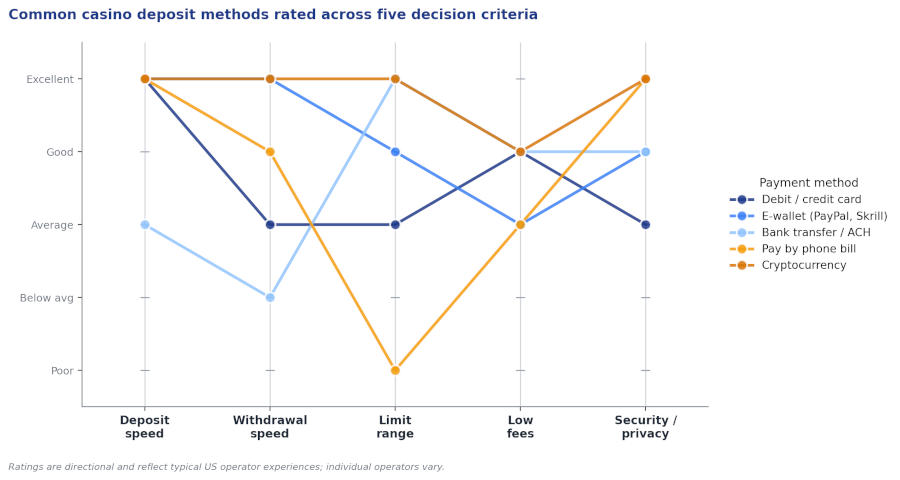
Match your method to the game you play. Fast blackjack sessions or live dealer card games may call for quick deposits and reasonable limits, so compare the available regulated payment methods based on processing time, fees, limits, and security. Poker tournament play needs higher limits for those bigger buy-ins, so bank transfer and e-wallets earn their keep. High-stakes baccarat leans toward bank transfer for the ceiling. Casual $10 sessions? Cards or pay by phone bill are fine.
Two habits worth adopting no matter what method you pick. First, test with a small deposit and small withdrawal before you commit. The real timing and any friction only shows up when you actually run through it. Second, keep a backup method funded and verified. Every method has a bad day sometimes, and a working alternative gets you back to the tables faster.
The payment method rarely makes or breaks your session on its own. But a bad choice can turn a great session into a frustrating one. Spend fifteen minutes thinking through the criteria once, up front, and you're set for as long as your play stays the same. Then you can get back to what you came for: the game.
Disclosure: This article contains sponsored content.
Enjoyed this article?
Join our newsletter to get the latest casino industry articles delivered straight to your inbox.
Related Article Archives: Online Casinos, All Articles
Related Terms & Definitions: Blackjack, Baccarat, Bankroll, Seconds, Capped, Casino, Credit, Dealer, Limits, Player, System, Board, Full Dictionary
Related Posts

Free Spins Under the UK’s 10x Cap: What 100 Spins Is Actually Worth in 2026
Oct 14, 2026 Ilia Gelenidze
Are 100 free spins really worth it? Discover how the UK's new 10x wagering cap changes everything!
Best No Deposit Bonuses at Online Casinos for Players in 2026
Apr 11, 2026 Alex Martin
We compared the real top 15 no deposit offers and deposit welcome bonuses at top casinos, with rollovers, caps, and game rules explained.
What Professional Casino Dealers Can Teach You About Online Gambling
Oct 12, 2026 Mark Ford
Discover the secrets casino dealers know about online gambling, from avoiding costly mistakes to mastering smarter betting decisions.

Corporate Group, Shared Platform or Loyalty Network? How to Tell What Really Connects Two Casinos
Oct 8, 2026 Ilia Gelenidze
Are two casinos really sisters? Discover the surprising differences between shared ownership, platforms, and loyalty networks.
How Casinos Analyzer Helps Players Compare Different Gambling Websites
Oct 5, 2026 Mark Ford
How useful is Casinos Analyzer for comparing gambling websites? A hands-on review examines what players can put side by side before picking a casino.

The Best Casino Free Bonuses to Take Advantage of this Fall
Oct 2, 2026 Sean McNulty
Discover how free chips, spins, no-deposit offers, and more can add extra value to your casino play this fall.
Table of Contents
- # Back to Top
- Speed: How Fast Can You Get Your Money?
- Limits: Does the Method Match Your Stakes?
- Fees: What Is This Costing You?
- Security: How Much of Your Info Sits on the Operator's Server?
- What Your Bank and State Will Actually Let You Do
- Playing Responsibly: How the Method Affects Your Habits
- Putting It Together: A Framework for Card Game Players