
How to Deal Caribbean Stud Poker
Welcome to Caribbean Stud Poker dealer training. As the dealer, you are the conductor of the game: while the players place the wagers, you control the pace, the accuracy, and the security of the table. Caribbean Stud runs on strict protocol, and your proficiency and clear communication are the biggest drivers of the player experience. This guide walks you through the standard procedure from the opening Ante to the final payout.
Brief History
Caribbean Stud Poker is widely credited to 1980s Aruba, where it blended poker hand rankings with house-banked simplicity, though the precise origin is disputed (a similar game, “Casino Poker,” is often attributed to David Sklansky in 1982).
The Table and Equipment
The Caribbean Stud table is built for clarity and efficiency, with a layout similar to a blackjack table that seats several players.
The Deck
A single standard 52-card deck shuffled manually or by an automatic shuffler after every round.
The Betting Areas
Each seat has three areas: the Ante, the Bet (also called the Raise or Call), and a sensor or slot for the optional Progressive Jackpot side bet.
The Progressive Jackpot Display
Most tables include a digital sign showing the current value of the progressive jackpot.
Card Values and Hand Rankings
Caribbean Stud uses standard poker hand rankings, highest to lowest:
- Royal Flush (A-K-Q-J-10 of the same suit)
- Straight Flush
- Four of a Kind
- Full House
- Flush
- Straight
- Three of a Kind
- Two Pair
- One Pair
- High Card
The House Edge
Caribbean Stud Poker offers a higher house edge compared to other table games, making it a profitable game for the casino:
- Average House Edge: Approximately 5.224% on the Ante.
- Jackpot Bet: Significantly higher house edge, varying by the jackpot's size.
The house edge is traditionally defined as the expected loss to the original wager. In Caribbean Stud Poker the optimal strategy player will raise 52.23% of the time, for an average total wager of 2.045 units.
The Object of the Game
Each player is trying to make a five-card poker hand that beats the dealer’s hand. The catch: the dealer must “qualify” for the player to be paid in full on the Raise. You’ll announce and enforce that qualification every hand.
The Bets You’ll Manage
The Ante
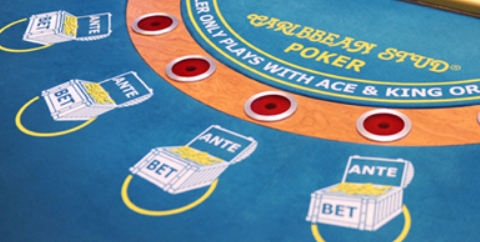
The Ante is the only mandatory bet — a player must post it to be dealt in, anywhere between the table minimum and maximum.
The dealer will scan the layout and verify that all players have finished wagering on their Ante bet. All Ante bets are placed in the Ante wagering area in front of each player. Any Ante wager made after the first card has hit the layout will be returned to the player.
The Ante pays 1:1 whenever the player’s hand beats the dealer’s, whether or not the dealer qualifies. If the player’s hand is identical to the dealer’s, the Ante pushes.
The Raise Bet
After seeing their five cards, each player either folds (forfeiting the Ante) or raises. The Raise must be exactly 2× the Ante — no more, no less. Once raises are set, the hand goes to showdown.
Caribbean Stud Poker — Raise Pay Table
Paid on the Raise when the dealer qualifies and the player wins. Verified against Wizard of Odds (standard US pay table).
| Hand | Payout | What It Is |
|---|---|---|
| Royal Flush | 100:1 | A-K-Q-J-10, same suit |
| Straight Flush | 50:1 | Five sequential cards, same suit |
| Four of a Kind | 20:1 | Four cards of the same rank |
| Full House | 7:1 | Three of a kind plus a pair |
| Flush | 5:1 | Five cards of the same suit |
| Straight | 4:1 | Five sequential cards |
| Three of a Kind | 3:1 | Three cards of the same rank |
| Two Pair | 2:1 | Two separate pairs |
| One Pair or less | 1:1 | A single pair, or high card |
Dealer Qualification
The dealer must hold at least Ace-King high to qualify. Understanding this rule is essential for making informed decisions during the game. After receiving the five cards, the player must decide whether to fold or raise based on their hand’s strength and the dealer’s upcard. When the player believes their hand is strong and the dealer will qualify, they may choose to place a raise bet.
The knowledge of the dealer’s qualifying requirement also affects risk assessment. If the player has a weaker hand but observe that the dealer’s visible card indicates a potential non-qualifying hand, the player might opt to raise, expecting the return of their raise bet along with the Ante payout.
This aspect introduces a strategic element to the game, requiring players to evaluate the likelihood of the dealer qualifying against the strength of their own hand.
The Progressive Jackpot Bet
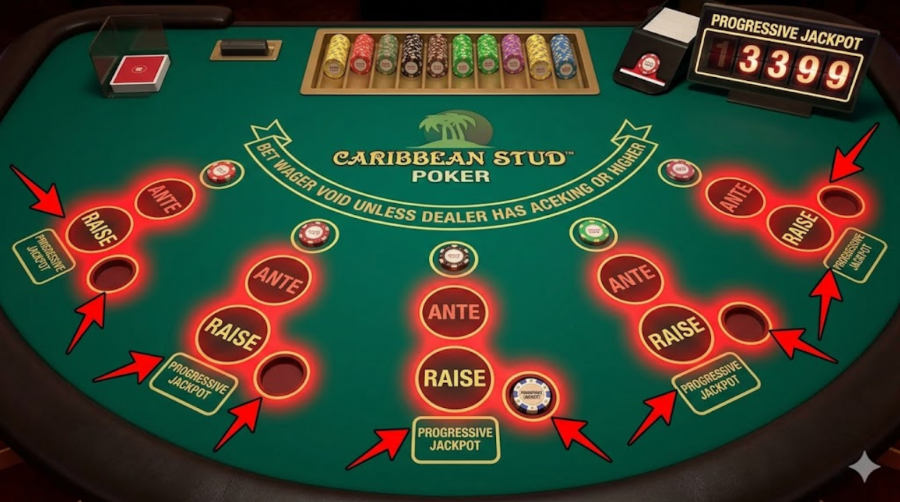
The optional progressive is activated with a flat $1 chip in the jackpot field, regardless of the Ante size. Only $1 may be placed, no higher wager wil be accepted. Before the cards are delivered, the dealer will quickly scan all progressive jackpots to ensure that no bet is over $1. The dealer will then press the Play button on the control panel, locking out any late bets. As the dealer is collecting the $1 wager, make sure the light stays on after the bet has been taken away. If you locked out the bets but one of the lights didn’t turn on for a $1 wager, notify your floor supervisor. All wagers must be placed before the dealer deliers the cards.
The Jackpot is paid on the strength of the player’s five-card hand alone: a royal flush typically wins the full meter, with consolation prizes for lesser hands. The progressive wager is always treated as a side bet and the dealer’s hand has no bearing on the progressive wager outcome.
Regardless of the dealer's hands, if the player's hand has a ranking which qualifies to win the progressive jackpot and the progressive spotlight is lit, the cards will remain spread in front of the player's bet. The floor supervisor will be called over where further instruction will be given.
Typical consolation payouts, which vary by casino; might be $50 for a flush, $100 for a full house, $500 for four of a kind, and 10% of the meter for a straight flush. Because there’s no drawing in Caribbean Stud, these hands are hard to make. When the jackpot is hit, it resets to its seed value (often $10,000 or more).
At the end of each hand, the dealer will press the END button, allowing players the opportunity to bet again on the progressive jackpot.
A Round of Caribbean Stud
Below, we will walk you through a hand of Caribbean Stud Poker, from the moment the player sits down at the table, all the way to the showdown and final payouts.
1. Take the Bets
Call for Antes. Confirm each player who wants in has posted an Ante and collect any $1 progressive side bets before dealing. Make sure the progressive jackpot light is lit up before placing the $1 wager in your bank.
2. Deal the Cards
Taking one hand at a time from the automatic shuffler, the dealer will deliver the cards directly to each player and to the dealer starting from the left and going clockwise to the right. Spread each hand slightly so that your floor supervisor and surveillance can read the number of cards. Any hand found with more or less than 5 cards will void the entire round. An exposed card does not constitute a missed deal. All unused cards will be placed in the discard rack.
The dealer's hand will be placed in front of the tray and slightly spread so the dealer can visually check the number of cards. The dealer's bottom card will then be turned up or exposed. The dealer will then straighten the five cards with the exposed card on top.
3. Players Fold or Raise
Working around the table, each player either folds (you collect the Ante and their cards) or places a Raise of exactly 2× the Ante. Players may look at their own cards but must not reveal or discuss them with others.
After the player has placed a Raise, they will place all of their cards face-down and to the left of the player’s wager.
If the player folds, the Ante bet is lost. The dealer will take the Ante bet and then pick up the player's cards and spread them unexposed, face-down, to verify that there are 5 cards. The cards will then be placed in the discard rack.
4. The Showdown
Once every player has acted, reveal your remaining four cards and read your hand. Determine whether you qualify, then compare your hand to each active player’s.
5. Settle the Bets
Before the dealer pays the Ante, the dealer will check the player's cards and verify if they have a winning Progressive Jackpot or not. They will also verify that all 5 cards are there.
Pay winners and collect from losers per the rules above: Ante at 1:1, Raise per the pay table when you qualify, Raise pushed when you don’t. Pay accurately and announce each payout.
If the player does not have a winning Progressive Jackpot, or if they did not play the jackpot, the dealer will pick up the player's cards and put them in the discard rack.
6. The Progressive Jackpot
Resolve progressive side bets on the player’s five-card hand. Any jackpot or major progressive win must be verified by a supervisor before payment.
The Dealer Qualification Rules
In Caribbean Stud Poker, the dealer’s hand must meet a qualifying criterion for the game to proceed to a showdown. Specifically, the dealer needs at least an Ace-King combination to qualify. This rule is important as it determines whether the player’s raise bet will be evaluated against the dealer’s hand or returned to the player. In precise terms, the lowest qualifying hand is A-K-4-3-2, and the highest non-qualifying hand is A-Q-J-10-9.
If the dealer doesn’t qualify, the player’s Raise bet is returned, and the Ante is paid 1:1 or even money. If the dealer qualifies, the Ante and Raise are settled against the dealer’s hand: the player wins both if their hand is higher, loses both if it’s lower, and on a tie, both the Ante and the Raise push.
The Math
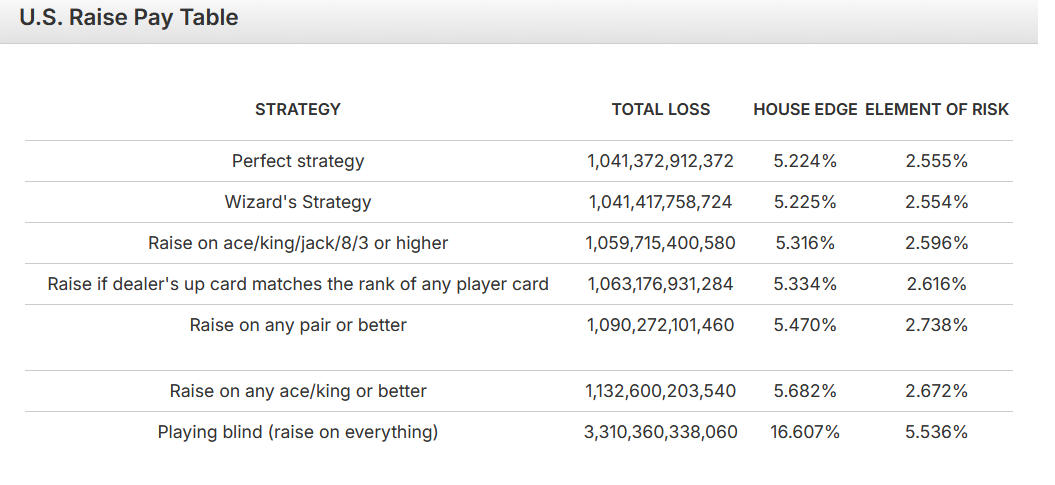
Dealers don’t need the math to run the game, but it helps to understand it. Caribbean Stud carries a house edge of about 5.224% on the Ante. That figure can look harsh, but it’s measured against the Ante alone. Under optimal play a player raises just over half the time (about 52%), so the average amount wagered ends up around twice the Ante; measured against that average wager, the cost is closer to 2.56%. The progressive side bet carries a much higher edge that shrinks only as the meter grows
The following table can be found at the Wizard of Odds website.
Procedural Best Practices
A few habits keep the game clean and professional:
- Accuracy over speed — never rush a payout.
- Run the “Dealer qualifies?” check, out loud, on every single hand.
- Announce payouts clearly to eliminate confusion and build trust.
- Have a supervisor verify every jackpot or major progressive win before paying.
- Keep the deck secure and follow your house’s shuffle and procedure standards.
Conclusion
Dealing Caribbean Stud well comes down to mechanical precision and steady focus. Stick to the qualification rule, announce payouts clearly, and verify jackpots, and you’ll run a smooth, professional game that players trust. With consistent practice, the procedure becomes second nature.
Enjoyed this lesson?
Join our newsletter to get the latest casino industry courses delivered straight to your inbox.
Related Free Learning Hubs: Caribbean Stud Poker, All Hubs
Related Terms & Definitions: Straight Flush, Discard Rack, Royal Flush, Even Money, Full House, House Edge, Blackjack, Late Bets, Showdown, Straight, Deliver, Jackpot, Full Dictionary
Related Courses
How to Play Caribbean Stud Poker
Dec 21, 2025 Daniel Odeyemi
An easy guide on how to play Caribbean Stud Poker with this quick guide. Learn wager placement, hand rankings, winning rules, and optimal gameplay strategies.
Buy Bets vs Place Bets
Jul 17, 2026 Massimo Morana
Learn the difference between buy bets and place bets in craps. Compare payouts, house edge, commission fees, and discover when buy bets are better than place bets.

How to Play Ultimate Texas Hold’Em
Jul 9, 2026 Daniel Odeyemi and Heather Ferris
Learn how to play Ultimate Texas Hold’em: its rules, gameplay structure, and the optimal raise strategy for the best outcome.

Crap Stick Calls
Mar 25, 2026 Daniel Odeyemi and Heather Ferris
We interviewed a veteran dealer with 30+ years of experience to bring you the most authentic craps stick calls. Learn the rhymes and calls used in casinos today.
How to Deal Blackjack
Jul 8, 2026 Heather Ferris
Learn how to deal blackjack with professional dealer training on casino procedures, payouts, table layout, game security, common mistakes, and dealer auditions.

How to Play Big Baccarat
Jun 8, 2026 Massimo Morana
Master Big Baccarat's rules, bets, etiquette, and hidden secrets before stepping into the casino's most prestigious game.
Table of Contents
- # Back to Top
- Brief History
- The Table and Equipment
- Card Values and Hand Rankings
- The House Edge
- The Object of the Game
- The Bets You’ll Manage
- Caribbean Stud Poker — Raise Pay Table
- Dealer Qualification
- The Progressive Jackpot Bet
- A Round of Caribbean Stud
- The Dealer Qualification Rules
- The Math
- Procedural Best Practices
- Conclusion