Series: How to Deal Blackjack • Part 7 of 10
Blackjack Dealer Procedures: Double Down, Split, Insurance & Player Actions
Blackjack Dealer Procedures: Double Down, Split, Insurance & Player Actions
Professional Blackjack Player Action Procedures
Every player's decision creates additional responsibilities for the dealer.
Whether a player doubles down, splits, surrenders, takes insurance, or requests change, dealers must follow standardized casino procedures designed to protect the integrity of the game while keeping play accurate, consistent, and easy to read.
This guide explains the professional procedures used in casinos, along with practical advice from Heather Ferris based on her firsthand experience dealing blackjack.
In This Guide
Whether you're preparing for dealer school, practicing for a casino audition, or learning professional blackjack procedures, this guide covers how dealers handle every major player action.
- Why Player Action Procedures Matter
- Double Down Procedures
- Shoe Games
- Handheld Games
- Doubling for Less
- Hard 12 or Higher
- Split Procedures
- Surrender Procedures
- Blackjack Payout Procedures
- Insurance
- Even Money
- Single Deck Procedures
- Making Change
- Cheque Change
- Heather's Professional Dealer Tips
- Dealer Audition Tips
- Common Beginner Dealer Mistakes
- Frequently Asked Questions
Common Player Actions in Blackjack
Professional blackjack dealers routinely handle the following player actions:
- Hit
- Stand
- Double Down
- Split
- Surrender
- Insurance
- Even Money
- Blackjack Payouts
- Making Change
- Cheque Change
Each action follows casino procedures designed to support fairness, accuracy, and game security. Exact rules and procedures can vary by casino, so dealers should always follow their property's house procedures.
Why Casinos Standardize Player Actions
Player decisions happen quickly, but dealers must respond correctly every time.
Casinos require standardized procedures because every action can affect wagers, payouts, surveillance, and game security.
Game Security
Consistent procedures reduce dealer mistakes and make unusual or incorrect actions easier for supervisors and surveillance to identify.
Protecting the Players
Following the same process helps ensure wagers and payouts are handled fairly and consistently.
Protecting the Dealer
Using approved procedures protects dealers during disputes and makes transactions easier to verify.
Surveillance Requirements
Casino cameras rely on readable chip movements, clear hand signals, and consistent procedures when reviewing a game.
Professional Efficiency
The more consistent a dealer's routine becomes, the easier it is to become faster without sacrificing accuracy.
Double Down
Double Down on a Shoe Game
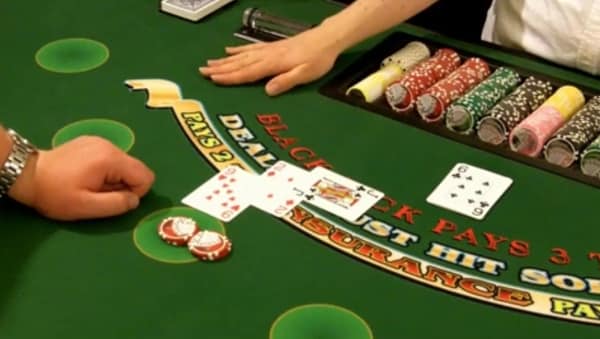
The double down card is delivered face up and perpendicular to the last card in the hand.
Doubling Down on a Handheld Game
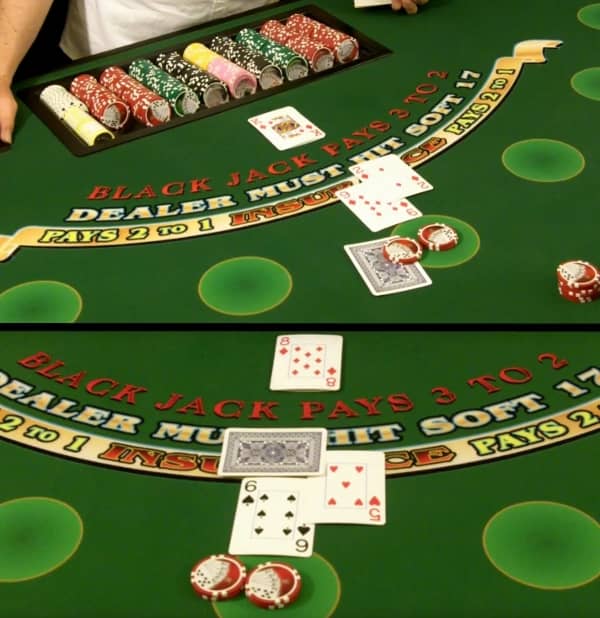
There are two ways to deliver a double down card on a handheld game. The first and most popular way is to place the hit card face down under the player's double down bet.
The second way to deliver the card is face down and perpendicular to the last card.
Doubling for Less
It is an abnormal move, so you must give an alert call to your floor by calling out, "Doubling for less."
If the player wins, make sure you pay each bet individually.
Doubling on a Hard 12 or Higher
This is another unusual move that players may make when they are counting cards.
Always verify the player's decision before you call out, "Doubling on a hard 12."
Always deliver the card face up because if the player busts, the bet must be immediately taken.
Splitting
Make sure the player does not bet less than their original bet.
When one hand is a win and one hand is a loss, pay or take each bet individually. Don't simply leave the wagers in place. Each transaction should be clear and readable for the cameras.
On a handheld game, a split must be dealt face up. The player must use the same hand signals that they would on a shoe game.
Depending on the casino, a player may or may not be allowed to double down after a split.
Heather's Dealer Tip: Splitting Aces
At some casinos, split aces receive only one card each, so make sure you know the house rules. When delivering that card, turn it diagonally without covering the pips. A pip is one of the hearts, clubs, diamonds, or spades printed on the card. The pips should remain visible so floor supervisors can identify the value of the cards from across the pit.
Heather's Dealer Tip: Multiple Player Actions
New dealers can become overwhelmed when several players split or double down during the same hand because the table suddenly looks much more chaotic. Slow down and complete one player's hand at a time. The cards will fit on the table. Follow the same procedure every time and remember that accuracy comes before speed.
Surrender
Surrender is available at some casinos.
The player will announce "Surrender" and use their fingers to draw a line behind their bet.
Take the player's bet and place it in the center-left portion of the table. Then, using clean money, put up half the amount of the wager.
Place it on the center-right portion of the table where the cameras can clearly see the transaction. Then place the clean money in the betting circle.
Pick up the cards and place them in the discard rack.
If you have an ace up card, do not allow surrender until you've checked to see whether you have blackjack. The player cannot surrender if the dealer has blackjack.
Blackjack Payout Procedures
If a player gets a blackjack, they are paid according to the blackjack payout offered by that particular table.
A traditional 3:2 blackjack pays one and a half times the player's original wager. As soon as the bet has been paid, the cards should be placed in the discard rack.
When paying a 3:2 blackjack, the calculation is easier than it may initially appear: pay the amount of the original wager plus half of that amount.
See the complete Blackjack Payout Chart.
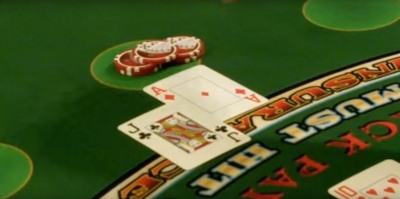
There are two ways to pay a blackjack. The first and most popular way is to bridge the payoff.
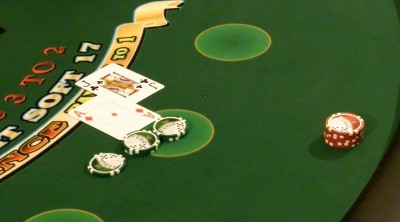
The second method is to place the payoff next to the original bet and then place the bonus amount next to the payoff.
Never alter or convert any part of the player's original bet.
If there is a tip wager for the dealer, that wager receives the applicable blackjack payout as well.
Insurance
When you show an ace up card, turn the card sideways and offer "Insurance" while running your hand over the full length of the insurance line.
Give the players time to decide whether they want insurance without unnecessarily slowing down the game.
Players must place their insurance wagers on the insurance line for the wager to be valid.
The dealer must also verify that the player has not exceeded the maximum insurance wager, which is one-half of the original bet.
When everyone has decided, run your hand back across the insurance line while saying, "Insurance is closed."
This protects the game by creating a clear point at which insurance wagering has ended.
Heather's Dealer Tip: Insurance
When offering insurance, clearly open the bet by running your hand across the insurance line and give players time to make their decision. When everyone is finished, run your hand back across the line and clearly say, "Insurance is closed." This creates a clear end to the betting period and makes it harder for someone to claim they intended to take insurance after the dealer's hand has already been checked.
Even Money
If a player has a blackjack and insists on taking insurance, explain that taking "Even Money" accomplishes the same result.
If you have an ace up card and the player has blackjack, ask the player if they want even money.
If the player says yes, before looking at your hole card, pay 1:1 on the player's original bet.
Take the cards and place them into the discard rack, and then check the hole card.
The total amount of insurance wagers can be combined and placed on the insurance line in the middle according to house procedure.
Single Deck
You only have one cut card that must be placed on the bottom of the deck, so dealers need to know when to shuffle.
You don't want to run out of cards in the middle of a hand.
Dealers may be given a formula determining how many hands can be dealt before shuffling based on the number of players at the table.
Under the procedure described here:
- With 1 player, deal 5 hands before shuffling.
- With 2 players, deal 4 hands.
- With 3 players, deal 3 hands.
- With 4 or more players, deal 2 hands before shuffling.
Always follow the procedures used by your casino.
Some single-deck blackjack games pay 6:5 rather than 3:2. At a 6:5 table, every $5 of a qualifying blackjack wager pays $6.
Dealer tip wagers receive the applicable blackjack payout as well.
If the player's wager contains an amount that isn't divisible by five, follow the casino's established procedure for handling the odd amount.
On many single-deck games, there is no mid-deck entry. This means new players cannot begin playing until the dealer shuffles the deck.
Some casinos may also restrict double downs to totals such as 9, 10, or 11 or prohibit doubling after a split.
Because these rules vary considerably, dealers must know the rules of the specific game they are dealing.
Making Change
Dealers complete change procedures many times during a shift.
Making change involves exchanging currency for an equivalent value in casino cheques.
Cash Change
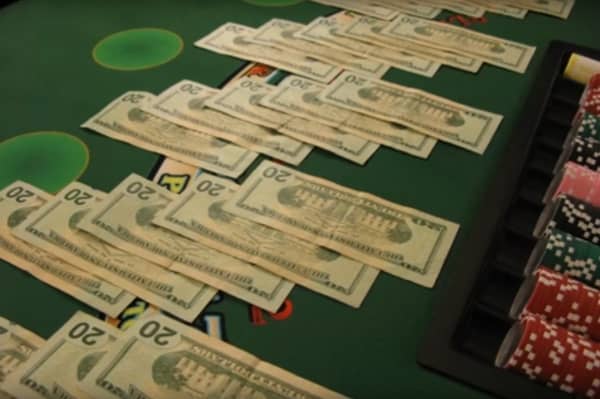
When a player hands you money, you need to exchange it for cheques.
Take the cash and spread it across the left side of the table with the backs of the bills facing up. Keep all bills facing the same direction and separate the different denominations.
Under the procedure described here, alert the floor by calling out, "Change $100," for a transaction of $100 or more.
The floor needs to track how much money is dropped, which is why the alert call is important.
Take out the appropriate cheques, cut them, and verify the amount.
Take your hand away from the cheques and pause briefly so the cameras have a clear view of the transaction.
Stack the cheques and give them to the player.
When handing cheques to a player, never conceal the cheques in a closed fist or between both hands.
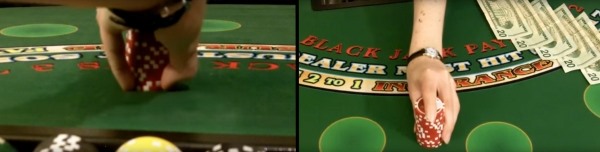
Slide the stack using the bottom fingers to move it while the forefinger keeps the stack steady.
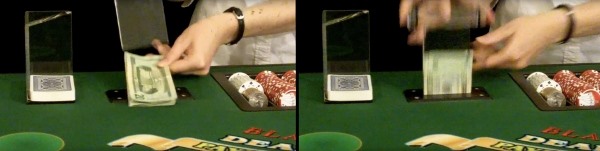
Once the player has all of their cheques, pick up the currency with your left hand.
Using your right hand, pick up the paddle, place the money over the hole, and slide the paddle in to drop the currency into the drop box.
Never drop the cash into the drop box before handing the player their cheques.
There is also a specific way to break down currency on the table:
- $1 bills are placed in rows of five, making each column worth $5.
- $5 bills are placed in rows of five, making each column worth $25.
- $10 bills are placed in rows of five, making each column worth $50.
- $20 bills are placed in rows of five, making each column worth $100.
- $100 bills are placed in rows of five, making each column worth $500.
Place the currency lengthwise and use the paddle to slide it into the drop box.
If you have a large sum of money, the following technique can help move the cash into the drop box:

Cheque Change
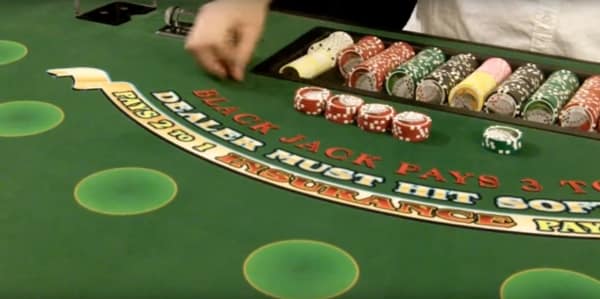
When a player hands you a high-value cheque, you may need to exchange it for smaller-denomination cheques.
Take the cheque and place it on the left side of the table.
Take out the appropriate lower-denomination cheques, bring them to the right of the center of the table, and size into them while verifying the correct amount.
Under the procedure described here, call out, "Cheque Change $100," and wait for approval.
Once approved, slide the stack of cheques to the player.
Then pick up the original cheque and place it in the rack.
Never put the original cheque into the rack before giving the player their change.
Do not drop a cheque from your casino into the drop box. Place it in the rack instead. Foreign cheques may be handled differently according to casino procedure.
Blackjack Dealer Audition Tips
Practice Common Blackjack Payouts
Everyone learns differently, so choose the practice method that works best for you.
You can practice with friends at home while dealing the game to them.
You can also use the Blackjack Math Worksheet and Blackjack Math Worksheet Answer Key.
For additional payout practice, use the 3 to 2 Blackjack Payout Flashcards or 6 to 5 Blackjack Payout Flashcards.
The goal is repetition until common blackjack payouts become familiar.
Learn Insurance Procedures Thoroughly
Practice opening and closing insurance exactly the same way every time.
During an audition, clear hand movements and verbal calls help demonstrate that you understand both the wager and the game-protection procedures surrounding it.
Practice Split Hands With Multiple Players
Don't practice only simple one-player hands.
Set up rounds where multiple players split, double down, or make different decisions. This helps you learn to complete one hand at a time without losing track of the table.
Develop Consistent Chip Handling
Muscle memory takes hours of practice.
Some dealers experience stage fright during an audition, which is why repeated chip-handling practice is so valuable.
Familiar movements are easier to perform even when you're nervous.
Visit the Casino Before Your Audition
Visit the casino before your audition and observe how its blackjack games are dealt.
Watch the shuffle procedures, table rules, hand signals, payouts, and other house-specific procedures.
You can also talk with dealers who already work there. It's okay to mention that you'll be auditioning and ask whether they have general tips about the property's procedures.
Common Beginner Dealer Mistakes
Every dealer makes mistakes while learning.
Strong dealers develop consistent habits that make player decisions easier to manage.
Some common beginner mistakes include:
- Forgetting alert calls
- Incorrect blackjack payouts
- Misreading insurance wagers
- Paying split hands incorrectly
- Rushing when several players make different decisions
- Mishandling even money
- Forgetting casino-specific procedures
- Poor chip placement
- Blocking surveillance with your hands
- Sacrificing accuracy for speed
Consistency and repetition help reduce these mistakes over time.
Frequently Asked Questions
What player actions does a blackjack dealer need to know?
Blackjack dealers need to know how to handle hits, stands, double downs, splits, surrender, insurance, even money, blackjack payouts, cash change, and cheque change. Dealers also need to know the specific rules and procedures used by their casino.
How does a blackjack dealer handle a double down?
The exact procedure depends on whether the game is dealt from a shoe or handheld deck and on the casino's house rules. In a shoe game, the double-down card is typically delivered face up and perpendicular to the previous card. Dealers should also know the procedures for unusual actions such as doubling for less.
How do blackjack dealers handle split hands?
Dealers should verify the additional wager, follow the casino's rules for dealing each split hand, and resolve each wager individually. House rules may differ regarding split aces, resplitting, and doubling after a split.
How much can a player wager on blackjack insurance?
Insurance is generally limited to one-half of the player's original wager. The dealer should verify that the insurance wager does not exceed the allowed amount and follow the casino's procedure for opening and closing insurance.
What is even money in blackjack?
Even money may be offered when a player has blackjack and the dealer shows an ace. If the player accepts even money, the original blackjack wager is paid 1:1 before the dealer checks the hole card, according to the casino's procedure.
Why do blackjack dealers use alert calls?
Alert calls notify floor supervisors about certain transactions or unusual player actions. Examples in this guide include calls for doubling for less, unusual double downs, cash change, and cheque change. Exact alert requirements vary by casino.
What should I practice before a blackjack dealer audition?
Practice blackjack payouts, insurance, split and double-down procedures, chip handling, hand signals, and common alert calls. Repetition helps build the muscle memory needed to remain accurate when you're nervous.
Do blackjack procedures vary by casino?
Yes. Rules and procedures can differ between casinos, including surrender, split aces, doubling after splits, single-deck rules, alert calls, and other game-protection procedures. Dealers should always learn the house rules for the property where they work.
Enjoyed this lesson?
Join our newsletter to get the latest casino industry courses delivered straight to your inbox.
Series
How to Deal Blackjack
Part 7 of 10
Related Free Learning Hubs: Blackjack, All Hubs
Related Terms & Definitions: Center of the Table, Foreign Cheques, Betting Circle, Insurance Line, Discard Rack, Clean Money, Double Down, Single Deck, Even Money, Blackjack, Down Card, Face Down, Full Dictionary
Related Courses
How to Deal Blackjack
Jul 8, 2026 Heather Ferris
Learn how to deal blackjack with professional dealer training on casino procedures, payouts, table layout, game security, common mistakes, and dealer auditions.
How to Play Blackjack
Aug 8, 2020 Heather Ferris
Learn how to play blackjack step-by-step with this simple beginner guide. Understand rules, card values, and gameplay in minutes, plus tips to avoid common mistakes.

How to Deal Casino Party: Blackjack
Learn how to deal blackjack for casino parties, including dealer procedures, game protection, readability, muscle memory, and essential practice skills.

Partnerships that keep the cards on the felt
Jan 6, 2026 Heather Ferris
Here is an overview of the sponsored products and advertising options available through Vegas-Aces.

How to Deal Caribbean Stud Poker
Aug 16, 2026 Alessandro Cinà and Heather Ferris
A dealer’s guide to running Caribbean Stud Poker: the table layout, hand rankings, the Ante and raise, dealer qualification, payouts, and a step-by-step deal.

Crap Stick Calls
Mar 25, 2026 Daniel Odeyemi and Heather Ferris
We interviewed a veteran dealer with 30+ years of experience to bring you the most authentic craps stick calls. Learn the rhymes and calls used in casinos today.
Table of Contents
- # Back to Top
- Blackjack Dealer Procedures: Double Down, Split, Insurance & Player Actions
- Professional Blackjack Player Action Procedures
- In This Guide
- Common Player Actions in Blackjack
- Why Casinos Standardize Player Actions
- Double Down
- Splitting
- Surrender
- Blackjack Payout Procedures
- Insurance
- Even Money
- Single Deck
- Making Change
- Cheque Change
- Blackjack Dealer Audition Tips
- Common Beginner Dealer Mistakes
- Frequently Asked Questions
Series Navigation
Part 7 of 10
- Part 5: Blackjack Dealer Procedures: Handling Cheques & Playing the Game
- Part 6: Blackjack Dealer Procedures: Taking Bets, Paying Winners & Managing the Table
Part 7: Blackjack Dealer Procedures: Double Down, Split, Insurance & Player Actions
Current article
- Part 8: Blackjack Dealer Procedures: Color Ups, Money Plays & Casino Floor Calls
- Part 9: Blackjack Dealer Procedures: Markers, Fills, Credits, Breaks & Tokes