
Series: How to Deal Blackjack • Part 6 of 10
Blackjack Dealer Procedures: Taking Bets, Paying Winners & Managing the Table
Blackjack Dealer Procedures: Taking Bets, Paying Winners & Managing the Table
Professional Take & Pay Procedures
One of the most important responsibilities of a blackjack dealer is handling wagers accurately.
Every winning payment, losing bet, chip conversion, and card collection follows a specific sequence designed to protect the integrity of the game while allowing surveillance, supervisors, and players to clearly follow every transaction.
In this guide, you'll learn the professional Take & Pay procedures used in casinos, along with practical advice from Heather Ferris based on her firsthand experience as a blackjack dealer.
In This Guide
Whether you're preparing for dealer school, practicing for a casino audition, or learning professional blackjack procedures, this guide covers how dealers manage wagers, payouts, chips, cards, and game flow.
- Why the Take & Pay Procedure Matters
- Understanding the Take & Pay Procedure
- Paying Winning Bets
- Collecting Losing Bets
- Color for Color Exchanges
- Converting Cheques
- Dirty Money
- Reading the Rack
- Working Out of the Rack
- Picking Up Cards in Order
- Picking Up Cards on a Handheld Game
- Using the Discard Rack
- Heather's Professional Dealer Tips
- Blackjack Dealer Audition Tips
- Common Beginner Take & Pay Mistakes
- Frequently Asked Questions
How Blackjack Dealers Handle Winning and Losing Bets
Professional blackjack dealers generally follow this sequence:
- Verify the final outcome of every hand.
- Collect losing wagers and pay winning bets accurately according to the casino's procedures.
- Collect the cards in the proper order.
- Organize the rack as needed.
- Prepare the table for the next round.
The exact procedures can vary by casino, so dealers should always follow the house procedures where they work.
Why Casinos Follow a Strict Take & Pay Procedure
Casinos don't allow dealers to pay and collect bets in any order they choose. The Take & Pay procedure creates consistency, reduces mistakes, and protects everyone involved in the game.
Game Security
Following the same procedure every hand helps reduce dealer errors and makes unusual or incorrect transactions easier for supervisors and surveillance to identify.
Protecting the Players
Clearly paying winners and collecting losing bets helps ensure every wager is handled fairly and transparently.
Protecting the Dealer
A consistent routine protects dealers from payout disputes and makes it easier to explain or review a transaction if questions arise.
Surveillance Requirements
Casino cameras monitor the gaming tables and chip movements. Clear, consistent procedures make transactions easier for surveillance and floor supervisors to review.
Professional Efficiency
Once dealers develop good habits, the Take & Pay procedure allows the game to move efficiently without sacrificing accuracy.
Heather's Dealer Tip
Correct, accurate payouts matter more than speed. If you rush and make a mistake, it can take far longer to call over a floor supervisor and correct the problem than it would have taken to deal at a steady pace and make the correct payout the first time. Casinos prefer an accurate dealer over a fast dealer who regularly makes mistakes.
Taking and Paying Bets
The Take & Pay Procedure will be performed many times per shift whenever a dealer wins or loses.
Always start at the bet furthest to the right and work toward the left. Compare each player's cards to the dealer's cards one hand at a time before moving to the next hand.
Always look at the player's cards again and mentally double-check the hand before taking or paying the wager.
Consistency is important. Developing the habit of following the same process every hand helps prevent mistakes, especially when the table becomes busy.
If the Player Loses
Take the money first, collecting as many cheques as you can comfortably hold, and then put them in your rack.
After all bets have been resolved, pick up the cards. Sort the cheques after the cards have been placed in the discard rack.
Never sort through the cheques on the table.
If the Player Wins
Pay the bet first.
There are two primary ways of paying the bet: Color for Color or Converting the cheques.
Pay all bets in the betting circle, and make sure the payoff touches the winning wager. Double-down and split wagers may be paid outside the circle for clarity.
After all bets have been resolved, pick up the cards.
Heather's Dealer Tip
Don't rush payouts. New dealers often worry about being fast, but supervisors care much more about consistency and accuracy. It takes more time to correct an incorrect payout than it does to pay the wager correctly the first time.
Color for Color
"Color for Color" means paying a uniform stack of cheques using the same color and the same number of cheques as the player's wager.
Never unnecessarily touch or rearrange the player's cheques while paying Color for Color.
There are situations where Color for Color may not be appropriate. For example, a player may already have a large stack or multiple stacks of the same denomination. In that situation, converting the payout may make more sense.
When you have the choice between Color for Color and a conversion, Color for Color is generally the preferred option for break-in dealers because it keeps the transaction straightforward and easy to read.
Never throw or slide cheques toward a player.
If an incorrect amount is paid, do not leave part of the payoff with the player. Bring the entire payoff back to the tray and return with the correct amount.
When making payoffs:
- Do not pass cheques from one hand to the other.
- Make the payoff on the side of the wager.
- Never pay behind the wager.
- Never pay on top of the cards.
- Only touch the player's bet when necessary, such as straightening a stack before dealing, reading a wager over five cheques, or breaking down a multi-color bet.
Converting Cheques
Converting cheques means paying a wager with a larger denomination when the player has multiple cheques of the same color.
Make sure you're comfortable with conversions before attempting them, and convert only when necessary.
For example, if you give a player $50 but forget to take back $10 during a conversion, you've overpaid the player. Besides costing the casino money, an incorrect conversion can make the transaction appear suspicious.
Do not convert a player into $500 denominations or higher without the floor supervisor's consent.
Conversions may be appropriate when:
- The dealer's rack is very low on a particular denomination and is waiting for a fill.
- The player is betting more than five cheques of one color.
- The player has accumulated a large number of cheques of one denomination.
Dirty Money
"Dirty money" refers to cheques that were previously in play and have just been collected from losing wagers.
Never pay a winning wager with dirty money.
Instead, put the collected cheques into the appropriate tube in the rack and make the payout using "clean money," meaning cheques taken from the rack that were not collected from another wager during that hand.
Keeping collected and payout cheques separate makes transactions easier to follow if a wager is questioned. Because supervisors and surveillance understand the dealer's collection procedure, maintaining the correct order can help reconstruct what happened.
The Rack
Working Out of the Rack
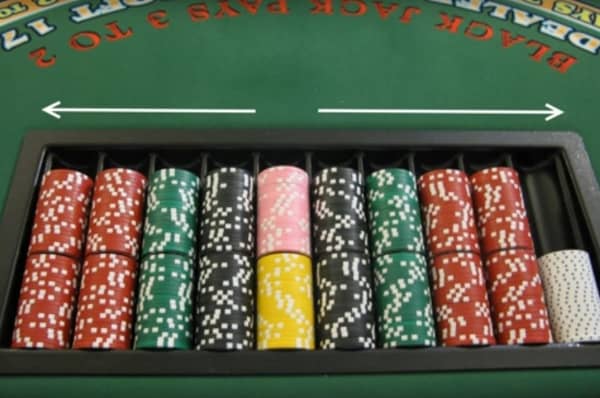
Always use the tube of a particular color that is furthest from the center.
If you use your right hand to pay the right side of the table, use the right side of the rack. The same principle applies when paying with your left hand.
Start with the outside tubes and work your way inward. Cheques can be reorganized within the rack as needed to keep the bank orderly and readable.
Reading the Rack
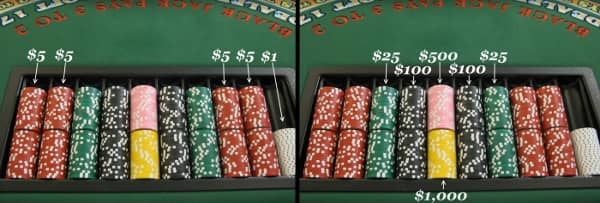
Each tube holds one denomination.
Smaller denominations are generally kept toward the outside, while larger denominations are placed toward the middle where the dealer can better protect them.
Never store cheques in a random or assorted order. Keep the rack organized according to the casino's procedures.
Place a separator between each stack of 20 cheques of the same color to make the rack easier to read.
Heather's Dealer Tip: Building Confidence
One of the best ways to become comfortable handling multiple wagers is to practice at home. Invite a few friends over and have them talk, tell jokes, and create normal distractions while you deal blackjack. Practice keeping track of the cards and making the correct Take & Pay decisions while maintaining a conversation. Learning to stay accurate around people you trust can help prepare you for the distractions of a live casino table.
The Cards
Picking Up the Cards in Order
How you pick up the cards is important.
There may be times when a player disputes a hand and the floor supervisor needs to reconstruct, or "run back," the cards. For that review to work, the dealer must have collected the cards in the proper order.
A dealer should never run back the cards on their own.
Start by picking up the dealer's cards so they are on top of the stack. This allows the dealer's cards to be the first ones out if the hand is reconstructed.
Some casinos use a different procedure and require the dealer's cards to be on the bottom of the stack, so always learn and follow your casino's house rules.
Next, starting with the hand furthest to the right, pick up the cards from right to left.
Use your thumb and forefinger to catch the cards as you slide in the direction of the cards. Hold the cards at an angle so the bottom-left corner sweeps underneath the next card while moving diagonally.
Place the cards into the discard rack.
Picking Up the Cards on a Handheld Deck
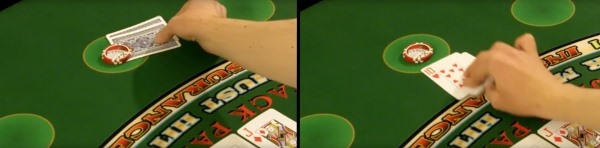
Because the cards are face down in a handheld game, dealers need to follow the proper collection procedure.
Start with the player on your right and work toward the left.
Grab the tops of the cards and flip them from top to bottom. Do not roll the cards over using the deck hand.
Lay the cards in front of the player's wager in the correct position, then complete the Take & Pay Procedure before moving to the next hand.
Discard Rack
When the shoe is finished, remove the remaining cards. Turn the undealt portion of the deck 180 degrees and place it in a random location in the discard rack according to house procedure.
Blackjack Dealer Audition Tips
Casino dealer auditions are an opportunity to demonstrate more than speed. Management is watching whether you can deal a clean, accurate, readable game.
Practice Common Blackjack Payouts
Practice at home before going to an audition.
If auditions make you nervous, one option is to apply first at casinos where you're less interested in working. This gives you experience with the audition process before applying to the casino where you most want to work.
Learn Chip Values by Sight and Touch
Practice handling and cutting different chip denominations until the movements become comfortable.
It is especially helpful to practice cutting a stack of 20 while concentrating on accurately cutting the first stack into four or five cheques, depending on the denomination and exercise you're practicing.
Develop a Consistent Take & Pay Routine
Pay Color for Color rather than attempting unnecessary conversions during an audition.
You want to show management that you can size into the bet and deal a clean game. Keep your movements clear, concise, and readable to the floor, players, and cameras.
Enjoyed this lesson?
Join our newsletter to get the latest casino industry courses delivered straight to your inbox.
Series
How to Deal Blackjack
Part 6 of 10
Related Free Learning Hubs: Blackjack, All Hubs
Related Terms & Definitions: Color for Color, Betting Circle, Discard Rack, Clean Money, Dirty Money, Collection, Blackjack, Face Down, Audition, Break-in, Position, Casino, Full Dictionary
Related Courses
How to Deal Blackjack
Jul 8, 2026 Heather Ferris
Learn how to deal blackjack with professional dealer training on casino procedures, payouts, table layout, game security, common mistakes, and dealer auditions.
How to Play Blackjack
Aug 8, 2020 Heather Ferris
Learn how to play blackjack step-by-step with this simple beginner guide. Understand rules, card values, and gameplay in minutes, plus tips to avoid common mistakes.

How to Deal Casino Party: Blackjack
Learn how to deal blackjack for casino parties, including dealer procedures, game protection, readability, muscle memory, and essential practice skills.

How to Deal Caribbean Stud Poker
Aug 16, 2026 Alessandro Cinà and Heather Ferris
A dealer’s guide to running Caribbean Stud Poker: the table layout, hand rankings, the Ante and raise, dealer qualification, payouts, and a step-by-step deal.
Buy Bets vs Place Bets
Jul 17, 2026 Massimo Morana
Learn the difference between buy bets and place bets in craps. Compare payouts, house edge, commission fees, and discover when buy bets are better than place bets.

Crap Stick Calls
Mar 25, 2026 Daniel Odeyemi and Heather Ferris
We interviewed a veteran dealer with 30+ years of experience to bring you the most authentic craps stick calls. Learn the rhymes and calls used in casinos today.
Table of Contents
- # Back to Top
- Blackjack Dealer Procedures: Taking Bets, Paying Winners & Managing the Table
- Professional Take & Pay Procedures
- In This Guide
- How Blackjack Dealers Handle Winning and Losing Bets
- Why Casinos Follow a Strict Take & Pay Procedure
- Taking and Paying Bets
- If the Player Loses
- If the Player Wins
- Color for Color
- Converting Cheques
- Dirty Money
- The Rack
- The Cards
- Discard Rack
- Blackjack Dealer Audition Tips
Series Navigation
Part 6 of 10
- Part 4: Blackjack Dealer Procedures: Delivering Cards, Pitching, and Tucking the Hole Card
- Part 5: Blackjack Dealer Procedures: Handling Cheques & Playing the Game
Part 6: Blackjack Dealer Procedures: Taking Bets, Paying Winners & Managing the Table
Current article
- Part 7: Blackjack Dealer Procedures: Double Down, Split, Insurance & Player Actions
- Part 8: Blackjack Dealer Procedures: Color Ups, Money Plays & Casino Floor Calls