
Craps Payout Chart: Every Bet, Odds & Payout Explained
Craps payouts can seem a bit technical or overwhelming to master because there are multiple odds ratios. They vary based on the specific number rolled. Different bets pay at different odds, and some must be placed in specific increments. However, dealers have mastered calculating craps payouts quickly, and you can too.
This Vegas-Aces’ guide explains craps payouts the way casino dealers actually calculate them at the table. For easy reference, we will provide you with the craps payout chart details.
We’ve made a printable PDF with all the craps payouts, bet increments, and house edges to download and use:
Disclaimer: Every casino is different and some casinos will pay different odds than other casinos. Make sure you know your house rules.
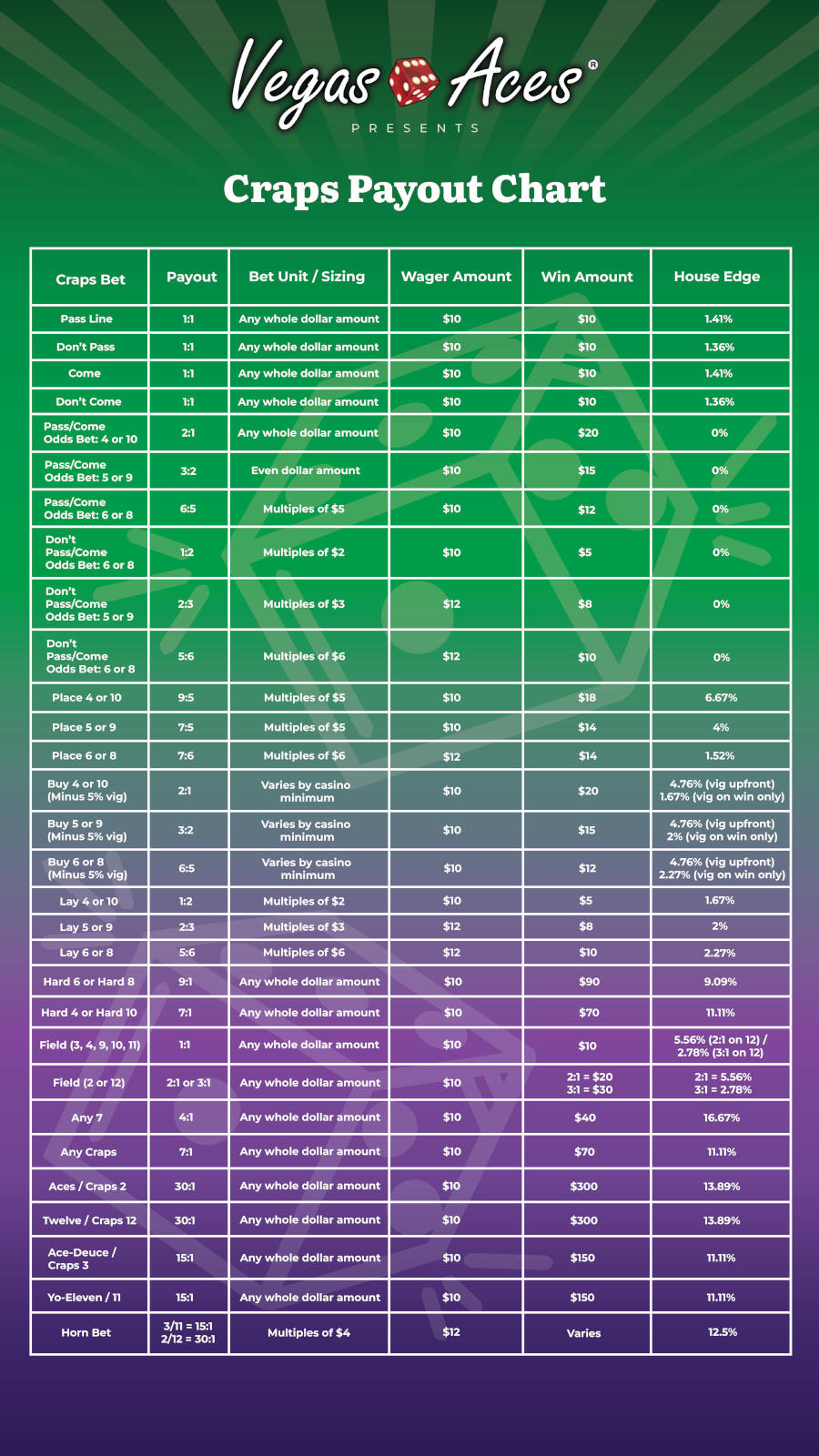
Craps Payout Chart
Check out this craps payout chart to see what your bets will pay.
| Craps Bet | Payout | Bet Unit / Sizing | Wager Amount | Win Amount | House Edge |
|---|---|---|---|---|---|
| Pass Line | 1:1 | Any whole dollar amount | $10 | $10 | 1.41% |
| Don’t Pass | 1:1 | Any whole dollar amount | $10 | $10 | 1.36% |
| Come | 1:1 | Any whole dollar amount | $10 | $10 | 1.41% |
| Don’t Come | 1:1 | Any whole dollar amount | $10 | $10 | 1.36% |
| Pass/Come Odds Bet: 4 or 10 | 2:1 | Any whole dollar amount | $10 | $20 | 0% |
| Pass/Come Odds Bet: 5 or 9 | 3:2 | Multiples of $2 | $10 | $15 | 0% |
| Pass/Come Odds Bet: 6 or 8 | 6:5 | Multiples of $5 | $10 | $12 | 0% |
| Don't Pass/Come Odds Bets: 4 or 10 | 1:2 | Multiples of $2 | $10 | $5 | 0% |
| Don't Pass/Come Odds Bets: 5 or 9 | 2:3 | Multiples of $3 | $12 | $8 | 0% |
| Don't Pass/Come Odds Bets: 6 or 8 | 5:6 | Multiples of $6 | $12 | $10 | 0% |
| Place 4 or 10 | 9:5 | Multiples of $5 | $10 | $18 | 6.67% |
| Place 5 or 9 | 7:5 | Multiples of $5 | $10 | $14 | 4% |
| Place 6 or 8 | 7:6 | Multiples of $6 | $12 | $14 | 1.52% |
| Buy 4 or 10 (Minus 5% vig) |
2:1 | Varies by casino minimum | $10 | $20 | 4.76% (vig upfront) 1.67% (Vig on win only) |
| Buy 5 or 9 (Minus 5% vig) |
3:2 | Varies by casino minimum | $10 | $15 | 4.76% (vig upfront) 2% (Vig on win only) |
| Buy 6 or 8 (Minus 5% vig) |
6:5 | Varies by casino minimum | $10 | $12 | 4.76% (vig upfront) 2.27% (Vig on win only) |
| Lay 4 or 10 | 1:2 | Multiples of $2 | $10 | $5 | 1.67% |
| Lay 5 or 9 | 2:3 | Multiples of $3 | $12 | $8 | 2% |
| Lay 6 or 8 | 5:6 | Multiples of $6 | $12 | $10 | 2.27% |
| Hard 6 or Hard 8 | 9:1 | Any whole dollar amount | $10 | $90 | 9.09% |
| Hard 4 or Hard 10 | 7:1 | Any whole dollar amount | $10 | $70 | 11.11% |
| Field (3, 4, 9, 10, 11) | 1:1 | Any whole dollar amount | $10 | $10 | 5.56% (2:1 on 12) / 2.78% (3:1 on 12) |
| Field (2 or 12) | 2:1 or 3:1 | Any whole dollar amount | $10 | 2:1 = $20 3:1 = $30 |
2:1 = 5.56% 3:1 = 2.78% |
| Any 7 | 4:1 | Any whole dollar amount | $10 | $40 | 16.67% |
| Any Craps | 7:1 | Any whole dollar amount | $10 | $70 | 11.11% |
| Aces / Craps 2 | 30:1 | Any whole dollar amount | $10 | $300 | 13.89% |
| Twelve / Craps 12 | 30:1 | Any whole dollar amount | $10 | $300 | 13.89% |
| Ace-Deuce / Craps 3 | 15:1 | Any whole dollar amount | $10 | $150 | 11.11% |
| Yo-Eleven / 11 | 15:1 | Any whole dollar amount | $10 | $150 | 11.11% |
| Horn Bet | 3/11=15:1 2/12=30:1 | Multiples of $4 | $12 | Varies | 12.5% |
Reading the Chart
- Bet Unit / Sizing refers to the dollar amount of increments you need to bet on specific wagers so that the casino pays you full payout odds. Casinos do not like to deal in loose change or fractional chips. They prefer to pay you in bets, and they pay the nearest whole dollar.
- Place 6 & 8: Always bet in $6 increments, i.e ($6, $12, $18, $30, etc.)
- Place 4, 5, 9, 10: Always bet in $5 increments. I.e ($5, $10, $15, $20, etc.)
- Lay 4 & 10: Always bet in $2 increments, i.e ($10, $12, $14, $16, $18, $20, etc.)
- Lay 5 & 9: Always bet in $3 increments ($6, $9, $12, $15, etc)
- Lay 6 & 8: Always bet in $6 increments ($6, $12, $18, $30, etc.)
- Horn Bet (2, 3, 11, 12): Always bet in $4 increments ($4, $8, $12, $16, etc)
On Buy bets, casinos charge a 5% commission (vig) either up front or on wins only, depending on the casino's rules. The commission is charged because these bets pay true mathematical odds.
House Edges are affected by craps odds and payouts.
How Craps Payouts Work
Craps bet payouts vary based on the wager placed, bet size unit rule, and the roll outcome.
What Does 1:1 Mean?
Craps bets such as Pass Line, Don't Pass, Come, Don’t Come, and Field (3, 4, 9, 10, 11) offer 1:1 payouts, meaning they pay even money. You get an equal amount of your bet size as your payout when you win.
Example: On a $10 bet, you win $10. For a total return of $20
What Does 7:6 Mean?
The Place 6 or 8 bet offers a 7:6 payout, which means for every $6 you bet, you win $7 in profit if your wager hits.
Example: On a $12 bet, you win $14. For a total return of $26
Why Craps Bets Use Specific Bet Amounts
Craps bets use specific bet amounts commonly referred to as bet units to avoid dealing with loose change or fractional chips. The house wants to pay your win in the nearest whole dollar.
For example, for Place 5 or 9 bets, dealers want you to bet in multiples of $5. So for every $5 you bet, you are paid $7 in profit. If you bet $10, you get $14 in profit.
Breakage
If you placed $6, on a 5 or 9 Place Bet, your profit would be $8.40 ($6 × 7/5). Casinos don't handle small changes like $0.40. So you will only get $8. This is called Breakage and it is why bet sizing is so important. Specific bet amounts enable dealers to calculate payouts correctly.
Breakage is when the casino rounds up, or down, in the casino’s favor. If the player doesn’t bet the correct amount, ending up with a payout that includes cents, the casino will round down in their favor. Using the above example, instead of paying you $8.40, you would get paid $8 and lose out on $0.40.
Pass Line and Don’t Pass Payouts
Pass Line Payout
The pass line payout is 1:1. It pays even money. If you wager $10, you get $10 profit. If you wager $12, you get $12. So, there isn't a special bet amount needed.
The condition for winning a Pass Line bet depends on the phase of the game, whether at the come-out roll or at the point.
On the come-out roll, you win if the craps shooter rolls a 7 or an 11. You lose if the roll outcome is a 2, 3, or 12. However, if the shooter rolls a 4, 5, 6, 8, 9, or 10, that number becomes the Point, and the winning condition changes. After a Point is established, you win if the shooter rolls that exact Point again, however, you lose if a 7 is rolled.
Don’t Pass Payout
The Don’t Pass is the opposite of the Pass Line. It pays 1:1, or even money. On the come-out, you win on 2 or 3 and lose on 7 or 11. If a Point is set (4, 5, 6, 8, 9, 10), you win if a 7 is rolled before the Point and lose if the Point is rolled first. A 12 is a push (a tie) with the “Bar 12” rule, which is the standard at most casinos, including the Las Vegas Strip. A few places, notably in Reno and Lake Tahoe, bar the 2 instead of the 12.
Come and Don’t Come Bet Payouts
Come Bet Payout
Come Bet Pays even money (1:1). But you can only place this bet after a Point has been established. You win if the shooter rolls a 7 or 11; lose if the roll is 2, 3, or 12 (Craps). But a Point is Set if the shooter rolls either a 4, 5, 6, 8, 9, or 10. This means that your wager is taken out of the Come box and placed in the number that was just rolled. Your bet wins if that number rolls again before a 7. You lose if a 7 is rolled before that specific number.
Don’t Come Bet Payout
A Don't Come bet pays even money (1:1). It is the exact opposite of a Come bet, but you can only place it after a Point has been set as well.
You win if the chosen shooter rolls a 2 or 3; push (tie) if the roll is a 12 (thanks to the Bar 12 rule). You lose your wage if the shooter rolls a 7 or 11. A Point is only set if the shooter rolls a 4, 5, 6, 8, 9, or 10. Again, your bet is picked up from the Don’t Come box, by the dealer, and placed behind the number that was just rolled. In this case, you win if a 7 rolls before that number or lose if the number rolls before a 7.
Craps Odds Bet Payouts
Craps Odds Bet is often said to be the best bet in the house because it pays out at true mathematical odds and has a 0.00% house edge. You can play Odds on the Pass Line, the Don’t Pass Line, the Come and the Don’t Come wagers.
Pass Line and Come Odds
Pays 2:1 on 4 or 10, 3:2 on 5 or 9, and 6:5 on 6 or 8. When you place it (“taking odds”), you’re adding an optional wager behind your Pass Line or Come bet after a Point is set; it’s a separate wager.
Example: the point is 6, so you back a $10 Pass Line bet with a $10 Odds bet (a multiple of $5). If the 6 rolls before a 7, the Odds ($10) pays 6:5 ($12), and the Pass Line ($10) pays 1:1 ($10). That’s $22 profit. You lose the Odds bet if a 7 rolls first.
When playing odds for the 5 or the 9, players must play even number wagers. The reason why is because there are no $0.50 pieces on the craps table. So if you bet $5, the payout is $7.50. The casino will apply breakage, and round down, so the player would only get $7. If the player wants the full payout for this wager, they must bet an even number.
The Come Odds bet works the same way. Odds are placed on top of your Come bet and are tied to your Come point.
Don’t Pass and Don’t Come Odds
The Don’t Pass and Don’t Come Odds Bet pay 1:2 when you wager on 4 or 10, 2:3 on 5 or 9, and 5:6 on 6 or 8. It works opposite of the Pass and Come Odds Bet. When you place this bet, you are “laying odds.” You also enjoy true mathematical odds and a 0% house edge. However, you have to risk more money to win less because the payout you get is the opposite of the true odds. For example, on a 4 or 10, if you bet $10 odds, and a 7 is rolled, you will win $5. (One $5 chip for every two $5 chips that are played.) On a 5 or 9, if you bet $15 odds, you will win $10 when a 7 is rolled. (Two $5 chips are won for every three $5 chips that are played.) On a 6 or 8, if you bet $12 odds, you will win $10 when a 7 is rolled. (Every $6 wager will be paid with a $5 chip.)
Craps Place Bet Payouts
Unlike Come bets where the dice determines what number you bet on, with a Place Bet you choose what numbers you wish to bet on. Place Bets are similar to Come Bets except you don’t need two rolls of the dice before you get paid. However, since you are picking the numbers instead of the dice determining the number the odds are paid slightly less.
Place 4 and 10
Pays 9:5. Wager $20 and win, and you’re paid $36. Wagers must be made in increments of $5.
For most players, trying to figure out what 9:5 pays seems impossible, however, if you think of this like a casino dealer, it will be much easier to figure out. Because bets are made in $5 increments, that means that we are focused on units. $20 are four $5 chips, or 4 units. Whatever the number of units are, multiply that by 9.
4 x 9 = $36.
So a $20 Place Bet on a 4 or 10 pays $36.
Let’s try something harder. $100 is twenty $5 chips, or 20 units. Whatever the number of units are, multiply that by 9. We know 10 x 9 is 90. 90 + 90 = 180.
20 x 9 = $180.
So a $100 Place Bet on a 4 or 10 pays $180.
Place 5 and 9
Pays 7:5. Wager $20 and win, and you’re paid $28. Wagers must be made in increments of $5.
Because bets are made in $5 increments, that means that we are focused on units. $25 are five $5 chips, or 5 units. Whatever the number of units are, multiply that by 7.
5 x 7 = $35.
So a $25 Place Bet on a 5 or 9 pays $35.
Let’s try something harder. $75 is fifteen $5 chips, or 15 units. Whatever the number of units are, multiply that by 7. We know 10 x 7 is 70. Half of 70 is 35. 70 + 35 = 105.
15 x 7 = $105.
So a $75 Place Bet on a 5 or 9 pays $105.
Place 6 and 8
Pays 7:6. Wager $24 and win, and you’re paid $28. Wagers must be made in increments of $6.
Because bets are made in $6 increments, that means that we are focused on units. $18 are three $6 bets ($5 red chip and a $1 white chip), or 3 units. Whatever the number of units are, multiply that by 7.
3 x 7 = $21.
So an $18 Place Bet on a 6 or 8 pays $21.
Let’s try something harder. $72 is twelve $6 bets, or 12 units. Whatever the number of units are, multiply that by 7. We know 10 x 7 is 70. 2 x 7 is 14. 70 + 14 = 84.
12 x 7 = $84.
So a $72 Place Bet on a 6 or 8 pays $84.
As a strategy, buy the 4 or 10, but place the 5, 6, 8, and 9.
Craps Buy Bet Payouts
Buy bets differ from Place bets in that the payouts pay the true odds. To cover its edge, casinos charge a 5% vig or commission, based on the amount that is wagered, either upfront or on your winnings, depending on the casino's rules.
When trying to figure out the vig, we are going to do the math like dealers do, and base it off the unit. This means that for every $5 chip, the vig is $0.25. $20 is four $5 chips, or 4 units.
4 x 0.25 = 1
The 5% vig for a $20 wager is $1.
For every $25 chip, the 5% vig is $1.25 and for every $100 chip, the vig is $5.
Buy 4 and 10
It pays 2:1. If you wager $20 and you win, you get a profit of $40. 5% vig will be charged on the winnings, which will be $2. The dealer pays you $38 in profit.
The best way to play a 4 or 10 Buy Bet, is by wagering $25. The vig is rounded down in favor of the player. This means that instead of paying a $1.25 vig, you only have to pay $1 vig. $5 of your wager was just played for free, no commission required.
Buy 5 and 9
It pays 3:2. If you wager $20 and you win, you get a profit of $30. 5% vig will be charged at $1.50. The dealer pays you $28.5 in profit.
When buying the 5 or the 9, players must play even number wagers. The reason why is because there are no $0.50 pieces on the craps table. So if you bet $5, the payout is $7.50. The casino will apply breakage, and round down, so the player would only get $7. If the player wants the full payout for this wager, they must bet an even number.
Buy 6 and 8
It pays 6:5. If you wager $20 and you win, you get paid $24 minus the commission. A 5% vig will is $1.20. The casino will round down and only charge you $1 for the vig. The dealer will pay you $23 in profit.
As a playing strategy, it is best to Buy the 4 or 10, Place the 5 or 9, and Place the 6 or 8.
Lay Bet Payouts
A Lay bet is a wager that the table’s shooter will roll a 7 before rolling a specified point number (4, 5, 6, 8, 9, or 10). Lay bets pay out at true mathematical odds. The casino charges a 5% vigorish based on the amount that you win.
Lay 4 and 10
It pays 1:2, and you have to wager multiples of $2. If you wager $40 and win, you get a $20 profit. The casino will take $1, charging a 5% vig. You win $19 in profit.
Lay 5 and 9
It pays 2:3, and you have to wager multiples of $3. If you wager $30 and win, you get a $20 profit. The casino will take $1, charging a 5% vig. You win $19 in profit.
Lay 6 and 8
It pays 5:6, and you have to wager multiples of $6. If you wager $24 and win, you get a $20 profit. The casino will take $1 at a 5% vig. You win $19 in profit.
Note: the lay house edges above (1.67%, 2%, 2.27%) are expressed as a percentage of the amount you lay. Some charts express them against the amount you’re risking to win, which gives higher figures (about 2.44%, 3.23%, and 4.00%). Same bet, different denominator.
Field Bet Payouts
Field Bets pay even money, except the wager on 2 and 12, which may pay 2:1 or 3:1, depending on the applicable casino rule.
What Does the Field Bet Pay?
| Field Bet | Payout |
|---|---|
| 3, 4, 9, 10, 11 | 1:1 |
| 2 or 12 | 2:1 on the 2 2:1 or 3:1 on the 12 |
Ensure you check out the craps table, as this will tell you what a 12 pays, or ask the dealer before you play.
Hardway Payouts
Hardways pay well but carry a high house edge. A roll is “hard” when it comes up as a pair (e.g., 2-2, 3-3, 4-4, or 5-5).
Hard 4
Hard 4 (2-2): pays 7:1. A $5 bet would win $35.
Hard 6
Hard 6 (3-3): pays 9:1. A $5 bet would win $45.
Hard 8
Hard 8 (4-4): pays 9:1. A $5 bet would win $45.
Hard 10
Hard 10 (5-5): pays 7:1. A $5 bet would win $35.
Proposition Bet Payouts
Proposition Bets, aka Prop Bets, are one-roll bets found in the center of the craps table. Proposition Bet Payouts vary based on the number selected or the casino played at.
Depending on the casino, the payout could be “to 1” or “for 1”. What is the difference? There’s a pretty big difference and it’s good to know what these words mean. “To 1” means that the players original bet stays on the table. For example, 3 to 1 means that $1 is paid $3 and the player gets to keep $4, the $3 won and the original $1 bet.
“For 1” means the casino takes the original bet. For example, 3 for 1 means that $1 is paid $3 and the casino takes the original $1 bet. The player gets to keep $3.
Prop Bets include:
Any 7
It pays 4:1. A $5 wager would win $20.
Any Craps
It pays 7:1. A $5 wager would win $35.
Craps 2
It pays 30:1. A $5 wager would win $150.
Craps 3 (Ace Deuce)
It pays pays 15:1. A $5 wager would win $75.
Twelve (Box cars)
It pays 30:1. A $5 wager would win $150.
Eleven (Yo)
It pays 15:1. A $5 wager would win $75.
Horn Bet
A one-roll combination split equally — so bet in multiples of $4. $1 will go on each number 2, 3, 11, and 12. On a $4 Horn ($1 each), a 3 or 11 pays 15:1 for a total win of $15. And a 2 or 12 pays 30:1 for a total win of $30. Minus the $3 on the three losing numbers. Payouts vary by casino.
If you want a Horn High bet, this is made in increments of $5. The extra $1 would go on the number that is called. So, a Horn High 12 would have $1 on the 2, 3, and 11, and $2 on the 12.
C & E
The C stands for ANY CRAPS and the E stands for an ELEVEN. Any Craps numbers include 2,3, or 12. If either of those numbers come up on the next roll of the dice you will be paid 7 to 1. If an 11 rolls you will be paid 15 to 1. This is a $2 minimum bet, a dollar each for the C and the E.
Craps Payouts by Bet Amount
Below is a quick-reference craps payout table based on the bet amount.
| Bet Type | Payout Odds | $5 Bet Wins | $10 Bet Wins | $25 Bet Wins | $100 Bet Wins |
|---|---|---|---|---|---|
| Pass Line | 1:1 | $5 | $10 | $25 | $100 |
| Don't Pass | 1:1 | $5 | $10 | $25 | $100 |
| Come Bet | 1:1 | $5 | $10 | $25 | $100 |
| Don't Come Bet | 1:1 | $5 | $10 | $25 | $100 |
| Pass/Come Odds: 4 or 10 | 2:1 | $10 | $20 | $50 | $200 |
| Pass/Come Odds: 5 or 9 | 3:2 | $7 | $15 | $37 | $150 |
| Pass/Come Odds: 6 or 8 | 6:5 | $6 | $12 | $30 | $120 |
| Field Bet* (*Not including 2 or 12) |
1:1 | $5 | $10 | $25 | $100 |
| Place 6 or 8 | 7:6 | $6 Wager $7 Payout |
$12 Wager $14 Payout |
$30 Wager $35 Payout |
$102 Wager $119 Payout |
| Place 5 or 9 | 7:5 | $7 | $14 | $35 | $140 |
| Place 4 or 10 | 9:5 | $9 | $18 | $45 | $180 |
| Buy 6 or 8 (5% vig on wins) | 6:5 | $6 | $12 | $30 | $120 |
| Buy 5 or 9 (5% vig on wins) | 3:2 | $7 | $15 | $37 | $150 |
| Buy 4 or 10 (5% vig on wins) | 2:1 | $10 | $20 | $50 | $200 |
| Lay 4 or 10 | 1:2 | $2 | $5 | $12 | $50 |
| Lay 5 or 9 | 2:3 | $6 Wager $4 Payout |
$15 Wager $10 Payout |
$30 Wager $20 Payout |
$102 Wager $68 Payout |
| Lay 6 or 8 | 5:6 | $6 Wager $5 Payout |
$12 Wager $10 Payout |
$30 Wager $25 Payout |
$102 Wager $85 Payout |
| Hard 6 or 8 | 9:1 | $45 | $90 | $225 | $900 |
| Hard 4 or 10 | 7:1 | $35 | $70 | $175 | $700 |
| Any 7 | 4:1 | $20 | $40 | $100 | $400 |
| Any Craps | 7:1 | $35 | $70 | $175 | $700 |
| Aces / Craps 2 | 30:1 | $150 | $300 | $750 | $3,000 |
| Twelve / Craps 12 | 30:1 | $150 | $300 | $750 | $3,000 |
| Ace-Deuce / Craps 3 | 15:1 | $75 | $150 | $375 | $1,500 |
| Yo-Eleven / 11 | 15:1 | $75 | $150 | $375 | $1,500 |
How Casino Dealers Calculate Craps Payouts
Casino dealers are trained to calculate craps payouts fast. They often do not need a craps payout calculator. They do need to be good at multiplication and math. Dealers also use “keys” to figure out payouts. Keys are mathematical shortcuts to complicated problems. Luckily, we see the same odds for multiple bets, which means dealers have less to memorize. Here is how dealers calculate common bets:
3 to 2
The odds bet for a Pass or Come wager for the 5 or 9 get paid 3 to 2. So does buying the 5 or 9. This is the same payout that dealers make when a player gets a blackjack. 3 to 2 is another way of saying 1.5, or one and a half times the players bet. Dealers look at the players bet and figure out what half is. For example, half of $10 is $5. Then add that to the original wager.
$10 + $5 = $15
Luckily, players usually bet even number wagers so they are not shorted the full payout. So new craps dealers don’t have to worry about calculating what a $25 payout is. (Half of $25 is $12.50. $12.50 + $25 = $37.50 Breakage applies, so the player would be paid $37)
Let’s do another one. The player bets $30. Half of $30 is $15.
$15 + $30 = $45
6 to 5
The odds bet for a Pass or Come wager for the 6 or 8 get paid 6 to 5. So does buying the 6 or 8. This is the same payout that dealers make when a player gets a 6 to 5 blackjack. The easiest way to pay 6 to 5 is to pay-per-unit. Don’t the math is a headache, so dealers don’t bother. Instead, we look at the chips, or units, and pay depending on the chips, or units, played. Every red $5 chip is paid with one red $5 chip and one white $1 chip. Every green $25 chip is paid even money plus one red $5 chip. And every black $100 chip is paid even money plus $20. (When paying $100, think of it as four $25 chips, that get paid an extra four $5 chips.) And if the player does an odd amount, such as adding an extra $1 to their wager, every $1 gets paid even money, because breakage applies.
For example, $10 is two red $5 chips. This gets paid even money plus $2.
$10 + $2 = $12
Let’s do another one. The player bets $30. They immediately get paid even money. Now let’s figure out the bonus. $30 is one green $25 chip and one red $5 chip. We know that every green $25 chip gets an extra $5, and every red $5 chip gets an extra $1. So we pay even money plus $6.
$30 + $5 + $1 = $36
7 to 6
Place Bets for the 6 or 8 are paid 7 to 6. This is where knowing your times table is incredibly helpful. When making the bet, it must be made in increments of 6. If the player puts down $30, the dealer knows that $6 x 5 = $30. If the dealer wants to know what that bet pays, they will multiply $7 by 5.
$7 x 5 = $35
Let’s do another one. If the player bets $48, the dealer knows that $6 x 8 = $48. So instead of multiplying 6 by 8, the dealer will multiply 7 by 8.
$7 x 8 = $56
Another way that dealers figure out the payout is they “add the cap”. Do you notice how dealers heel part of the wager? So, on a $6 bet, the $1 is heeled. On a $12 bet the $2 is heeled. The dealer will add the cap. For example, on a $6 bet, the cap is the $1 that is heeled. They add that $1 to the wager and get the payout $7. On a $12 bet, the cap is the $2 that is heeled. They add those $2 to the wager and get the payout $14. On a $30 bet, the cap is the $5 that is heeled. They add that $5 to the wager and get the payout $35. Now this doesn’t work with every bet, but it does work with the smaller betting amounts that are most often used.
7 to 5
Place Bets for the 5 or 9 are paid 7 to 5. This is where knowing your times table is incredibly helpful. When making the bet, it must be made in increments of 5. If the player puts down $25, the dealer knows that $5 x 5 = $25. If the dealer wants to know what that bet pays, they will multiply $7 by 5.
$7 x 5 = $35
Let’s do another one. If the player bets $40, the dealer knows that $5 x 8 = $40. So instead of multiplying 5 by 8, the dealer will multiply 7 by 8.
$7 x 8 = $56
9 to 5
Place Bets for the 4 or 10 are paid 9 to 5. This is where knowing your times table is incredibly helpful. When making the bet, it must be made in increments of 5. If the player puts down $10, the dealer knows that $5 x 2 = $10. If the dealer wants to know what that bet pays, they will multiply $9 by 2.
$9 x 2 = $18
Let’s do another one. If the player bets $35, the dealer knows that $5 x 7 = $35. So instead of multiplying 5 by 7, the dealer will multiply 9 by 7.
$9 x 7 = $63
Calculating the Vig
We all know that math can be hard sometimes, so what dealers do to make things easier for themselves is they calculate per unit. The vig is 5% of the amount won. A $20 win = $1 vig. When trying to figure out the vig, we are going to do the math like dealers do, and base it off the unit. This means that for every $5 chip, the vig is $0.25. $20 is four $5 chips, or 4 units.
4 x 0.25 = 1
The 5% vig for a $20 wager is $1.
For every $25 chip, the 5% vig is $1.25 and for every $100 chip, the vig is $5. So, when we pay per unit, if we see 2 green chips and 3 red chips, we know the 2 green chips are $2.50 and the 3 red chips are $0.75. $2.50 + $0.75 = $3.25.
Calculating Lay Bets or Don’t Odds
Trying to figure out the payouts for Lay bets' and Don’t odds can be confusing at first. The odds are reversed and not like any other odds in the casino. Players and dealers are so used to payouts being larger than wagers that it takes some time to wrap their head around wagers that must be larger than the payouts.
Let’s start off with an easy fact. Wagers have to be in multiples of $2, $3, or $6, depending on the number. The Don’ts and Lay bets for a 4 or 10 offer a 1:2 payout, which requires the wager to be made in multiples of $2. The Don’ts and Lay bets for a 5 or 9 offer a 2:3 payout, which requires the wager to be made in multiples of $3. And the Don’ts and Lay bets for a 6 or 8 offer a 5:6 payout, which requires the wager to be made in multiples of $6.
There are a couple ways you can calculate this. By unit or by the times table. For example, 2 to 3 means that every 3 units will be paid 2 units. $15 is three $5 chips. Those 3 units will be paid 2 units, or $10. You could also use multiplication and division. It’s really helpful to know your times tables for 2, 3, and 6. For 2:3, first, divide the bet by 3 and then multiply it by 2. For example, if you have a $45 wager, divide that by 3, which is $15, and then multiply that by 2, which is $30.
The same can be done for a 5:6 payout. $30 is 6 units of $5 red chips. That would pay 5 units of $5 red chips which equals $25. Or you can take $60, divide by 6, which gives you 10, then multiply that by 5, which is $50. 1:2 is the easiest because that is just half of the bet. Half of $30 is $15, which is the payout.
Craps Payouts vs. True Odds
Craps payout odds are the amounts the casino pays on a specific bet, based on the house edge. True odds, on the other hand, are the actual probability of the dice roll outcome of specific numbers. True odds have a 0% house edge.
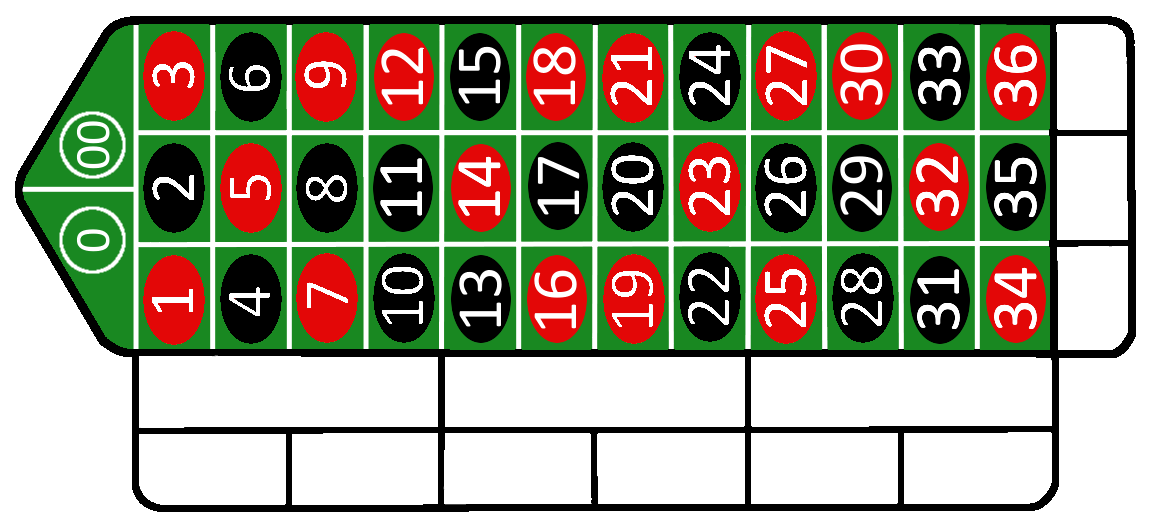
For example, the best way to see the difference between casino odds and true odds is on roulette. Double zero roulette has 36 numbers on the layout, plus zero and double zero. That is 38 numbers total. True odds would pay 38 to 1. But roulette doesn’t pay a straight up number 38:1. Instead it pays 35 to 1, giving the casino a house edge of 5.26%.
Which Craps Bets Have the Best Payouts?
Based on the house edge, the craps bets with the best payouts are the Pass/Come Odds bets on any point number. These bets have true mathematical odds and have a house edge of 0%.
| Point # | House Pays | True Odds | House Edge |
|---|---|---|---|
| 4 or 10 | 2:1 | 2:1 | 0% |
| 5 or 9 | 3:2 | 3:2 | 0% |
| 6 or 8 | 6:5 | 6:5 | 0% |
Craps Payout Cheat Sheet
We’ve made a printable PDF with all the craps payouts, bet increments, and house edges to download and use:
Frequently Asked Questions
What is the payout for craps?
Craps payouts range from 1:1 (even money on the Don’t Pass Line) up to 30:1 (on the Prop Box) depending on the bet you place.
What does a $12 bet on 6 or 8 pay in craps?
A place bet on 6 or 8 pays 7:6, so a $12 bet pays $14. Casinos prefer players to wager in increments of $6**.**
What does a $10 Place bet on 5 pay?
A $10 Place bet on 5 pays $14.
What does a $10 Place bet on 4 pay?
A $10 Place bet on 4 pays $18.
What do odds pay in craps?
An Odds bet in craps pays true mathematical odds: 2:1 on point numbers 4 and 10, 3:2 on point numbers 5 and 9, and 6:5 on point numbers 6 and 8. This is the best bet in the house with a 0% house edge.
What does the Field bet pay in craps?
Depending on the casino rules, a Field bet pays 1:1 (even money) on numbers 3, 4, 9, 10, and 11, 2:1 on 2, and 2:1 or 3:1 on 12
What do Hardways pay in craps?
Hardways pay 7:1 for Hard 4 or 10, and 9:1 for Hard 6 or 8.
What is the difference between Place and Buy bet payouts?
Place bets' payout odds are lower, whereas Buy bets pay true mathematical odds, but you have to pay a 5% vig on your wins most times. We have an entire article explaining the difference between Place bets and Buy bets.
Why do craps bets need to be made in certain amounts?
Craps bets must be placed in specific amounts so payouts can be paid in the fullest amount. Casinos do not keep change, such as 50 cents, on the table, so if the bet is made incorrectly, the casino will round down, paying the player less money than what they deserve.
Do craps payouts vary by casino?
Yes, payouts on bets like the Field 12 and the prop bets vary by casino.
Enjoyed this article?
Join our newsletter to get the latest casino industry articles delivered straight to your inbox.
Related Free Learning Hubs: Craps, All Hubs
Related Terms & Definitions: Proposition Bets, Don't Come Bet, Green Chips, Laying Odds, Straight Up, Commission, Even Money, House Edge, Percentage, Ace-Deuce, Any Craps, Blackjack, Full Dictionary
Related Posts

10 of the Most Common Mistakes at the Craps Table
Oct 12, 2026 Heather Ferris
Discover the 10 biggest craps mistakes that cost players money, frustrate dealers, and turn winning opportunities into disasters!
Casino Gaming Charges: Commission, Vigorish, and Rake
Mar 6, 2015 Daniel Odeyemi
Learn how casinos calculate and deduct commissions, rake, or vigorish when you play table games such as Baccarat, Craps, Pai Gow Poker, and Poker.
Craps Stick Calls
Dec 7, 2020 Heather Ferris
craps stick calls explained with guides, charts, and dealer training. Get accurate info, real examples, and clear steps to improve your casino skills.

Sic Bo vs. Craps: Which Dice Game Is More Preferable among Korean Pro Players?
Apr 24, 2025 David Perez
Even in South Korea, competition between Sic Bo and Craps is often a cause for heated controversies among their pro players.

Craps Press Moves ft. Casino Dealer Jay
Sep 24, 2024 Heather Ferris
Special guest Casino Dealer Jay goes over the most common press moves dealers will see on the craps table. This is a perfect exercise for break-in dealers when practicing at home.

Online Craps Variations and Odds
Sep 8, 2023 Anna Martyushev
Craps evolved over the centuries into the many forms in which we play it today. Learn the variations and their different rules and odds.
Table of Contents
- # Back to Top
- Craps Payout Chart
- How Craps Payouts Work
- Pass Line and Don’t Pass Payouts
- Come and Don’t Come Bet Payouts
- Craps Odds Bet Payouts
- Craps Place Bet Payouts
- Craps Buy Bet Payouts
- Field Bet Payouts
- Hardway Payouts
- Proposition Bet Payouts
- Craps Payouts by Bet Amount
- How Casino Dealers Calculate Craps Payouts
- Frequently Asked Questions