
Series: How to Play Big Baccarat • Part 1 of 4
Basics of Playing Big Baccarat
Big Baccarat is the elegant, full-size version of Baccarat. It is the game you see in high-limit rooms, private salons, and the most serious areas of the casino floor. The rules are simple enough for a brand-new player to understand in a few minutes, but the atmosphere can feel intimidating because the game is formal, the limits are high, and the pace is controlled by procedure.
This guide covers everything you need to know to sit down at a Big Baccarat table and play with confidence. We will cover the layout and how to read it; the bets available to you; how the cards are valued; how the hands are resolved; what the optional side bets are and whether you should take them; how you interact with the shoe if you are offered the chance to face the cards; and the etiquette and customs that the game’s high-limit environment demands. By the end you will understand not just the mechanics but the culture of the game, which is half of what Big Baccarat is about.
A Short History
Baccarat was originally called “Baccara,” the Italian word for zero, because tens and face cards are worth zero in the game. It moved from Italy into France, where it became associated with nobility and private gaming rooms. Over time, several versions developed, including Chemin de fer and Baccarat en Banque.
The modern, house-banked version of the game we deal today was developed in Cuba in the 1950s and was first played at George Raft's Capri Casino in Havana. The rules of the modern game are commonly credited to Tommy Renzoni. Baccarat made its first appearance in the United States at Saratoga and Palm Beach, but disappeared from the American scene around 1912 when blackjack arrived in New York's so-called "sawdust joints." By 1976 the game had arrived in Atlantic City at Resorts International, and from there it spread to every major casino floor in the world. Today, Big Baccarat is a staple of every serious high-limit room from Las Vegas to Macau to Monte Carlo, because the rules are fast, the decisions are simple, and the house edge on the two main wagers is very small compared with many other casino games.
Why players like it
- This game is easy to learn because there are only three main bets: Banker, Player, and Tie.
- There are no complicated playing decisions after the cards come out.
- The Banker and Player bets carry low house advantages compared with many other table-game wagers.
- The reveal has suspense. Cards may be squeezed, turned slowly, and celebrated by the table.
- The game has a formal, high-limit feel without requiring advanced strategy.
Player Tip: The words “Player” and “Banker” do not mean you are playing against the casino in the way you do in Blackjack. They are simply the names of the two hands on the layout. You are choosing which hand you think will finish with the higher point count.
The Object of the Game
The object of Baccarat is to wager on the hand that finishes closest to nine. There are two hands: the Player hand and the Banker hand. The hand with the higher final point count wins. If both hands finish with the same point count, the result is a Tie.
You are not trying to reach twenty-one. You are not trying to beat the dealer’s up-card. You are not making decisions after the cards are dealt. Everything comes down to the final single-digit total of each hand.
The one-sentence version
Bet Banker, Player, or Tie. The dealer deals two hands. The fixed drawing rules determine whether either hand receives a third card. The hand closest to nine wins.
How Totals Work
Every Baccarat hand has a point count from zero to nine. If the cards add to a two-digit number, you drop the left digit and keep only the right digit. That means a total of 15 becomes 5, a total of 12 becomes 2, and a total of 20 becomes 0.
| Cards in Hand | Total Value | Baccarat Point Count |
|---|---|---|
| 7, 8 | 15 | 5 |
| King, 9 | 9 | 9 |
| Ace, 2, 4 | 7 | 7 |
| 10, Jack, 6 | 6 | 6 |
| 9, 9 | 18 | 8 |
| Ace, 2, 9 | 12 | 2 |
| Queen, King | 0 | 0 |
| 5, 5, 5 | 15 | 5 |
Sample point counts. Add the card values, then keep only the right-hand digit.
Natural Hands
If the first two cards dealt to either hand total 8 or 9, that hand is called a Natural. A natural ends the round immediately. No third cards are drawn. The higher natural wins; equal naturals tie.
| Opening Hands | Result |
|---|---|
| Player 9 vs Banker 6 | Player wins with a natural 9. |
| Player 8 vs Banker 9 | Banker wins with a natural 9 over natural 8. |
| Player 8 vs Banker 8 | Tie hand. |
| Player 7 vs Banker 9 | Banker wins with a natural 9. |
Natural 8s and 9s stop the drawing procedure.
Player Tip: The best possible Baccarat total is 9. A total of 10 is not better than 9; it is zero, because the tens digit is dropped.
The Table, Layout & Equipment
Big Baccarat is played on the full-size Baccarat table. The table may have up to fourteen or fifteen numbered seats, a Caller in the center, and two Base Dealers handling wagers on either side. In many casinos the table sits in a higher-limit area, and the presentation is slower and more ceremonial than Mini Baccarat.
There are three sizes of Baccarat table, and you should know the difference even though the rules of the game are identical across all three. Mini Baccarat is a small table similar in shape to a Blackjack table, with up to seven seated player positions and a single dealer. Midi Baccarat is a larger table with up to nine seats, often dealt by one or two dealers depending on the property. Big Baccarat is the full-size table with up to 14 or 15 numbered seats and the full three-dealer crew.
What You See on the Layout
- A numbered betting area for each seated player.
- On some Big Baccarat tables, you’ll notice that position #4 is missing because the #4 is considered bad luck in Asian culture.
- A Banker betting spot for each position.
- A Player betting spot for each position.
- A Tie betting spot for each position.
- Optional side-bet boxes, commonly Perfect Pairs and Dragon Bonus.
- Commission boxes used by the dealers to track Banker commission.
- A shoe, a discard rack, a game-results display, and posted table-limit signs.
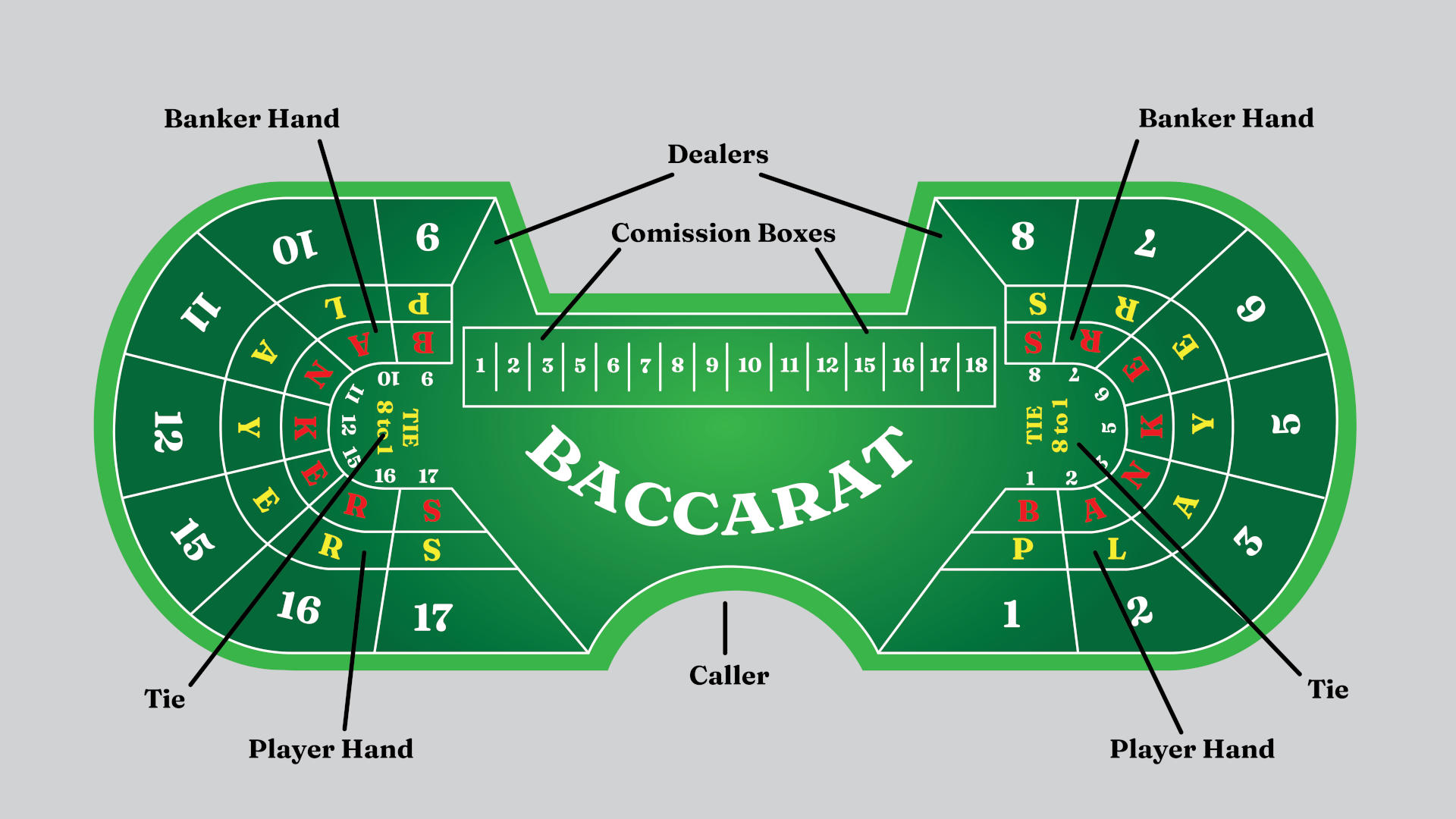
The Table Signs Matters
Before you sit down, look at the table signs. They tell you the minimum bet, the maximum bet, whether the game is using the standard commission schedule or a no-commission variation, and which side-bet pay tables are in effect. Baccarat rules are consistent, but pay tables and table limits can vary by property.
| Item on the Sign | Why It Matters |
|---|---|
| Minimum wager | This is the smallest bet allowed on the main betting areas. |
| Maximum wager | This is the largest wager allowed without special approval. |
| Commission schedule | Standard Baccarat charges 5% commission on winning Banker bets. |
| No-commission exception | Some games pay Banker wins at half-pay when Banker wins with a total of 6. |
| Side-bet pay table | Perfect Pairs and Dragon Bonus pay tables vary by property. |
| Table differential | Some casinos restrict the difference between total Banker and total Player action. |
The Commission Boxes
Directly in front of the Caller, running along the center of the layout, is a row of small numbered squares. These are the commission boxes, one for each seat at the table. When you win a wager on the Banker hand, the Base Dealer marks a five-percent commission in the commission box that corresponds to your seat number. Those markers — small flat tokens called lammers — accumulate throughout the shoe and are collected at the end of the shoe, when you leave the table, or sooner at your preference.
The Dealing Shoe
The cards are dealt from a dealing shoe, a rectangular box with a non-transparent sliding cover that holds all of the decks in play. The shoe sits on the layout and moves from customer to customer as the shoe progresses. If the shoe is offered to you, it means you have been given the opportunity to physically deal the cards. Accepting or declining is entirely up to you.
Who Handles the Cards?
In Big Baccarat, the customer with the shoe may physically slide the cards out. The casino still controls the game. The Caller directs the customer, the table rules determine whether cards are drawn, and the dealers settle the wagers. The customer holding the shoe is not the Banker, and they are not making decisions for the table.
Player Tip: Do not be intimidated by the shoe. Holding the shoe is ceremonial. The result is still governed by fixed rules. If you do not want to touch the cards, you can decline when the shoe is offered.
Enjoyed this lesson?
Join our newsletter to get the latest casino industry courses delivered straight to your inbox.
Series
How to Play Big Baccarat
Part 1 of 4
Next
Card Values & Bet Outcomes
Related Free Learning Hubs: Big Baccarat, All Hubs
Related Terms & Definitions: Discard Rack, Commission, House Edge, Blackjack, Baccarat, Position, Maximum, Minimum, Natural, Action, Banker, Casino, Full Dictionary
Related Courses
Buy Bets vs Place Bets
Jul 17, 2026 Massimo Morana
Learn the difference between buy bets and place bets in craps. Compare payouts, house edge, commission fees, and discover when buy bets are better than place bets.
How to Deal Caribbean Stud Poker
Aug 16, 2026 Alessandro Cinà and Heather Ferris
A dealer’s guide to running Caribbean Stud Poker: the table layout, hand rankings, the Ante and raise, dealer qualification, payouts, and a step-by-step deal.

How to Play Ultimate Texas Hold’Em
Jul 9, 2026 Daniel Odeyemi and Heather Ferris
Learn how to play Ultimate Texas Hold’em: its rules, gameplay structure, and the optimal raise strategy for the best outcome.
How to Become an Online Casino Dealer in Malta
May 9, 2026 Massimo Morana
Malta’s booming iGaming industry trains multilingual beginners to become online casino dealers in world-famous live studios.

Partnerships that keep the cards on the felt
Jan 6, 2026 Heather Ferris
Here is an overview of the sponsored products and advertising options available through Vegas-Aces.

How to Get a Job as a Casino Dealer in Italy
Sep 14, 2026 Alessandro Cina
Discover what it takes to become a casino dealer in Italy, from essential skills and requirements to career opportunities.
Table of Contents
- # Back to Top
- A Short History
- The Object of the Game
- How Totals Work
- Natural Hands
- The Table, Layout & Equipment
Series Navigation
Part 1 of 4
Part 1: Basics of Playing Big Baccarat
Current article
- Part 2: Card Values & Bet Outcomes
- Part 3: Full Round of Play and Drawing a Third Card
- Part 4: Etiquette, Common Mistakes and Scoreboard Explained