
Series: How to Play Big Baccarat • Part 2 of 4
Card Values & Bet Outcomes
Card Values
Baccarat card values are simple, but they are different from most other casino games. Cards from 2 through 9 are worth their face value. Tens, Jacks, Queens, and Kings are worth zero. Aces are worth one.
| Card | Baccarat Value |
|---|---|
| 2 through 9 | Face value |
| 10, Jack, Queen, King | 0 |
| Ace | 1 |
The zero cards
The zero cards are what give Baccarat its name and its rhythm. A King and a Queen together total zero. A 10 and a 9 total nine. A Jack, a 6, and a 7 total 13, which becomes three. The face cards do not help unless they preserve the right-hand digit you already want.
Fast counting method
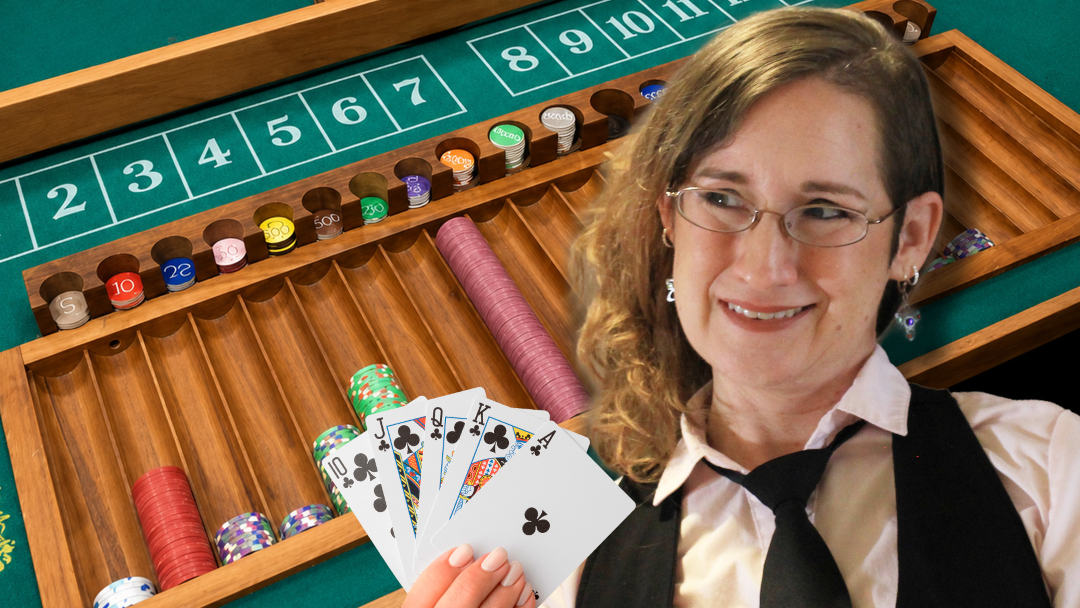
- Ignore every 10, Jack, Queen, and King because they are zero.
- Add Aces as one.
- Add 2 through 9 at face value.
- If the total is 10 or more, drop the tens digit.
- Announce only the final single-digit point count.
| Hand | Math | Point Count |
|---|---|---|
| 8 + 7 | 15, drop the 1 | 5 |
| 9 + 6 | 15, drop the 1 | 5 |
| Ace + 9 | 10, drop the 1 | 0 |
| 4 + 4 + 2 | 10, drop the 1 | 0 |
| Queen + 5 + 3 | 18, drop the 1 | 8 |
Practice totals. The right-hand digit is always the answer.
Player Tip: A hand can never “bust” in Baccarat. Drawing a third card can make a good-looking hand worse, but there is no bust total. The rules simply finish the hand and compare the final digits.
The Three Main Bets
There are three main wagers on a Baccarat layout: Banker, Player, and Tie. These are the bets that appear on every Baccarat layout in every casino in the world. Understanding what each one pays, and the conditions under which each one wins, is the foundation of the game.
| Wager | Wins When | Typical Payout |
|---|---|---|
| Banker | Banker final count is higher than Player | 1 to 1, less 5% commission |
| Player | Player final count is higher than Banker | 1 to 1 |
| Tie | Both final counts are equal | 8 to 1 |
The Banker bet
The Banker bet is the most popular main wager because it has the lowest house advantage under the standard commission schedule. It wins when the Banker hand finishes with a higher point count than the Player hand. It loses when the Banker hand finishes lower. It pushes on a tie. In the standard game, a winning Banker wager pays even money, and the casino charges a five-percent commission on the amount won. It has been found that Banker wins more than Player, which is why there is a 5% commission on Banker.
The Player bet
The Player bet wins when the Player hand finishes with a higher point count than the Banker hand. It loses when the Player hand finishes lower, and it pushes on a tie. It pays even money and has no commission in the standard game. The Player bet has a slightly higher house advantage than Banker, but it is simpler to understand because a $100 win pays $100 with no commission calculation.
The Tie bet
The Tie bet wins only when the two final point counts are exactly equal. It pays 8 to 1. Banker and Player wagers push on a tie, meaning they neither win nor lose. The Tie bet pays more because it wins far less often, and it carries a much higher house advantage than the two main wagers.
What “push” means on a tie result
When the round ends in a tie, Banker bets and Player bets push. Your wager is neither collected nor paid; it simply sits there for the next round. After a tie result you have the option, before the next round begins, to remove your Banker or Player wager, reduce it, increase it, or leave it as it is. You may also add a new Tie bet for the next round if you wish. The important thing is that a tie does not cost you your Banker or Player wager.
| Example Bet | Result | What Happens |
|---|---|---|
| $100 on Banker | Banker wins | Player and Tie bets lose; Banker bet wins even money, with commission owed. |
| $100 on Player | Player wins | Banker and Tie bets lose; Player bet wins $100. |
| $25 on Tie | Both hands finish 6 | Tie pays $200, and Banker/Player wagers push. |
| $100 on Banker | Tie hand | Banker wager pushes; no Banker commission is owed. |
Main bet settlement examples.
Player Tip: For most new players, the cleanest approach is to learn the Banker and Player bets first. Add Tie and side bets only after you fully understand the base game.
How to Place a Wager
All wagers in Baccarat are placed using casino chips, not cash. Place your chips in the appropriate betting box on the layout before the Caller announces “No more bets, cards please.” Once that announcement is made, no wager may be placed, increased, or withdrawn until the round is fully settled. Smaller-denomination chips go on top of larger ones. You are responsible for the correct placement of your own wager, whether or not the dealer assists you.
Basic betting procedure
1. Choose the seat or standing-player area where your wager belongs.
2. Place chips on Banker, Player, Tie, or an approved side-bet box.
3. Stack smaller denominations on top of larger denominations.
4. Make sure the bet is fully inside the correct betting area.
5. Stop touching the wager once the dealer calls “No more bets.”
When bets close
The Caller will announce “No more bets, cards please.” Once that phrase is called, the round has started. No wager may be made, increased, reduced, or withdrawn until the result has been decided and the dealers begin the take-and-pay sequence.
Call bets and verbal wagers
Some casinos allow a verbal wager only when it is accompanied by chips and the dealer has enough time to place the wager before the round closes. Do not assume a spoken wager is valid. The safest rule for players is simple: chips on the layout before “No more bets.”
| Good Wagering Habit | Why It Helps |
|---|---|
| Place chips early | The dealer has time to verify the wager before the round closes. |
| Keep chips inside the box | Prevents confusion over which bet you intended. |
| Do not reach after cards are out | Protects you from disputes and protects the game. |
| Ask before betting side bets | Side-bet limits and pay tables vary. |
Clean wagering habits make the game smoother for everyone.
Player Tip: Once the cards are out, hands off the layout. If you accidentally placed the wrong bet, wait until the round is finished and speak to the dealer or supervisor. Do not reach into a live layout.
Standard Payouts & Commission
The standard Baccarat schedule is easy to state: Player pays even money, Banker pays even money less a five-percent commission, and Tie pays 8 to 1. Side bets have their own posted pay tables.
| Wager | Payout | Notes |
|---|---|---|
| Player | 1 to 1 | No commission. |
| Banker - Schedule A | 1 to 1 less 5% commission | The commission is based on the amount won. |
| Banker - Schedule B | 1 to 1, except Banker 6 pays 1 to 2 | No commission version. Confirm posted table sign. |
| Tie | 8 to 1 | Banker and Player bets push on a tie. |
Common main-bet payout schedules.
How the 5% commission works
In the standard commission game, a Banker win is paid even money, and the casino records or collects 5% of the win. If you bet $100 on Banker and Banker wins, the winning amount is $100, and the commission is $5. Depending on property procedure, that $5 may be collected immediately or tracked in the commission box and collected later.
| Banker Bet | Banker Win | 5% Commission | Net Win After Commission |
|---|---|---|---|
| $25 | $25 | $1.25 | $23.75 |
| $100 | $100 | $5 | $95 |
| $500 | $500 | $25 | $475 |
| $1,000 | $1,000 | $50 | $950 |
Examples of standard Banker commission.
No-commission variation
Some tables use a no-commission schedule. In that version, Banker wins even money, except when Banker wins with a final point count of 6, in which case the payout is reduced to half-pay (1 to 2). A $100 Banker bet would pay $50 on a Banker 6. Always check the table sign before you play, because the posted rule controls the payout.
Player Tip: The standard Banker bet is still usually the best mathematical main bet even after commission. But commission matters. Know whether the game is standard commission or no-commission before you start betting.
The House Edge and Why it Matters for You
Based on an eight-deck shoe over an infinite number of hands, the Banker hand wins about 45.84 percent of decisions, the Player hand wins about 44.61 percent, and a tie occurs about 9.55 percent of the time. If you exclude ties, the Banker wins about 50.68 percent and the Player wins about 49.32 percent. That difference is small but it favors the Banker and the casino's only edge on the Banker bet comes from collecting the five-percent commission on every winning Banker wager.
After the commission is factored in, the casino's edge on the Banker bet is roughly 1.18 percent, or about $1.18 for every $100 wagered on the Bank. The Player bet carries a slightly larger house edge of about 1.24 percent. The Tie bet carries an enormous house edge of about 14.09 percent.
Side Bets
Side bets add excitement, but they are optional. They must be placed before the cards are dealt, and they usually resolve independently of the main Banker, Player, or Tie wager. A side bet can win even when your main bet loses, and a main bet can win while your side bet loses.
Perfect Pairs
Perfect Pairs is a wager that the first two cards dealt to the chosen hand will form a pair. It can usually be wagered on the Player hand, the Banker hand, or both, depending on the layout. The pair type determines the payout.
| Pair Type | Definition | Common Payout Range |
|---|---|---|
| Mixed Pair | Same value, one red card and one black card | 5 to 1 or 6 to 1 |
| Coloured Pair | Same value and same colour, different suits | 10 to 1 or 12 to 1 |
| Perfect Pair | Same value and same suit | 25 to 1 or 30 to 1 |
Dragon Bonus
Dragon Bonus is a wager that the chosen hand will win naturally or win by a large margin. A natural winner commonly pays even money. A non-natural win by four or more points pays according to the margin of victory, with larger margins paying more.
| Dragon Bonus Result | Typical Treatment |
|---|---|
| Natural winner | Pays 1 to 1. |
| Natural tie | Push. |
| Non-natural win by 4 points | Pays from the posted pay table. |
| Non-natural win by 5 to 9 points | Pays increasingly larger odds as the margin increases. |
| Chosen hand loses or wins by fewer than 4 points | Loses. |
How side bets resolve
Perfect Pairs is decided by the first two cards only. Later third cards do not create a Perfect Pair. Dragon Bonus is decided by the final result of the chosen hand, but margin payouts apply only to non-natural wins. These details matter because side bets often look simple until an unusual hand appears.
Player Tip: Side bets are for entertainment, not for reducing the house edge. Learn the main game first, then treat side bets as optional action.
Enjoyed this lesson?
Join our newsletter to get the latest casino industry courses delivered straight to your inbox.
Series
How to Play Big Baccarat
Part 2 of 4
Related Free Learning Hubs: Big Baccarat, All Hubs
Related Courses

How to Play Big Baccarat
Jun 8, 2026 Massimo Morana
Master Big Baccarat's rules, bets, etiquette, and hidden secrets before stepping into the casino's most prestigious game.

How to Deal Caribbean Stud Poker
Aug 16, 2026 Alessandro Cinà and Heather Ferris
A dealer’s guide to running Caribbean Stud Poker: the table layout, hand rankings, the Ante and raise, dealer qualification, payouts, and a step-by-step deal.
Buy Bets vs Place Bets
Jul 17, 2026 Massimo Morana
Learn the difference between buy bets and place bets in craps. Compare payouts, house edge, commission fees, and discover when buy bets are better than place bets.

How to Play Ultimate Texas Hold’Em
Jul 9, 2026 Daniel Odeyemi and Heather Ferris
Learn how to play Ultimate Texas Hold’em: its rules, gameplay structure, and the optimal raise strategy for the best outcome.

How to Become an Online Casino Dealer in Malta
May 9, 2026 Massimo Morana
Malta’s booming iGaming industry trains multilingual beginners to become online casino dealers in world-famous live studios.

How to Get a Job as a Casino Dealer in Italy
Sep 14, 2026 Alessandro Cina
Discover what it takes to become a casino dealer in Italy, from essential skills and requirements to career opportunities.
Table of Contents
- # Back to Top
- Card Values
- The Three Main Bets
- How to Place a Wager
- Standard Payouts & Commission
- The House Edge and Why it Matters for You
- Side Bets
Series Navigation
Part 2 of 4
- Part 1: Basics of Playing Big Baccarat
Part 2: Card Values & Bet Outcomes
Current article
- Part 3: Full Round of Play and Drawing a Third Card
- Part 4: Etiquette, Common Mistakes and Scoreboard Explained